
Ukrainian drone manufacturers are setting their sights on Asia, pursuing new defense partnerships with Japan, Taiwan, and the Philippines as tensions over China’s posture toward Taiwan continue to drive up military spending across the region.
The CEO of UFORCE, a Ukrainian company that produces attack drones, traveled to Tokyo in April to present a proposal to Japanese officials and defense industry representatives. His pitch: manufacture thousands of Ukrainian-designed drones to protect Japan and its allies.
Just days before that visit, American forces had used UFORCE waterborne drones to destroy a vessel during a classified military exercise conducted where the South China Sea meets the Pacific Ocean. The company’s Magura surface drone has also spent years effectively blocking portions of the Black Sea from Russian naval activity.
Although East Asia’s maritime landscape differs significantly from the Black Sea, UFORCE CEO Oleg Rogynskyy told Reuters that “the impact is extremely similar.”
The details of those Tokyo meetings had not been previously made public. They represent part of a broader campaign by Ukrainian defense firms to capitalize on a wave of military investment by U.S. allies in Asia who are looking to counter an increasingly bold China and prevent a military conflict over Taiwan. Reuters gathered information from 20 individuals, including defense industry figures and officials from both Ukraine and Japan.
Ukraine’s reputation as a leader in drone warfare — a capability that has helped the country hold its own against Russia for more than four years despite being outmatched in conventional military power — has become a major selling point. Kyiv has already translated that battlefield experience into diplomatic and defense agreements in Europe and the Middle East. President Volodymyr Zelenskiy stated in February that Ukraine was “ready to open up our technologies” — including sea drones — to Japan.
Former Japanese defense minister Itsunori Onodera, who continues to hold significant influence as a lawmaker, said he welcomed Ukraine’s outreach. Japan needs equipment “that is actually demonstrating effective power,” he told Reuters.
Ukrainian firms including UFORCE, Skyeton, and General Cherry are looking for manufacturing partners in Japan, which recently lifted longstanding restrictions on arms exports. Japan’s military has hosted at least one previously undisclosed demonstration of drone technology from Ukrainian firm Swarmer. However, three people involved in broader discussions between Japanese officials and Ukrainian companies described those conversations as still in early, exploratory stages.
Japan’s defense ministry declined to discuss its interactions with Ukrainian drone producers but said Tokyo was “examining all possible options to ensure acquisition of equipment needed for Japan’s ‘new way of warfare.’”
Japanese Prime Minister Sanae Takaichi has cautioned that Tokyo could find itself drawn into a conflict involving Taiwan. China has refused to rule out using military force to bring Taiwan under its control and routinely conducts military exercises near the self-governing island.
Executives from three Ukrainian companies and a drone industry association said they are also exploring potential business with Taiwan, though they acknowledged being careful given that Ukraine does not maintain formal diplomatic relations with the island, which China claims as part of its territory.
The United States is legally obligated to help Taiwan defend itself. Admiral Samuel Paparo, the top American military commander in the region, said in 2024 that drones would be central to any military response in a conflict scenario, describing how they could generate an “unmanned hellscape” that would give the U.S. and its partners time to respond.
Naval analyst Bryan Clark of the Hudson Institute, a Washington-based think tank, said drones will also be essential to fill defensive gaps along the chain of islands stretching from Japan through Taiwan to the Philippines. The U.S. drone exercise in April was conducted near Itbayat, a Philippine island located roughly 100 miles south of Taiwan, according to UFORCE and U.S. military sources.
A spokesperson for U.S. Pacific Command did not directly address questions about Ukraine’s efforts to build drone partnerships in Asia but confirmed it had met with Ukrainian drone manufacturers “to discuss how Black Sea operations could apply to the Indo-Pacific.”
Japan launched a major defense expansion in 2022, motivated in part by fears that the war in Ukraine could serve as a blueprint for conflict in East Asia. That buildup gained momentum when the hawkish Takaichi took office late last year, pushing Japanese companies to increase weapons production, including unmanned systems. Many of Japan’s defense manufacturers have historically been reluctant to enter the arms trade due to concerns about their reputations, particularly given their commercial ties to China.
Tokyo has set aside nearly $2 billion for drone systems in this year’s defense budget and aims to produce 80,000 drones annually by the end of the decade — a massive jump from the roughly 1,000 manufactured in 2024, according to the Japan UAV Association. Still, that figure falls well short of the 7 million drones Ukraine is targeting for production this year.
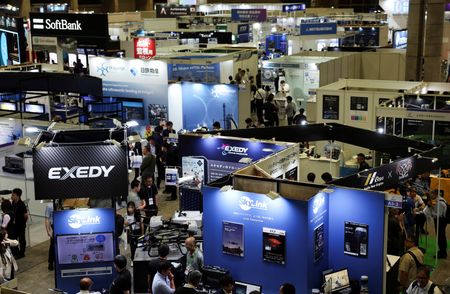
General Cherry, a Ukrainian company specializing in kamikaze drones, is among those seeking Japanese manufacturing partners. Co-founder Stanislav Gryshyn told Reuters during a recent Tokyo trip — where he attended a drone exhibition, held meetings with potential partners, and networked with Japanese government officials at a Ukrainian embassy event — that “Japan is the best way to the Asian market.”
Skyeton, whose long-range surveillance drones it says could help monitor Japan’s more than 14,000 islands, also conducted meetings in Japan last year.
Ukraine’s ambassador to the Philippines, Yuliia Fediv, told Reuters that Kyiv has been in discussions with Manila about drone technology cooperation. Ukrainian drone executives said any drones sold to the Philippines would likely be produced in Japan due to its stronger manufacturing capabilities. The Philippines, which has been involved in a series of escalating maritime standoffs with China, is already a significant customer of Japanese defense equipment. Fediv declined to provide further details, and the Philippines defense ministry did not respond to a request for comment.
Swarmer president Alex Fink told Reuters that his company — a U.S.-listed Ukrainian drone software firm — has conducted demonstrations for a unit of Japan’s military. A late April test involved using Swarmer’s artificial intelligence software to coordinate a group of drones on a seek-and-destroy mission in Japan. Fink said the demonstration was arranged through Japanese e-commerce company Rakuten, whose billionaire founder Hiroshi ‘Mickey’ Mikitani has been one of Japan’s most outspoken advocates for Ukraine. Rakuten declined to comment on the demonstration but confirmed it is supporting Swarmer’s expansion in Japan.
Ukrainian companies are also working to reduce their reliance on Chinese-made drone components by sourcing parts from friendlier markets in East Asia. China manufactures many drone components and has placed some limits on their export, but similar parts are also produced in Japan and Taiwan, both of which host numerous suppliers of cameras, microelectronics, and related technology.
In May, the Ukrainian drone industry association IRON brought a delegation of roughly a dozen members to Taichung, a major industrial center in Taiwan, to connect with local suppliers. IRON chief executive Volodymyr Cherniuk said the primary goal was to help Ukrainian firms identify component suppliers. Reuters is the first to report the details of that gathering.
In at least one case, the relationship goes further: Elson Zhang of Jiin Ming Industry, one of the participating Taiwanese companies, told Reuters his firm is involved in an early-stage project with a Ukrainian partner to develop a drone that could potentially be sold back to Taiwan. He declined to identify the Ukrainian company.
Cherniuk said he plans to lead a delegation of IRON members to Tokyo later this year to seek Japanese production partners. “We would be happy for our drones to protect any country from invasion,” he said. “We know the best how it feels.”