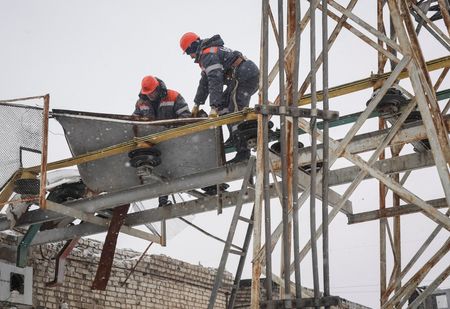

Ukraine is experiencing its most severe economic downturn since the opening phase of Russia’s military invasion, as relentless aerial bombardments have devastated the nation’s electrical infrastructure during the conflict’s fifth year, compelling businesses to reduce production and diminishing government income.
Industrial leaders across Ukraine’s manufacturing sector – spanning steel production, mining operations, cement manufacturing, and food processing – report being compelled to slash output while absorbing increased operational expenses as they attempt to adjust work schedules and protect machinery from unexpected power failures, according to executives from eight major companies.
Sergii Pylypenko, who leads Kovalska Group – the nation’s top concrete and construction materials manufacturer – explained that backup diesel generators purchased by his company cannot sustain full production at their large-scale facilities.
“For more than two months now, we have been working under emergency power cuts without any predictable schedule,” Pylypenko stated.
“In certain periods, the lack of a stable power supply can reduce production volumes by up to 50%.”
The Ukrainian economy contracted by approximately one-third during the war’s initial year, and while experiencing slight expansion in following years, it remains significantly smaller than pre-invasion levels and depends heavily on public sector expenditure. Nearly 6 million citizens have departed Ukraine while over 3 million face internal displacement, representing more than one-fifth of the country’s pre-war population.
During February, the monthly business activity recovery index compiled by Kyiv’s Institute for Economic Research – which measures companies reporting improved versus deteriorated business conditions compared to the previous year – recorded its first negative reading since 2023.
Ukraine’s economic health proves essential not just for generating tax income to support military operations and service debt obligations, and manufacturing weapons, but also for creating employment opportunities and economic stability for veterans and returning refugees once peace is restored.
Oleksandr Myronenko, serving as chief operating officer at Metinvest – a mining and metals corporation generating approximately $7 billion in annual revenue – described how extended power interruptions complicate restarting operations following Russian attacks.
Metinvest, under the control of Rinat Akhmetov, among Ukraine’s wealthiest individuals, has served as a significant source of tax income and steel for military needs.
The company had projected expansion this year within Ukraine but failed to meet those targets during the first two months due to Russian bombardment effects, according to Myronenko.
“This included damage to generating capacities and also to the transport infrastructure, which affects not only steel makers but all producers in Ukraine: they have to decrease volumes,” he explained.
Nataliia Kolesnichenko, an economist with Kyiv’s Centre for Economic Studies, calculated that energy demand surpassed available supply by 30% during January and February. “The energy situation has deteriorated dramatically in recent months,” she noted.
Energy Minister Denys Shmyhal reported on February 12 that despite rising temperatures, maximum demand reached 16.4 gigawatts, considerably exceeding Ukraine’s production capacity of 12.3 gigawatts, with the country importing nearly 2 gigawatts during peak periods.
Companies must navigate reduced output, increased expenses, supply chain disruptions, and extended delivery periods. These factors impact competitiveness and will drive inflation higher, which already operates at approximately 7%, according to three economists.
The electrical crisis has already led Ukraine’s central bank to lower its annual economic growth projection to 1.8% from 2% – matching the 1.8% growth anticipated to be reported for the previous year.
Independent economic analysts express greater caution. Dragon Capital, an investment firm, predicts 1% growth this year due to electricity shortages, while ICU – a Kyiv-based asset management and investment banking company – has reduced its growth forecast to 0.8% from 1.2%.
ICU determined that roughly 20-25% of economic production depends on reliable electricity access.
Numerous small enterprises have fought to survive during the war’s coldest and darkest winter season, also dealing with reduced consumer spending caused by prolonged blackouts.
Prime Minister Yulia Svyrydenko revealed that the energy crisis cost the national budget approximately 12 billion hryvnias ($280 million) in customs duties and tax collections during January alone.
An increase in Ukraine’s debt burden to nearly 100% of gross domestic product – despite two restructuring efforts – has concerned some investors. Last week, when Geneva peace negotiations appeared to stagnate, Ukrainian bond prices declined.
However, Ukraine appears close to securing an agreement with the International Monetary Fund for a new $8.1 billion lending package after the IMF agreed to relax certain conditions, including controversial tax hikes, Svyrydenko has indicated.
IMF approval should facilitate European Union assistance valued at roughly 90 billion euros ($105 billion) across two years, provided Hungarian opposition can be resolved – crucial support following President Donald Trump’s administration’s termination of direct budget assistance.
Hungary recently threatened to block the aid unless Kyiv restores Russian oil deliveries through the Druzhba pipeline.
More urgently, Hungary and Slovakia last week warned they would cease power exports to Ukraine if oil transportation did not resume. Kyiv attributed pipeline damage to Russian strikes and by Monday had provided no repair timeline.
Hungary and Slovakia supplied 68% of Ukraine’s imported electricity this month, according to Kyiv-based consultancy ExPro.
While businesses have invested millions of hryvnias in backup power systems, including generators, batteries, solar equipment, and gas, a recent survey by Ukraine’s European Business Association revealed that outages created difficulties for four out of five companies. Half reduced production, while 61% reported increased costs.
International steelmaker ArcelorMittal experienced approximately 10% losses in hot metal production and over 25% in finished rolled products due to electricity shortages in January.
ArcelorMittal halted one continuous casting machine to prevent emergency shutdowns and equipment damage, resulting in more than 70% losses in planned hot-rolled billet production.