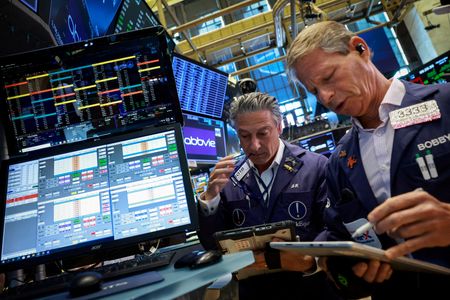

Major U.S. stock markets closed Wednesday with losses exceeding 1%, driven down by continued weakness in semiconductor stocks and growing concerns over escalating tensions with Iran.
President Donald Trump warned that the U.S. would launch another attack on Iran if no peace agreement is reached. This statement came after one of the most serious exchanges of hostilities in the Middle East conflict over the past two months.
Semiconductor stocks took a particularly hard hit, with their sector index dropping 3.6%. Companies like Nvidia and Broadcom were among the heaviest weights dragging down the S&P 500, as investors continue to worry about inflated valuations in the chip sector.
The technology sector of the S&P 500 has now fallen 11% from its record closing high on June 2, officially entering correction territory.
Wall Street’s fear gauge, the Cboe Volatility Index, continued its recent upward trend.
Tom Hainlin, an investment strategist at U.S. Bank Wealth Management in Minneapolis, noted that investors continue to take profits from technology investments.
He explained that market participants are now “pricing in maybe a higher interest rate” following recent economic reports and are also concerned about the ongoing conflict.
“Perhaps that conflict continues on into the mid to late summer,” he stated.
The market decline was worsened by drops in trucking company shares, including XPO, J.B. Hunt and Old Dominion, after Amazon revealed plans to expand its less-than-truckload freight operations across the U.S. The industrial sector led all declining sectors with a 3.4% drop.
The Dow Jones Industrial Average dropped 953.33 points, or 1.87%, closing at 49,918.78. The S&P 500 decreased 119.66 points, or 1.62%, to finish at 7,266.99. The Nasdaq Composite fell 509.32 points, or 1.98%, ending at 25,169.50.
The Federal Reserve is anticipated to keep interest rates unchanged at its June policy meeting. However, investors are factoring in at least one quarter-point rate increase before the year ends.
Last Friday’s employment report exceeded expectations. Wednesday brought news that U.S. consumer prices rose 4.2% over the 12 months ending in May, marking the biggest increase since April 2023. The Middle East conflict has pushed up gasoline and other energy costs.
The inflation rate matched economist predictions in a recent poll.
Oracle stock declined approximately 1% in after-hours trading following its earnings announcement.
During regular trading, Super Micro Computer plummeted 28% after revealing plans to raise $7 billion through various equity and equity-related financing deals to fund component purchases for its expanding AI server business.
The shift away from high-performing technology stocks has benefited other market sectors that have underperformed this year, including healthcare, real estate and consumer staples.
The highly anticipated $1.75 trillion SpaceX public offering scheduled for Friday, aiming for a record $75 billion fundraising goal, could add additional pressure to U.S. markets as worries grow about excessive enthusiasm in the technology sector.
On the New York Stock Exchange, declining stocks outnumbered advancing ones by a ratio of 1.87-to-1. The exchange saw 179 new highs and 138 new lows.
On the Nasdaq, 1,772 stocks gained while 3,129 declined, with falling issues outnumbering rising ones by 1.77-to-1. The S&P 500 recorded 22 new 52-week highs and 8 new lows, while the Nasdaq Composite saw 139 new highs and 141 new lows.
Trading volume on U.S. exchanges reached 20.7 billion shares, slightly above the 20.6 billion average over the previous 20 trading sessions.