
DUBAI — The U.S. military has been quietly managing a large-scale, covert oil transfer operation near the Strait of Hormuz, borrowing a technique that Iran itself has used for years to evade international sanctions, according to a Reuters investigation.
The operation, which began in early May, takes place at two locations just outside the strait — one near the coast of Fujairah in the United Arab Emirates and another off Oman’s port of Sohar. Eleven people with direct knowledge of the operation identified those sites to Reuters. Shipping data and satellite imagery reviewed by the news agency show at least 92 ships have participated in the transfers so far.
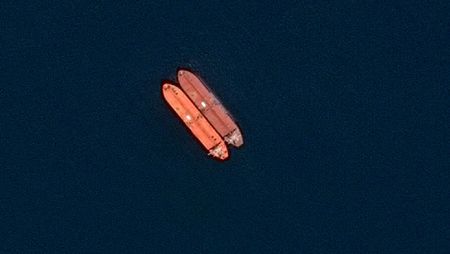
Satellite images from as recently as June 11 captured 17 pairs of ships carrying out oil transfers simultaneously at the two locations.
An Apache helicopter that was shot down by Iran on June 9 — triggering retaliatory U.S. bombings — was also part of this mission, according to four sources, including a former U.S. official with knowledge of the incident. On the day the Apache was downed, Reuters used satellite imagery to count six pairs of tanker ships clustered near the port of Sohar. Both crew members were rescued by a drone boat, U.S. officials confirmed.
Reuters was unable to confirm the specific role the Apache played in the oil transfer operation. When asked about it, a U.S. defense official stated that no Central Command forces are participating in any offshore ship-to-ship oil transfer operation. The White House directed questions to Centcom, and the Iranian government did not respond to requests for comment.
The two transfer zones sit near boundaries drawn by a new Iranian body called the Persian Gulf Strait Authority, which was established to oversee the Hormuz Strait. Ships that do not follow Iran’s directives face the threat of drone and missile strikes from the Islamic Revolutionary Guard Corps.
The nearby port of Fujairah has been struck repeatedly by Iranian fire during the period this operation has been active. This past weekend, a maritime risk management group called Vanguard reported that an “unknown projectile” hit a tanker off the Omani coast. Vanguard said in a statement that the crew was unharmed and that while some cargo leaked, there was no environmental damage. The group did not confirm whether that vessel was engaged in a ship-to-ship transfer at the time.
Iran effectively shut down the Strait of Hormuz in response to the U.S.-Israeli war, blocking a waterway through which roughly one-fifth of the world’s oil consumption normally flows. That closure has caused what experts describe as the most severe global energy supply disruption ever recorded and has contributed to rising inflation worldwide.
Although the ship-to-ship transfers are considered risky and inefficient, they appear to be part of the Trump administration’s broader push to restore oil flow from the Gulf. President Donald Trump stated that the Strait of Hormuz would reopen Friday under a peace framework announced with Iran this week, though specifics of that deal remain unclear. Reuters could not determine whether the announced agreement has had any impact on the transfer operation.
A separate Reuters investigation published May 20 revealed that Iran has built its own system for moving ships through the other side of the strait, using island checkpoints, diplomatic arrangements and, in some cases, fees.
Eight sources — including a private security contractor directly involved in the transfers — told Reuters the American operation is entirely under U.S. military control. Tankers are required to gather at a designated meeting point before reaching the strait, then depart in staggered intervals, keeping roughly 3,000 to 4,000 meters between vessels. Their tracking transponders are switched off and their lights are kept dark, according to four sources.
A network of waypoints allows the U.S. military to track each vessel’s progress. As one source put it, the Americans are “obviously watching you all the time.”
Once through the strait and just past the zone Iran has claimed control over, the tankers pull alongside much larger receiving ships known as Very Large Crude Carriers, or VLCCs, to begin offloading their oil. Each transfer takes between 24 and 40 hours. The smaller tankers then return through the strait while the fully loaded VLCCs continue on to their destinations.
The operation depends on a small number of shipping companies willing to move their vessels through the strait despite Iran’s blockade. But the risks are significant. “You just don’t know when Iran might just decide to start using drones or even gunboats in order to prevent even those ships from transiting the strait,” said Noam Raydan, a senior fellow at the Washington Institute who focuses on maritime risk and reviewed Reuters’ findings.
Iran has used the ship-to-ship transfer method for years to disguise the origin of its oil and sidestep sanctions. Typically, Iran operates one pair of ships at a time to stay under the radar, given that its prewar oil exports were relatively modest. The U.S.-led operation, by contrast, involves mass simultaneous transfers and is designed to give Gulf oil producers greater protection from Iranian attacks while moving crude oil, condensate and petroleum products to international buyers.
Reuters reviewed more than a dozen satellite images taken between May 2 and June 11, showing transfers involving state-owned Gulf tanker fleets and internationally operated vessels. Shipping data from LSEG and Kpler confirmed repeated rendezvous between tankers in the area during the same timeframe.
Based on the tankers’ carrying capacities and the imagery reviewed, Reuters estimated that at least 90 million barrels of crude oil and petroleum products may have moved through the offshore network since early May. That figure, while significant, remains far below the roughly 20 million barrels that passed through the strait on an average day before the war.
Michael Froman, president of the Council on Foreign Relations, noted the irony of the situation in a recent written commentary. “As the old rules weaken, it’s ironic that the United States is now taking a page out of the playbook of China, Russia, North Korea, and even Iran, whose so-called ‘dark fleets’ pioneered these techniques precisely to evade U.S. and UN sanctions,” he wrote. His remarks referred to the practice of sending ships through the strait without transponders — something President Trump mentioned publicly on June 10 following the Apache downing.
Six sources with direct knowledge of the operation said the U.S. has supported participating ships through aerial surveillance, compliance screening and ongoing monitoring, rather than direct naval escort. Reuters found no evidence that U.S. military personnel were physically involved in the transfers themselves.
On the receiving end of the operation, international tanker operators play a dominant role, according to shipping records. One of them, Greece-based Dynacom Tankers Management, has publicly hinted at its involvement in finding creative solutions to move oil through the strait since the war began on February 28.
“Freedom of navigation is essential and nobody can impose tolls or any other burden,” said George Procopiou, Dynacom’s founder, speaking at a Capital Link shipping conference in Athens on June 1. “We are here to serve, and Greece has the tradition of breaking blockades since antiquity. I don’t want to go into more details, but I believe the hints are enough to understand what I mean.” Dynacom did not immediately respond to a request for comment on the U.S. operation.
A separate maritime security source raised concerns about the dangers the new system creates for the broader shipping industry. “There is a paucity of reliable data,” the source said, noting that transponders are switched off “and companies are not reporting through the usual reporting centres.” That creates collision risks, since vessels are traveling at night with no lights at speeds that make maneuvering difficult, according to multiple shipping industry officials.
Four sources familiar with the operation said that companies seeking access must go through a compliance review before being granted a transit window. That process involves submitting information to the U.S. Navy’s Naval Cooperation and Guidance for Shipping office in Bahrain. Two preliminary compliance documents reviewed by Reuters required operators to provide full geospatial tracking histories, complete beneficial ownership disclosure, cargo documentation and agreement to cargo testing. Approved vessels are then assigned specific transit windows and remain in contact with the Bahrain-based U.S. military office throughout the voyage.
Emirati exports make up a significant share of the transfer operation, according to shipping records. Six sources said the UAE’s state-owned national oil company ADNOC has been among the most active participants. The Kuwait Oil Tanker Company has also been heavily involved. On June 6, one of the busiest days of the operation, approximately 2.3 million barrels of crude were transferred from one of its ships off the coast of Sohar, according to data from TankerTrackers.com. The vessel that received that cargo, identified as Sea Ruby, was spotted five days later off India’s southwest coast, heading toward China where the oil was expected to be unloaded. The UAE government, ADNOC and the Kuwait Oil Tanker Company did not respond to requests for comment.
“I don’t see a permanent solution in all of this,” Raydan said. “This is a temporary solution amid exceptional times.”