
The U.S. military has launched another round of strikes against Iran, just hours after a tanker was hit in the Strait of Hormuz — the most serious flare-up since the two nations agreed to a temporary peace deal two weeks ago.
Both countries are pointing fingers at each other, each claiming the other side broke the agreement that was meant to bring an end to a four-month-long conflict.
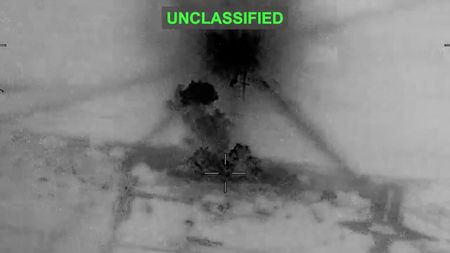
U.S. Central Command announced Saturday that its forces conducted new strikes following a drone attack by Iran on a Panama-flagged tanker earlier that morning. Iran’s state broadcaster IRIB reported early Sunday local time that explosions were heard in the southern Iranian city of Sirik, though no additional details were provided.
“Iran was given a chance to honor the ceasefire agreement but elected not to,” U.S. Central Command said in an official statement. The command described the strikes as “in direct response to continued Iranian aggression against commercial shipping,” saying they targeted Iranian military surveillance, communications, air defense, drone storage, and mine-laying facilities.
A U.S. defense official later confirmed to Fox News that the strikes on Iranian targets had been completed.
Washington had previously reported hitting Iranian targets overnight, while Iran said it responded Saturday by striking locations connected to U.S. forces.
The tanker attack Saturday came on the heels of a cargo ship strike on Thursday, which set off the latest round of hostilities. Iran has been making renewed efforts to assert authority over the Strait of Hormuz — the world’s most critical route for energy shipments — which had only recently begun reopening after months of disruption.
Britain’s UKMTO maritime security agency reported that the tanker struck Saturday suffered damage to its bridge, though all crew members were confirmed safe. The Joint Maritime Information Center, operated by a coalition of navies working to protect shipping lanes, elevated its security threat level in response to the recent incidents.
Iran has not directly addressed reports of specific ship attacks. However, Iranian state television reported that the Revolutionary Guards fired “warning shots” at unidentified vessels trying to pass through shipping channels not authorized by Iran, and that ships were now seeking Iranian permits before attempting to cross the strait.
Iran’s foreign ministry earlier described its attacks on U.S.-linked military targets as “defensive” in nature. Bahrain, which serves as the home base for the U.S. Navy’s regional headquarters, reported an Iranian drone attack on its territory. The U.S. military did not immediately respond to those reports.
Iran has accused the United States of failing to uphold the interim agreement, specifically by not maintaining a promised ceasefire in Lebanon, which U.S. ally Israel invaded in March in pursuit of the Iran-backed militant group Hezbollah.
Israel and Lebanon have agreed to multiple U.S.-brokered ceasefires, with the most recent announced on Friday. However, these agreements have had limited effectiveness. Israel has insisted it will not pull back from territory it has taken, while Hezbollah has repeatedly refused to disarm as long as Israeli troops remain present.
Lebanese state television reported an Israeli drone strike Saturday in the Nabatiyeh area in southern Lebanon, a region that has been repeatedly hit throughout the conflict. The Israeli military said it had targeted an individual who posed a threat to its forces.
Hezbollah leader Naim Qassem rejected the day-old Israel-Lebanon ceasefire as a surrender, calling it “null and void.”
With hundreds of thousands of Lebanese citizens — primarily Shi’ite Muslims — still unable to return to homes in Israeli-occupied areas, resentment over the agreement has spread well beyond Hezbollah into the broader Shi’ite community.
Israeli Defense Minister Israel Katz praised the agreement, saying it allows Israel to maintain its hold over what he called a security zone in Lebanon and prevents displaced residents from returning.
Mohsen Rezaei, an adviser to Iran’s supreme leader, said Washington had violated the war-ending memorandum of understanding by backing what he described as proxy forces in the region and by creating tensions in the Strait of Hormuz.
Iran has also struck neighboring Gulf states that host major U.S. military installations. Iranian state television reported that the Revolutionary Guards delivered “a decisive response” after U.S. forces struck a communications tower in the port city of Sirik. Iran’s Mehr news agency reported that the port was operating normally, with no damage to its facilities or equipment.
Bahrain stated that Iran’s latest attacks were a violation of the memorandum of understanding.
Hundreds of ships, including oil-laden tankers, had been blocked inside the Gulf since the conflict began. As they started moving through the strait over the past two weeks, oil prices have dropped sharply — falling close to pre-war levels due to the surge in supply.
The U.S. has been encouraging ships to use a southern shipping lane along Oman’s coast, while Iran — which ultimately wants to collect fees for use of the strait — is pushing vessels to take a northern route through Iranian waters under its control.
Ebrahim Azizi, who chairs the Iranian parliament’s national security committee, said Saturday that any ship ignoring Iran’s navigation instructions would face a decisive response.
Vice President JD Vance, who serves as President Donald Trump’s lead negotiator on the conflict, said the United States has held up its end of the ceasefire deal and placed the blame squarely on Iran for any renewed hostilities.
“Iran signed a ceasefire agreement. We have honored it. If they have disagreements about how the MOU is being applied, they can pick up the phone. But violence will be met with violence,” Vance posted on X.