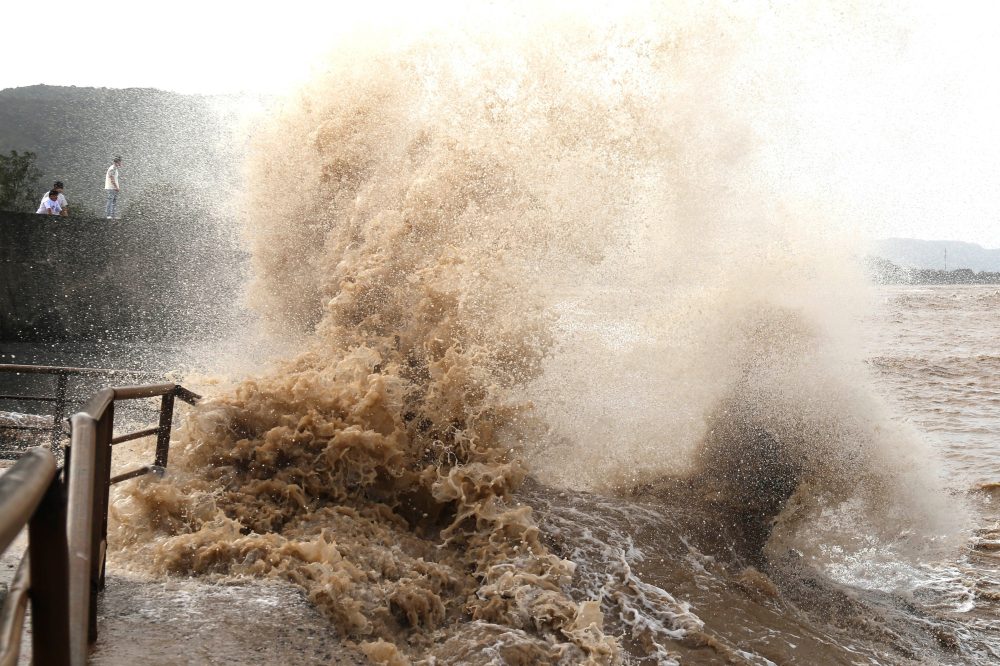

BEIJING (AP) — Typhoon Bavi came ashore in China’s eastern Zhejiang province before losing some of its punch, but the storm was still battering eastern China with dangerous winds and heavy rainfall throughout Sunday.
China’s national weather center reported that by early Sunday morning, the storm had weakened with maximum sustained winds of roughly 101 kilometers per hour — about 63 miles per hour — near its center. Forecasters expect the storm to continue tracking in a northwestward direction across eastern China.
Before reaching the Chinese mainland, Bavi passed to the north of Taiwan on Saturday without making a direct hit. Even so, the storm left its mark — Taiwan’s fire department reported that at least 134 people across the island had been injured as of 7 a.m. Sunday. Many of those hurt were motorcycle or bicycle riders caught in strong gusts, while others were injured on slick road surfaces.
China’s National Meteorological Center warned that numerous eastern Chinese cities should expect strong winds and heavy rain to continue throughout Sunday.
The scale of evacuations was massive. Authorities in Zhejiang province moved approximately 2.2 million residents out of harm’s way, while Shanghai relocated more than 290,000 people from vulnerable areas, according to state media. Fujian province also evacuated more than 180,000 residents.
Air travel took a major hit as well. The official Xinhua News Agency reported that Shanghai’s Pudong International Airport and Hongqiao International Airport were expected to cancel roughly 653 arriving and departing flights because of the typhoon.
In the coastal city of Yueqing, located in Zhejiang province, state broadcaster CCTV reported that more than 1,300 trees were knocked down, with at least 700 of them completely uprooted by the storm’s fury.