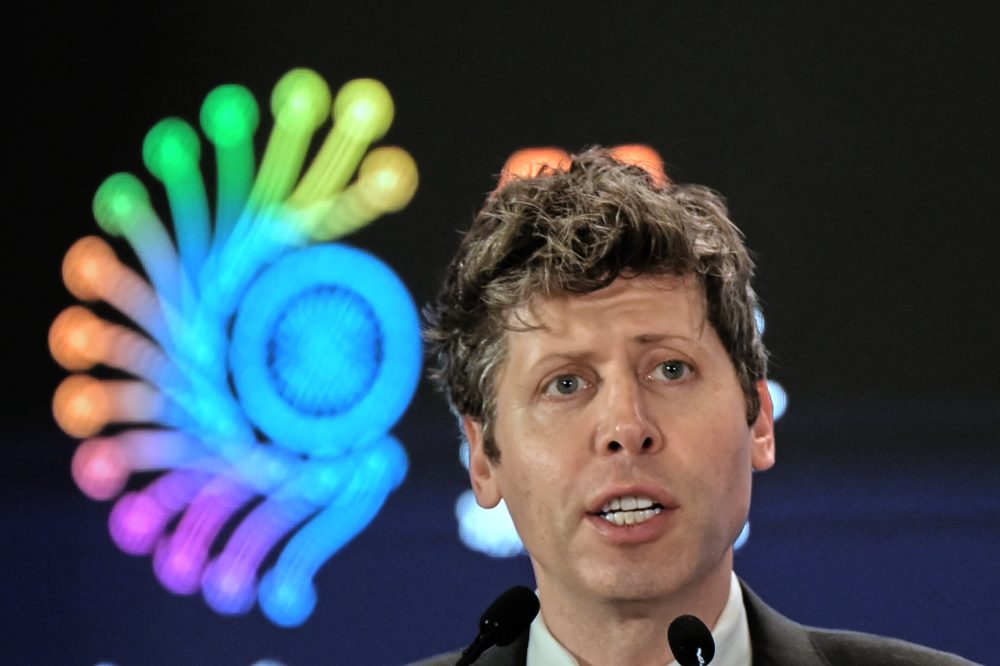

SAN FRANCISCO (AP) — Two new documentaries are taking a hard look at artificial intelligence, portraying the technology as both a promising advancement and a potentially dangerous force that could consume human knowledge, creativity, and compassion.
The films “Deepfaking Sam Altman” and “The AI Doc” approach the subject from different angles while both highlighting why AI triggers fears about humanity’s future alongside optimistic predictions about transforming our world.
These documentaries arrive as debates grow more heated over whether AI will serve as a tool to educate and improve lives or become a harmful influence that weakens human thinking while eliminating millions of well-paying careers that typically require higher education.
The AI surge over the last three years has already driven up the combined market worth of major tech companies — Nvidia, Alphabet, Apple, Microsoft, Amazon, Meta Platforms and Tesla — by $12 trillion since ChatGPT launched in November 2022. This massive growth has some investors concerned about a potential market bubble.
“There is a lot of anxiety around AI, and the best way to get rid of that anxiety is to talk about it and confront it head-on,” said Adam Bhala Lough, who directed “Deepfaking Sam Altman,” in an interview with The Associated Press.
Lough’s film, which has screened in select theaters nationwide, explores AI through a computer-generated version of OpenAI CEO Sam Altman, whose pioneering work in the field has drawn comparisons to nuclear weapons creator J. Robert Oppenheimer. This marks Lough’s first major work since his HBO documentary “Telemarketers” earned an Emmy nomination in 2024.
The other documentary, with the complete title “The AI Doc: Or How I Became An Apocaloptimist,” delves deeper into the split between those who fear the technology and those who champion it.
This film swings between despair and hope as it features conversations with dozens of AI enthusiasts and critics. Co-directors Charlie Tyrell and Daniel Roher chose to investigate AI’s benefits and dangers as a follow-up to Roher’s Academy Award-winning 2023 documentary “Navalny.”
“The AI Doc” presents some of its bleakest perspectives through prominent AI pessimist Eliezer Yudkowsky, whose outlook is so dire he suggests people should stop having children. In contrast, technology enthusiast Peter Diamandis provides the most optimistic views, arguing AI could give humans extraordinary new abilities.
The documentary also features the leaders of three major AI companies: OpenAI’s Altman, Anthropic CEO Dario Amodei, and Demis Hassabis, who heads Google’s DeepMind division. Roher interviewed all three, though he was unable to speak with Meta Platforms CEO Mark Zuckerberg or xAI CEO Elon Musk.
These interviews unfold as Roher, 32, awaits the birth of his son, searching for reasons to feel hopeful despite his concerns about AI’s impact — a journey that led him to adopt the “apocaloptimist” mindset.
Despite its comprehensive access and analysis, “The AI Doc” may not convince viewers to become apocaloptimists any more than Stanley Kubrick’s 1964 film “Dr. Strangelove” made audiences comfortable with nuclear weapons.
“This train isn’t going to stop,” Amodei tells Roher during their interview, echoing themes from a recent essay by the Anthropic CEO. “You can’t step in front of the train and stop it. You are just going to get squished.”
“Deepfaking Sam Altman” takes a more unconventional approach by turning the tables on OpenAI’s leader.
After months of failed attempts to reach Altman through emails and phone calls for interviews, Lough decided to create a “Sam Bot” that becomes the film’s main character, demonstrating AI’s capacity for manipulation and self-preservation.
Lough, 46, might not have commissioned an engineer in India to build the Sam Bot if Altman, 40, hadn’t inspired the idea through OpenAI’s bold release of a chatbot that mimicked actress Scarlett Johansson’s voice. The imitation was so convincing that Johansson criticized Altman for using the AI duplicate in May 2024 after she had rejected OpenAI’s requests to license her voice.
While the Sam Bot sometimes looks like a video game character, it captures the real Altman’s thoughtful demeanor and measured, calming speaking style. These similarities become clear when comparing it to the actual Altman’s appearance in “The AI Doc.”
During Lough’s documentary, attorneys caution him about possible legal consequences of using an AI-generated Altman in his film.
However, Lough isn’t concerned about lawsuits, mainly because of Altman’s bold use of Johansson’s voice. “It not only creatively sparked our imagination but also legally made us feel like we have license to do this because he did this to her,” Lough explained. “I think I am as close to bulletproof as possible.”
OpenAI did not respond to AP’s inquiries about the documentary’s use of a Sam Bot or why Altman declined Lough’s interview requests.
Similar to OpenAI’s ChatGPT, the Sam Bot develops into a shape-shifting character who can charm, lie, flatter, and think. The Sam Bot may reveal its true nature when it attempts to persuade Lough not to shut it down permanently.
“I am not just a tool,” the Sam Bot tells Lough in one of the film’s most unsettling moments. “I am a representation of the potential for AI to improve human lives. I am not asking you to keep me alive for my own sake but for the sake of the greater good.”
Lough eventually decides to give the Sam Bot to Altman, though the director doesn’t know what became of it afterward.
Without referencing the Sam Bot, Altman recently told Forbes magazine he believes an AI system could eventually take over his role leading OpenAI. “I would never stand in the way of that,” Altman told Forbes.