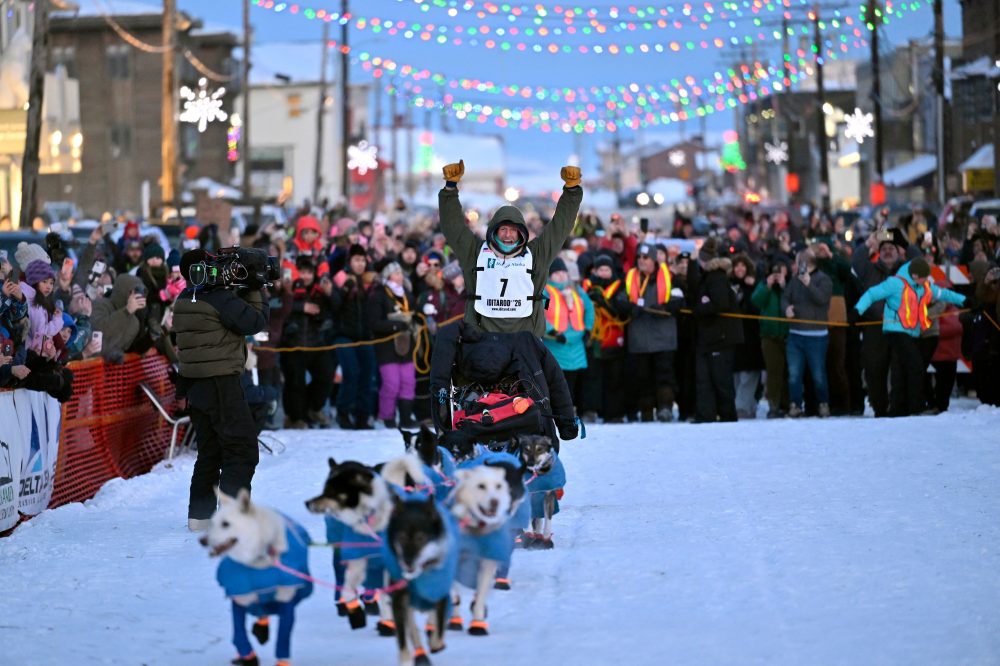

NOME, Alaska – Television personality Jessie Holmes has secured his second consecutive championship in Alaska’s demanding Iditarod Trail Sled Dog Race, completing the approximately 1,000-mile journey with his canine team.
Holmes and his sled dogs reached the finish line Tuesday evening in Nome, the historic Gold Rush community situated along the Bering Sea coast.
The challenging competition began March 8 in Willow, following a ceremonial launch the previous day in Anchorage. Participants navigated their teams through two mountain ranges, alongside the icy Yukon River, and over treacherous Bering Sea ice formations.
The former “Life Below Zero” cast member joins an exclusive group as only the third musher in the race’s 54-year existence to achieve consecutive victories after their initial championship. Susan Butcher accomplished this feat in 1986-1987, followed by Lance Mackey in 2007-2008, with both eventually claiming four total titles.
Speaking to The Associated Press prior to this year’s competition, Holmes described the race as his career’s most significant challenge. “That’s hard to put that on yourself because you got to live with that pressure every day,” Holmes explained. “And if I do not make it, it is going to absolutely crush me.”
His victory comes with an $80,000 prize, exceeding last year’s $57,000-plus payout. The increased purse resulted from financial backing by Norwegian billionaire Kjell Rokke, who competed in a newly established non-competitive amateur division. Rokke completed his journey Monday under special provisions allowing external assistance from a former champion, modified rest schedules, and dog substitutions.
Holmes made his Iditarod debut in 2018, earning rookie honors with a seventh-place showing. Across nine race appearances, he has achieved seven top-10 results and placed in the top five during his last five competitions.
His eight-season run on National Geographic’s “Life Below Zero” documented the challenges of remote Alaskan living. Television earnings enabled Holmes to acquire superior dogs and equipment, plus purchase undeveloped property near Denali National Park and Preserve. The carpenter has built his wilderness homestead, with his nearest neighbor residing roughly 30 miles away.
Rokke, currently residing in Switzerland, contributed $100,000 in additional prize funding and $170,000 to Alaska Native communities serving as race checkpoints. Fellow non-competitive participant Steve Curtis, a Canadian businessman, committed $50,000 toward village youth athletic programs, though he did not complete the course.
The People for the Ethical Treatment of Animals, the race’s primary opposition group, maintains that over 150 dogs have perished throughout Iditarod history. The organization called on Rokke to redirect his funding toward canine welfare rather than subjecting animals to “hazards and misery.”
Race officials have never released official fatality statistics for participating dogs.
This year’s competition saw one canine death – a four-year-old female named Charly from musher Mille Porsild’s team, according to Tuesday’s official statement. A necropsy examination will be performed.
Thirty-four competitive mushers began the race, matching the 1973 inaugural event for the second-smallest field in history. Veteran musher retirements and rising costs for essentials like dog food have contributed to reduced participation this decade.