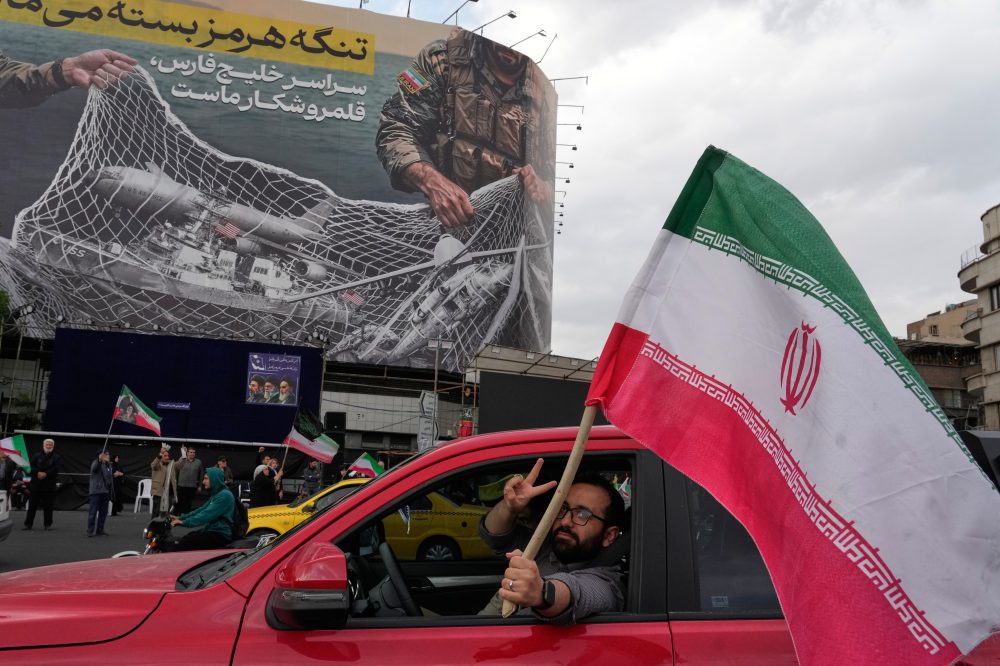

President Donald Trump’s announcement Monday of a naval blockade targeting Iranian ports threatens to send already elevated fuel costs even higher while raising serious questions about international maritime law and military effectiveness.
The blockade decision came after weekend ceasefire negotiations collapsed without reaching an agreement. Iran had previously restricted most tanker movement through the critical shipping channel, permitting only select vessels deemed favorable to pass while imposing substantial transit fees.
Military analysts warn that implementing such a blockade will demand extensive U.S. Navy resources and could raise concerns regarding the use of force under international maritime regulations. Supply chain specialists emphasize that these restrictions may severely impact the movement of petroleum, fertilizers, food products and other essential commodities to consumers already struggling with inflated costs.
Naval experts indicate that maintaining the blockade will require a sustained deployment of American warships and personnel, along with precise directives from both the Trump administration and Navy legal advisors.
The primary military obstacle involves managing the massive volume of maritime traffic that typically moves through the Strait of Hormuz, where approximately 20% of globally traded petroleum normally flows. A substantial naval presence may be necessary to implement these restrictions effectively, according to Sidharth Kaushal, who studies naval capabilities at the Royal United Services Institute, a London-based defense research organization.
“A lot depends on the early days of the blockade, how many vessels the Americans can seize, how much they can convince vessels attempting to slip through a cordon that they’re likely to be seized,” Kaushal said. “But in all likelihood, I’d say it will prove difficult for the U.S. to enforce.”
Todd Huntley, who leads Georgetown University Law Center’s National Security Law Program, noted that while the strait’s narrow geography limits the area requiring coverage, the sheer volume of shipping traffic “is going to be a challenge.”
According to Huntley, American officials may need to decide whether humanitarian supplies should reach Iranian ports, a choice that could affect the blockade’s compliance with international legal standards. Maritime law also mandates that any country implementing a blockade must do so fairly and provide proper notification to sailors.
“How it is carried out will determine whether it is lawful or not,” said Huntley, a former Navy captain and judge advocate general. “You can’t enact a blockade with the goal of starving the civilian population. Even the DOD law of war manual states that neutral vessels carrying relief supplies should be allowed to pass.”
Raul Pedrozo, an international law instructor at the Naval War College and former Navy captain and JAG officer, believes most commercial ships will avoid challenging a blockade rather than risk confrontation with U.S. naval forces.
“They see a warship, and they’re going to heave to,” Pedrozo said.
Historical evidence suggests blockades alone rarely achieve complete success but serve as tools to apply economic pressure during conflicts, according to military specialists.
“There are always ways to economize, import, substitute, or just give up on certain things that you can no longer build for want of foreign inputs,” Kaushal said. “It can make things a lot harder in a lot of ways, but it doesn’t necessarily achieve decisive outcomes.”
A maritime blockade cannot completely eliminate Iran’s commercial relationships with allies like China and Russia, nor block access to the Caspian Sea or Central Asian routes.
The operation also risks Iranian retaliation that could restart broader hostilities, warned Farzin Nadimi, an Iran and Persian Gulf specialist at the Washington Institute for Near East Policy.
Iran might respond by deploying underwater mines, rapid patrol boats and missile systems against shipping, creating additional disruption to global commerce.
“The U.S. wants this to be a short and sweet operation. I don’t think that it can be,” Nadimi said.
Trump warned that Iran’s remaining “fast attack ships” would face “quick and brutal” destruction if they approach the American blockade. Iran countered with its own warnings about targeting ports throughout the Persian Gulf and Gulf of Oman.
Given the threat of military action, experts predict most shipping companies will avoid the risk entirely. The waterway could remain effectively closed, driving petroleum and gasoline costs even higher. Stopping roughly 20% of global oil movement has already forced some regional producers to reduce output because their crude cannot reach markets.
“The problem with a two-side blockade is that you know it’s going to take much longer for the strait to open up and for some kind of agreement to come about — and that’s what’s going to send these prices further skyrocketing,” said Vidya Mani, a visiting associate professor at Cornell University whose research focuses on supply chains.
Market analysts caution that extended closure of the shipping route will worsen price increases. Oil markets have fluctuated sharply based on statements from Trump and others regarding the conflict’s progress, but prices remain elevated overall, with crude trading Monday above $100 per barrel, up from approximately $70 before hostilities began.
Consumers and businesses worldwide are experiencing the financial impact, especially in Asia where nations depend heavily on Middle Eastern fuel imports. Since oil trades as a global commodity, people everywhere are feeling increased costs at the pump.
American motorists have watched gasoline prices jump to an average exceeding $4.12 per gallon, compared to $2.98 before the conflict started.
The blockade would also disrupt food and fertilizer shipments, explained Patrick Penfield, a supply chain professor at Syracuse University. He predicted the United Arab Emirates, Qatar, Bahrain and neighboring countries could face “dramatic food price increases” as supplies would need to arrive by air transport.
Approximately 30% of global fertilizer also moves through the strait, potentially harming agricultural producers and worsening food insecurity worldwide.
“Now you’re talking about impacting the global harvest,” Penfield said. Combined with oil market disruptions, he noted that such instability and uncertainty “bleeds out throughout the whole world.”
Mani highlighted that chemicals used to manufacture basic products like paint and metals, including aluminum, would face additional supply interruptions. She pointed to cost pressures that existed even before the U.S. and Israel began military operations against Iran, including new Trump administration tariffs, pandemic-related supply problems and other international tensions.
“We just have to be prepared for constant higher prices, irrespective of how this blockade turns out,” she said. “Each crisis has a lingering effect on the next one.”