
WASHINGTON — Federal officials are proposing an aggressive construction timeline that would involve nearly round-the-clock work to build President Donald Trump’s massive triumphal arch near the Lincoln Memorial, according to a new National Park Service evaluation.
The proposed structure would stand 250 feet tall and require construction crews to work in two 10-hour shifts daily throughout the year to meet the administration’s three-year completion goal, the preliminary Park Service analysis reveals.
Building the monument would demand tower cranes reaching heights of 320 feet, along with forklifts, concrete pumping systems and other heavy machinery. The finished arch would tower more than double the height of the nearby Lincoln Memorial, according to the 24-page assessment released last week.
The evaluation was made public as part of an expedited historic preservation review that commenced Friday. The National Park Service manages the federal land where officials want to construct the arch.
Last week, the National Capital Planning Commission decided to request additional details from the Interior Department, which supervises the park service. This decision effectively allows the project to move forward while officials examine potential impacts on aviation and other construction-related concerns including area traffic patterns.
The June 4 decision followed almost three hours of public testimony from approximately 20 citizens, including representatives from historical and architectural groups. Most speakers voiced opposition to the arch, which represents one of multiple projects the Republican president is advancing to establish his legacy in Washington.
Site surveys and testing at the proposed location started last month, with other approvals currently in progress. The U.S. Commission of Fine Arts, which reviews designs but has no authority over actual construction or project funding, has given its approval to the arch’s design.
The capital planning commission wants more justification for the monument’s proposed height, plus additional information about illumination plans, stormwater management and visitor traffic and parking arrangements.
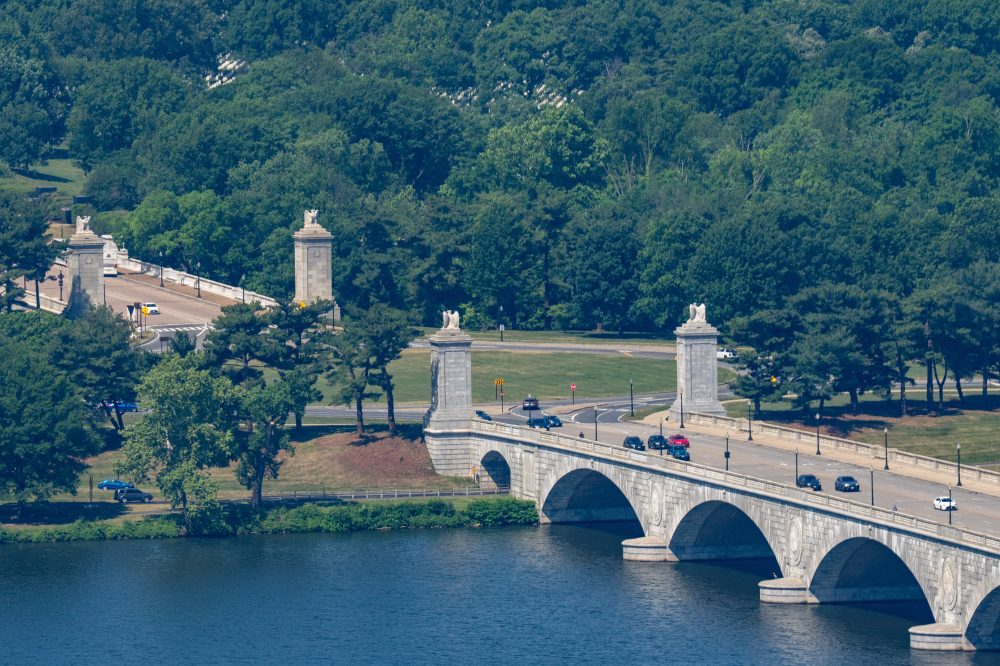
The selected location sits across the Potomac River from the memorial and lies within a flight corridor near Ronald Reagan Washington National Airport. The Federal Aviation Administration announced Wednesday it is examining whether the structure’s planned height could threaten aircraft operations in the vicinity. Last year, an American Airlines aircraft and an Army Black Hawk helicopter crashed in the busy airspace near the airport, resulting in 67 deaths.
The FAA analysis “found no adverse impacts to operations” at Reagan Airport from the proposed monument, but concluded that red obstruction lights would be required at the structure’s peak — a standard safety measure, according to spokesman Donnell Evans. The FAA plans to conduct a comprehensive aeronautical study working with the National Park Service, he added.
In its documentation, the park service stated that federally mandated aviation safety lighting would be built into the arch design “using the least intrusive technology available, ensuring compliance with aircraft visibility requirements while limiting unnecessary light emission.”
Will Scharf, who previously worked as Trump’s White House staff secretary, leads the commission and has expressed his view that federal height restrictions for new Washington construction should not cover the arch. Current law caps most building construction in Washington at 130 feet maximum.
Opponents contend the arch would overwhelm the skyline and interfere with the intentionally planned sightlines connecting the Lincoln Memorial and Arlington National Cemetery. The structure would exceed twice the height of the Lincoln Memorial at 99 feet and reach nearly half the elevation of the Washington Monument at approximately 555 feet.
Trump has advocated for the 250-foot monument to commemorate America’s 250th anniversary, stating the project could be funded through private contributions remaining from the new White House ballroom construction. The White House East Wing was torn down to accommodate the large ballroom.
Officials are still developing cost projections for the arch, though a combination of public and private funding is anticipated. A coalition of veterans and a historian have filed a federal lawsuit against the Trump administration seeking to halt the project due to concerns about visual disruptions.
Democratic Sen. Richard Blumenthal of Connecticut has criticized the administration for what he termed its “persistent lack of transparency” in promoting Trump’s Washington-area building initiatives. Along with the planned ballroom, Trump is also updating the Lincoln Memorial’s Reflecting Pool and reconstructing a public golf course along the Potomac River. None of these projects have undergone standard legal reviews or Congressional oversight.
“Your disregard for legal process and public interest has been apparent in projects ranging from the construction of a White House Ballroom and triumphal arch to the resealing of the Lincoln Memorial Reflecting Pool,” Blumenthal stated in a Tuesday letter to Interior Secretary Doug Burgum and acting park service director Jessica Bowron.