
President Donald Trump issued stark warnings Monday about potential attacks on Iran’s critical water and energy infrastructure, including facilities that produce drinking water from seawater. Military experts caution that such actions could spark a humanitarian crisis throughout the drought-stricken Middle East region.
Writing on Truth Social, Trump declared that unless a peace agreement emerges “shortly” and the crucial Strait of Hormuz shipping lane reopens immediately, “we will conclude our lovely ‘stay’ in Iran by blowing up and completely obliterating all of their Electric Generating Plants, Oil Wells and Kharg Island (and possibly all desalinization plants!), which we have purposefully not yet ‘touched.’”
Security analysts express greater concern about potential Iranian counter-attacks than Trump’s initial threats. While Iran depends minimally on desalinated water, neighboring Gulf nations rely on these facilities for most of their freshwater supply.
Dozens of water treatment facilities line the Persian Gulf shoreline, placing systems that serve millions of residents within striking distance of Iranian rockets and unmanned aircraft. Major metropolitan areas including Dubai and Abu Dhabi in the United Arab Emirates, plus Qatar’s capital Doha, could not maintain their current population levels without these installations.
“Desalination facilities are oftentimes necessary for the survival of the civilian population and intentional destruction of those types of facilities is a war crime,” stated Niku Jafarnia, who conducts research for Human Rights Watch.
Iran faces its fifth consecutive year of severe drought conditions, with some domestic news outlets reporting that water storage facilities serving Tehran hold less than 10% of normal capacity. Satellite imagery examined by The Associated Press confirms significantly reduced reservoir levels. The nation continues to depend primarily on rivers, lakes and declining underground water sources.
Israeli air attacks on March 7 targeted fuel storage sites around Tehran, creating thick smoke and acidic precipitation. Specialists cautioned that contamination could affect soil and portions of the city’s water infrastructure.
“Attacking water facilities, even one, could end up being harmful to the population in such a severe water scarcity context,” Jafarnia explained.
Prior to the military conflict that Israel and the United States initiated on February 28, Iran had been working rapidly to build more desalination capacity along its southern coastline and transport treated water to interior regions. However, infrastructure limitations, power costs and international economic restrictions have severely hampered expansion efforts.
Kuwait obtains approximately 90% of its drinking water through desalination, while Oman relies on the technology for roughly 86% and Saudi Arabia for about 70%. The process eliminates salt from ocean water, typically by forcing it through extremely fine filters using reverse osmosis technology, creating the freshwater that supports cities, tourism, manufacturing and some farming in one of Earth’s most arid regions.
Even facilities connected to national power networks with alternative supply options face risks of cascading failures across linked systems, according to David Michel, who serves as senior fellow for water security at the Center for Strategic and International Studies.
“It’s an asymmetrical tactic,” he noted. “Iran doesn’t have the same capacity to strike back … But it does have this possibility to impose costs on the Gulf countries to push them to intervene or call for a cessation of hostilities.”
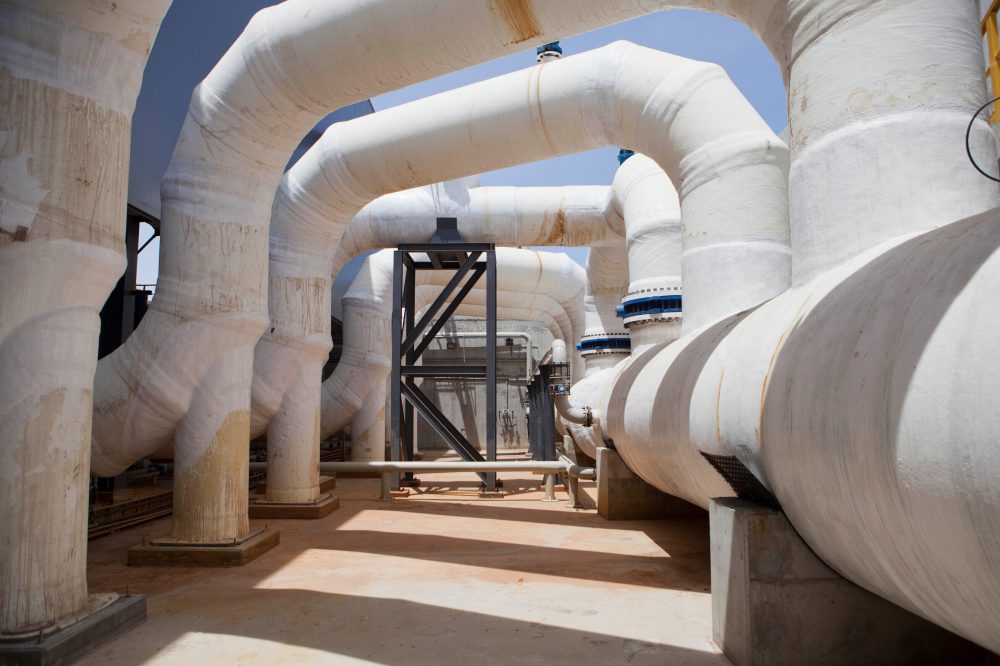
Water treatment plants contain numerous components including intake structures, processing equipment and power sources, with disruption to any element capable of halting operations, explained Ed Cullinane, Middle East editor at Global Water Intelligence, an industry publication.
“None of these assets are any more protected than any of the municipal areas that are currently being hit by ballistic missiles or drones,” Cullinane observed.
The Gulf region exports roughly one-third of global crude oil, with energy sales forming the foundation of national economies. Combat operations have already stopped tanker movement through vital shipping channels and interrupted port operations, compelling some producers to reduce exports as storage facilities reach capacity.
“Everyone thinks of Saudi Arabia and their neighbors as petrostates. But I call them saltwater kingdoms. They’re human-made fossil-fueled water superpowers,” said Michael Christopher Low, who directs the Middle East Center at the University of Utah. “It’s both a monumental achievement of the 20th century and a certain kind of vulnerability.”
Trump’s statements came amid escalating violence, with Tehran attacking a major water and power facility in Kuwait and an Israeli oil processing plant coming under fire, while American and Israeli military units launched fresh strikes against Iran.
A 2010 Central Intelligence Agency assessment cautioned that strikes on desalination infrastructure could create national emergencies in multiple Gulf states, with extended outages potentially lasting months if essential equipment suffered damage. The document noted that over 90% of the Gulf’s desalinated water originates from just 56 facilities, stating that “each of these critical plants is extremely vulnerable to sabotage or military action.”
Saudi Arabia and the UAE have constructed pipeline systems, water storage facilities and other backup measures intended to provide protection during brief interruptions. However, smaller nations including Bahrain, Qatar and Kuwait maintain fewer reserve supplies.
Desalination expansion has accelerated partly because climate change is worsening drought conditions throughout the region. The facilities themselves consume enormous amounts of energy and produce substantial carbon emissions, while their coastal positions leave them exposed to severe weather and ocean level increases.
During Iraq’s 1990-1991 occupation of Kuwait, withdrawing Iraqi military units sabotaged electrical stations and water treatment plants, Low recalled, while millions of barrels of petroleum were intentionally spilled into the Persian Gulf, threatening seawater intake systems used by desalination facilities across the area.
Emergency crews worked quickly to position protective barriers around intake valves at major installations, but the damage left Kuwait mostly without fresh water and reliant on emergency water shipments. Complete restoration required several years.
In recent years, Yemen’s Iran-supported Houthi forces have attacked Saudi desalination installations as regional tensions increased.
International humanitarian law, including sections of the Geneva Conventions, forbids attacking civilian infrastructure essential to population survival, including drinking water systems.