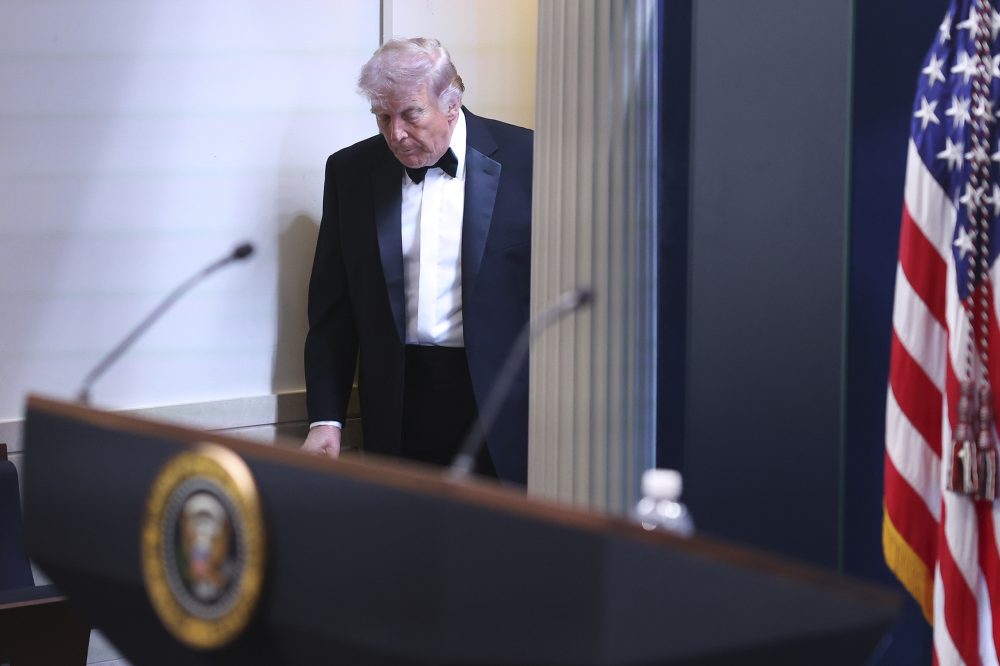

WASHINGTON — Following what he described as a third security threat against him in under two years, President Donald Trump adopted an unusually reflective tone while appealing for national reconciliation during a late Saturday press conference at the White House.
The incident unfolded just before Trump was set to speak at the White House Correspondents’ Association dinner, when an armed individual attempted to breach the security barrier at the Washington hotel venue. Law enforcement quickly apprehended the suspect, later identified as 31-year-old Cole Tomas Allen from Torrance, California, who was reportedly carrying firearms and bladed weapons.
“It’s always shocking when something like this happens. Happened to me, a little bit. And that never changes,” Trump remarked during the impromptu news briefing, displaying a notably subdued demeanor compared to his typical public appearances.
The president characterized his role as inherently risky, stating the presidency represents “a dangerous profession.” He observed that political violence has intensified both domestically and internationally, noting “No country is immune.”
Trump drew historical parallels to justify the threats against him, suggesting they reflect his administration’s effectiveness. “I’ve studied assassinations, and I must tell you the most impactful people — the people who do the most, take a look at Abraham Lincoln,” he explained. “The people that make the biggest impact, they’re the ones that they go after. They don’t go after the ones that don’t do much.”
Departing from his typically confrontational political style, Trump emphasized the need for Americans to bridge their divisions.
“We have to, we have to resolve our differences,” the president stated. “I will say, you had Republicans, Democrats, independents, conservatives, liberals and progressives. Those words are interchangeable, perhaps, but maybe they’re not. But yet everybody in that room, big crowd, record-setting crowd, there was a record-setting group of people, and there was a tremendous amount of love and coming together. I watched, I watched, and I was very, very impressed by that.”
However, by Sunday morning, Trump had shifted to promoting his controversial White House ballroom construction project on social media. He claimed the incident “would never have happened with the Militarily Top Secret Ballroom currently under construction at the White House. It cannot be built fast enough!” He also dismissed legal opposition to the project as the “ridiculous ballroom lawsuit.”
This pattern of initial calls for unity followed by a return to divisive rhetoric has emerged before. After surviving an assassination attempt during a Butler, Pennsylvania rally in 2024 that left him with an ear wound and killed a supporter, Trump initially delivered a unifying message at the Republican National Convention.
“The discord and division in our society must be healed. We must heal it quickly,” Trump said during his nomination acceptance speech. “As Americans, we are bound together by a single fate and a shared destiny. We rise together. Or we fall apart.”
Yet that same address eventually included his standard combative elements, featuring disputed claims about the 2020 election and harsh criticism of then-President Joe Biden.
A similar sequence occurred following a September 2024 incident at Trump’s West Palm Beach golf resort, where Secret Service agents engaged an armed individual. Trump’s golf partner Steve Witkoff initially described the president’s response as “courageous and stoic,” but Trump soon resumed attacking “radical” Democrats and “left-wing lunatics” while calling Ryan Routh, who received a life sentence for the attempt, a “sick” individual.
Saturday’s incident differed from previous threats as First Lady Melania Trump was present. The president described his wife as shaken but alert to the danger.
“I think she knew immediately,” Trump said. “She was saying ‘It’s a bad noise.’” He added, “It was a rather traumatic experience for her.”
Federal authorities continue investigating the incident and the suspect’s motivations.