
Speaking from Ankara, Turkey, where he was attending a NATO summit, President Donald Trump announced Wednesday that the United States was preparing to launch another wave of strikes against Iran — just hours after he declared the existing ceasefire was finished.
When reporters asked about the possibility of returning to open hostilities, Trump did not hold back. “We hit them very hard last night,” he said. “We’ll probably hit them hard again tonight.”
Trump framed the ongoing strikes as retaliation for Iran’s attacks on commercial vessels in the Strait of Hormuz, accusing the country of launching drones and a missile at ships. “They are behaving very badly,” he said of Iran.
While acknowledging that fears of a full reignition of the war were understandable, Trump declared the interim pause in fighting “over” — though he left the door slightly open for continued diplomacy. “For me, I think it’s over,” he said when asked about the ceasefire’s status. He added that U.S. representatives could keep talking, but expressed little confidence in the outcome. “They can talk, but I think they’re wasting their time,” he said.
Formal negotiations toward a final agreement had been expected to begin after the multi-day funeral for Iran’s Supreme Leader Ayatollah Ali Khamenei, who was killed on Feb. 28 in the opening moments of the war. That funeral period, which concludes Thursday, was supposed to be a time of reduced hostilities. The planned talks were set to address the most difficult issues, including fully reopening the strait and rolling back Iran’s contested nuclear program.
Iranian Parliament Speaker Mohammad Bagher Qalibaf responded defiantly on social media platform X. “The era of bullying and extortion is over,” he wrote. “It leads nowhere. We don’t fold.”
US Military Strikes Hit Iranian Targets
The U.S. military’s Central Command confirmed that American forces carried out strikes designed to “impose heavy costs for targeting and attacking commercial shipping crewed by innocent civilians in an international waterway.” The military said it struck Iranian air-defense systems, radar installations, and more than 60 small watercraft operated by Iran’s paramilitary Revolutionary Guard.
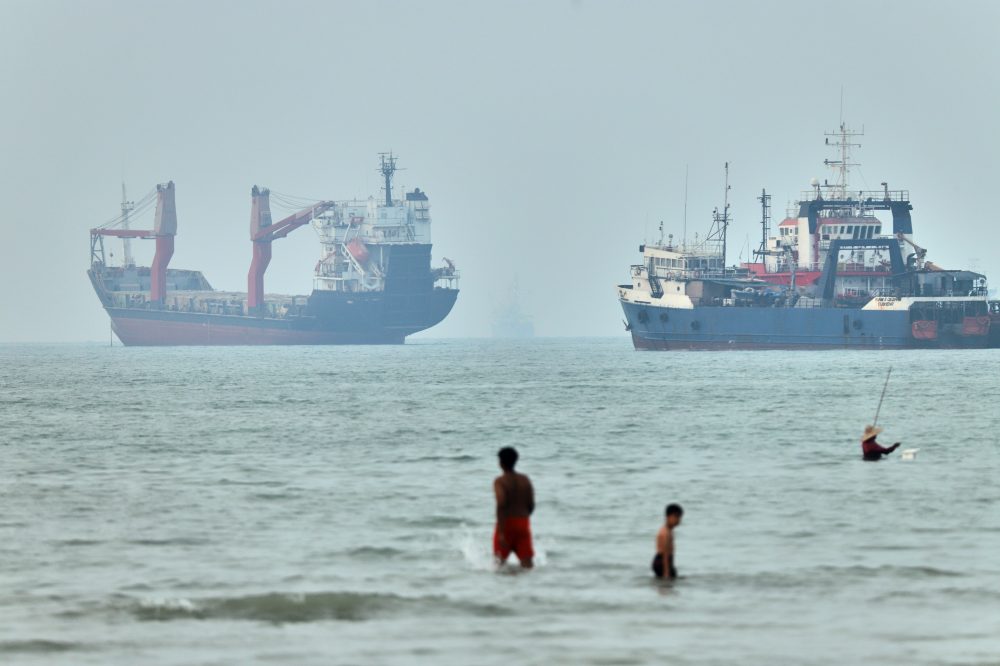
Those vessels had been central to Iran’s strategy of threatening ships in the strait, a waterway through which one-fifth of the world’s traded oil and natural gas flowed before the war began. Iran’s ability to choke off shipping there proved to be its most powerful strategic tool, and the resulting spike in energy, fertilizer, and food prices created pressure on the U.S. to negotiate. On Wednesday, the international oil benchmark Brent crude jumped more than 5% following Trump’s remarks.
The U.S. military stated it remains “prepared to hold Iran accountable when the agreement is not adhered to or obeyed,” and indicated this particular round of attacks had concluded.
Iranian state media reported explosions at multiple locations, including Bandar Mahshahr, where one member of the Revolutionary Guard was killed. Attacks were also reported near Bushehr, the site of Iran’s nuclear power plant complex.
Earlier Wednesday morning, both Bahrain — home to the U.S. Navy’s 5th Fleet — and Kuwait, where U.S. Army forces are stationed, activated missile alerts. The Revolutionary Guard issued a statement acknowledging it had targeted American military installations in both countries. Kuwait said it intercepted two ballistic missiles and 13 drones launched by Iran, and the country’s Electricity Ministry reported that power lines were knocked out after shrapnel fell on them.
A similar exchange of Iranian attacks on shipping and U.S. retaliatory strikes had taken place late last month, which also prompted Iranian attacks on Bahrain and Kuwait. Wednesday’s U.S. strikes occurred while Trump was in Turkey for the NATO summit.
Anwar Gargash, a senior diplomat from the United Arab Emirates, condemned Iran’s attacks on Bahrain and Kuwait, calling them “a clear indicator that Tehran remains incapable of committing to the requirements of de-escalation and turning the page on war.”
US Pulls Oil Sales License Granted to Iran
Prior to the latest strikes, the U.S. revoked a special license that had — for the first time in years — permitted Iran to conduct oil sales openly in U.S. dollars as part of the interim deal. Iran had long been suspected of selling sanctioned crude oil to China at below-market rates.
The license was pulled following the attacks on shipping. One tanker was struck and caught fire off the coast of Oman, according to the United Kingdom Maritime Trade Operations center. Iranian state television said the vessel had been attacked after ignoring warnings but stopped short of claiming direct responsibility.
A spokesperson for Qatar’s Foreign Ministry, Majed al-Ansari, confirmed the tanker was carrying Qatari natural gas and called the attack an “unacceptable attack” on international navigation and global energy security. He said Qatar — which has served as a key mediator alongside Pakistan in the ongoing talks — holds Iran “fully legally responsible.” Two additional ships suffered minor damage but no injuries were reported, and both vessels continued on their routes, according to the U.K. agency.
Under the terms of the interim agreement, Iran and the U.S. had agreed to allow ships to pass through the strait without fees for 60 days. However, Tehran has insisted it must control the routes those vessels take and has pledged to eventually charge passage fees — a move that would overturn decades of established practice in the waterway. The ships struck Tuesday all appeared to be traveling a route near Oman’s coastline rather than one dictated by Iran. Both the U.S. and a number of Gulf Arab nations have made clear they will not accept Iran imposing charges for passage through the strait.
Funeral Services for Khamenei Held in Iraq
Funeral ceremonies for Khamenei were held Wednesday in the Iraqi city of Najaf. Iranian President Masoud Pezeshkian attended, along with other Iranian and Iraqi officials including Iraqi Prime Minister Ali Falah al-Zaidi. Funeral prayers were also planned at the Imam Hussein shrine in Karbala. Khamenei’s remains are set to be returned to Iran for burial Thursday at the Imam Reza shrine in Mashhad, his birthplace.