
President Donald Trump dismissed any possibility of diplomatic talks with Iran during remarks to journalists on Air Force One Saturday, suggesting the ongoing military campaign might continue until Tehran’s government and armed forces are completely eliminated.
Trump indicated the air strikes could render negotiations unnecessary if Iran’s potential leaders are eliminated and its military capabilities destroyed.
“At some point, I don’t think there will be anybody left maybe to say ‘We surrender,’” Trump stated.
The president’s comments came as the U.S.-Israeli military operation against Iran moved into its second week, with Israel and Iran exchanging multiple strikes on Saturday.
In an unusual move, Iranian President Masoud Pezeshkian issued an apology to regional nations for Iran’s attacks on American facilities within their borders, attempting to reduce tensions throughout the Gulf region. However, his statement sparked backlash from hardline factions within Iran.
“I personally apologize to neighboring countries that were affected by Iran’s actions,” Pezeshkian declared, while asking these nations to avoid participating in U.S.-Israeli operations against Iran.
The Iranian leader called Trump’s demands for unconditional surrender from the Islamic Republic “a dream,” but announced that Iran’s interim leadership council had decided to halt strikes against neighboring countries unless attacks on Iran launched from their soil.
Israeli Prime Minister Benjamin Netanyahu responded during a broadcast address, promising safety for any Islamic Revolutionary Guard Corps members who surrender their weapons.
Ali Larijani, who serves as Iran’s secretary of the Supreme National Security Council, denied any internal disagreements among Iranian officials regarding war strategy during a state television appearance.
Early Sunday morning in Oslo, an explosion struck the U.S. embassy, resulting in minor property damage but no casualties, according to Norwegian authorities. Witnesses reported seeing smoke from the embassy area, though the cause and responsible parties remain unclear.
The State Department has not yet commented on the Oslo incident.
Saudi Arabia has warned Tehran that continued Iranian strikes against the kingdom and its energy infrastructure could prompt similar retaliation, sources familiar with the communications told Reuters.
Saudi defense officials announced they successfully intercepted a drone assault targeting Riyadh’s diplomatic district early Sunday, with no reported injuries.
Pezeshkian’s apologetic remarks created domestic political controversy, forcing his office to reaffirm Iran’s commitment to strong military responses against attacks from regional U.S. bases.
The president later repeated his statement on social media platforms but omitted the apology that had angered hardline elements, including the influential Revolutionary Guards.
Judiciary chief Mohseni-Ejei, a hardline member of the three-person council temporarily exercising supreme leader authority, stated that some regional countries’ territories were being used for attacks against Iran and retaliatory strikes would persist.
Following Pezeshkian’s announcement, Revolutionary Guards claimed their drones hit a U.S. air combat facility near Abu Dhabi in the United Arab Emirates, though Reuters could not confirm this report independently.
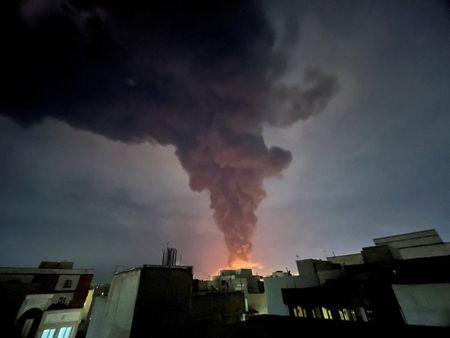
Kuwait’s military reported Saturday that drone attacks targeted fuel storage facilities at Kuwait International Airport.
Iranian news outlets, citing Oil Ministry sources, said fuel depots in three locations including Karaj, west of Tehran, were struck.
Iranian state media also reported Revolutionary Guards targeted U.S. forces at a Bahrain base, with explosions heard in Doha.
Iran has responded to the U.S.-Israeli campaign by striking both Israel and Gulf Arab nations hosting American military installations. Israel has launched additional attacks in Lebanon following border fire from the Iran-allied Hezbollah militia.
As the conflict expands, Israel warned Lebanon it would pay “a very heavy price” unless it controls Iran-allied Hezbollah fighters, while conducting airstrikes against the group’s strongholds and executing a deadly airborne operation in eastern Lebanon.
Saturday morning revealed additional buildings in Hezbollah-controlled southern Beirut suburbs reduced to smoking debris piles, dust, and twisted metal, Reuters footage showed.
Lebanon’s health ministry reported the death toll from Israeli attacks since Monday reached approximately 300, after at least four people died when an Israeli strike hit an apartment in the Ramada hotel building in central Beirut. This marked the first strike in the capital’s center since Israel-Hezbollah fighting resumed last week.
Iran’s U.N. ambassador Amir Saeid Iravani stated that U.S.-Israeli attacks have killed at least 1,332 Iranian civilians and injured thousands more. State media reported massive explosions in Tehran areas, while Israel confirmed strikes on Iranian missile facilities and command centers.
Iranian attacks have resulted in 10 Israeli deaths and at least six U.S. service member fatalities. The remains of the American service members arrived Saturday at a Delaware Air Force base.
Iran’s strategy of widespread disruption has increased conflict costs by driving up energy prices and damaging global business and supply chains.
Kuwait’s national oil company began reducing production Saturday, joining earlier output cuts from Iraq and Qatar.
The conflict has disrupted global markets, pushing oil prices to multi-year peaks with the Strait of Hormuz essentially closed.
Iranian media reported Saturday that hardline religious leaders are calling for quick selection of a new supreme leader, with meetings potentially beginning Sunday.