
WASHINGTON — President Donald Trump has dramatically stepped up his warnings about what he calls a communist takeover of the Democratic Party, as his political team quietly tests whether that message can win over voters beyond his loyal supporters ahead of November’s midterm elections.
Early results from internal focus groups suggest the anti-communist rhetoric strongly energizes Trump’s base and could push infrequent Republican voters to the polls, according to two people with knowledge of the testing. However, the message appears to have less impact on independent voters — who often decide close races — and on younger Americans who grew up after the Cold War ended.
Recent primary victories by democratic socialist and progressive candidates in Colorado, Kentucky, New York, Ohio, Texas, and other states have handed Trump and fellow Republicans a new line of attack: painting the Democratic Party as extreme rather than defending the administration’s own record on the rising cost of living.
A Reuters review of Trump’s public statements between June 23 and July 6 — a stretch during which a wave of left-leaning Democratic candidates won primaries in New York — found he used the word communism 81 times. Among those comments, he described some of the winning candidates as “hardcore, godless communists.”
Many of the progressive candidates in question have called for taxing the wealthy, reducing military spending, opposing U.S. financial support for Israel, expanding government programs, and eliminating U.S. Immigration and Customs Enforcement.
Trump, who has long favored blunt political labels, has been quick to brand supporters of those positions as communists. The candidates themselves, however, largely identify as democratic socialists — a movement that pursues progressive change through elections — which is distinct from communism, an ideology that calls for abolishing private property and eliminating class distinctions.
White House spokeswoman Olivia Wales defended the president’s language, saying “Democrats’ embrace of socialism and communism” represents an “existential threat to our country” and that Trump will “keep calling out their radicalism and drawing a sharp contrast with his commonsense, America First agenda.”
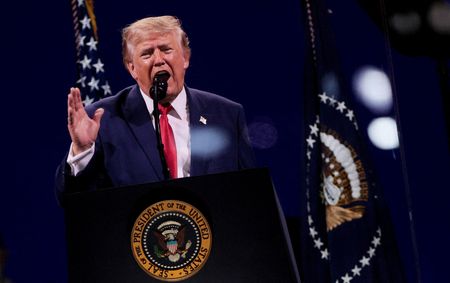
During his July Fourth address marking the 250th anniversary of American independence, Trump compared the rise of communism to a cancer. “You’ve got to cut it out, and you got to cut it out fast,” he told a crowd gathered on the National Mall in Washington.
By reaching for the communist label, Trump is reviving one of the oldest attack strategies in American politics — one previously used by Republicans Richard Nixon and Ronald Reagan during the Cold War era. Still, his choice to use a traditionally unifying Independence Day celebration as a venue for partisan attacks was seen as an unusual move.
Behind closed doors, Trump’s aides are refining the message through focus group testing as Republicans gear up for the final push toward November elections that will determine which party controls Congress.
Early focus group data suggests the word “communism” can pack more punch than “socialism” in certain races, while “socialism” may work better in paid advertising and local district messaging, according to one of the people familiar with the findings.
The message is seen as particularly effective with Hispanic voters in Florida and Texas, where appeals against socialist ideology have historically resonated with families who fled left-wing governments in Latin America.
“It’s an appealing message to voters and will help draw the contrast in November,” said Alex Pfeiffer, a spokesman for Trump’s super PAC MAGA Inc.
A 2025 Gallup poll found that Americans still view socialism more negatively than positively, with 57% holding an unfavorable opinion and 39% a favorable one. Democrats, however, were found to be more supportive of socialism than capitalism.
Republican strategist Amy Koch expressed doubt that the communist label would bring in younger voters or independents. “I just don’t think that communism means the same for anybody under 55,” she said.
U.S. Representative Suzan DelBene, who leads the House Democratic campaign committee, pushed back in a statement, saying Republicans were “resorting to desperate attacks that aren’t actually about the pocketbook issues.”
Over the past week, Trump has brought up communism during an Oval Office exchange with reporters, at the opening of the Theodore Roosevelt Presidential Library in North Dakota, and at Independence Day events at Mount Rushmore and on the National Mall. He has described it as “the most serious threat to our country since its existence,” suggested it may be a greater danger than World War One, World War Two, or the September 11, 2001 attacks, and labeled it “a mortal threat to American liberty.”
The strategy gives Republicans a way to go on offense after months spent defending Trump’s economic record — a task made harder by the president’s own mixed signals. Trump has said he loves inflation, dismissed rising gas prices tied to conflict with Iran as “peanuts,” and called a bipartisan housing bill aimed at lowering home costs “a big yawn.”
Republican leaders, including House Speaker Mike Johnson and Republican National Committee Chairman Joe Gruters, have moved quickly to amplify Trump’s message, framing the upcoming midterms as a choice between “common sense and extremism.”