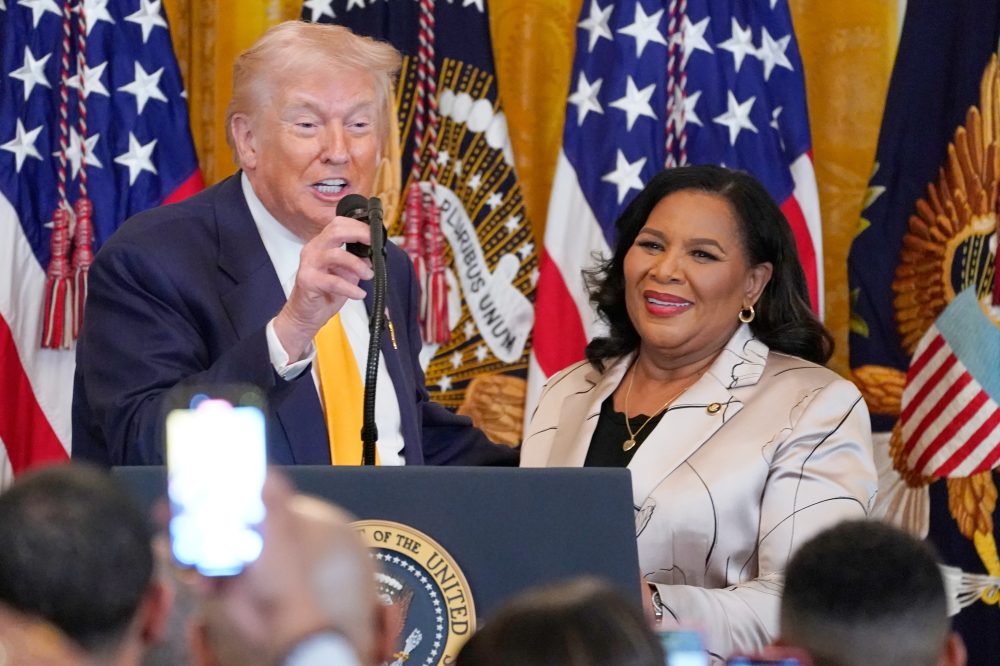

WASHINGTON — The White House welcomed guests Wednesday evening for its annual Black History Month celebration, occurring less than two weeks following President Donald Trump’s controversial social media post that generated widespread criticism from both political parties.
During Wednesday’s ceremony, Trump avoided mentioning the deleted social media content, which he has refused to apologize for despite significant public backlash. The president also made no reference to Barack Obama, America’s first Black commander-in-chief, instead focusing his remarks on other notable African American historical figures.
“We celebrate Black History Month. We honor the memory of those who came before us by continuing their legacy,” Trump stated during the reception.
The president highlighted several Black Americans who have publicly supported him, including former heavyweight champion Mike Tyson, whom Trump commended for speaking out against racism allegations. Trump also mentioned rapper Nicki Minaj, making comments about her appearance including remarks about her fingernails and calling her skin “so beautiful.”
Several administration officials joined Trump on stage, including Housing and Urban Development Secretary Scott Turner and White House pardon advisor Alice Marie Johnson.
“As you look out upon this sea of Black Americans, this president hears you. This president cares for you. Don’t let anyone tell you that this president right here, Donald Trump has not — is not for Black America,” Johnson declared. “Because he is.”
Trump outlined various policy initiatives he claims have helped Black communities, including legislation he enacted last year removing federal taxes on tip income and his decision to deploy National Guard units to restore order in cities with significant Black populations, including Washington, New Orleans and Memphis, Tennessee.
The White House gathering occurred one day after Trump defended himself on social media, writing that he has been “falsely and consistently called a Racist by the Scoundrels and Lunatics on the Radical Left” in a post intended to honor the late Rev. Jesse Jackson, who passed away Tuesday.
When reporters questioned White House press secretary Karoline Leavitt about the president’s statement, she responded Wednesday morning: “There is a lot this president has done for all Americans, regardless of race. And he has absolutely been falsely called and smeared as a racist.”
While Trump has consistently acknowledged Black History Month during his presidency, his administrative actions and public statements frequently conflict with celebrating diversity and recognizing Black American achievements.
The current administration has specifically targeted diversity, equity and inclusion initiatives that have provided employment opportunities for many Black Americans in government agencies and private companies over recent decades. Trump has labeled DEI programs as “discrimination” and is working to eliminate them from federal operations while encouraging private businesses to follow suit.
Despite this approach, Trump positions himself as a supporter of historically Black colleges and universities. The White House emphasized Wednesday that the administration allocated $500 million to HBCUs last year. However, this funding boost primarily came from redirecting federal dollars previously designated for institutions serving predominantly Hispanic student populations. The HBCU funding announcement came shortly after the Education Department withdrew $350 million from grant programs supporting colleges with substantial Hispanic and other minority enrollment. Administration officials declared those previous grant programs violated constitutional principles.
Trump launched his second presidential term by arguing that certain African American history curricula are designed to foster anti-American sentiment. He signed an executive directive titled “restoring truth and sanity to American history,” which his administration has used to remove historical content from national parks deemed to “inappropriately disparage Americans past or living,” including markers related to Black history.
Early in his current term, Trump issued an official proclamation designating February as Black History Month, even as the Defense Department announced it would no longer use official resources to observe cultural awareness months.
Last year’s White House Black History Month reception similarly followed another executive order that terminated federal diversity, equity and inclusion programs.