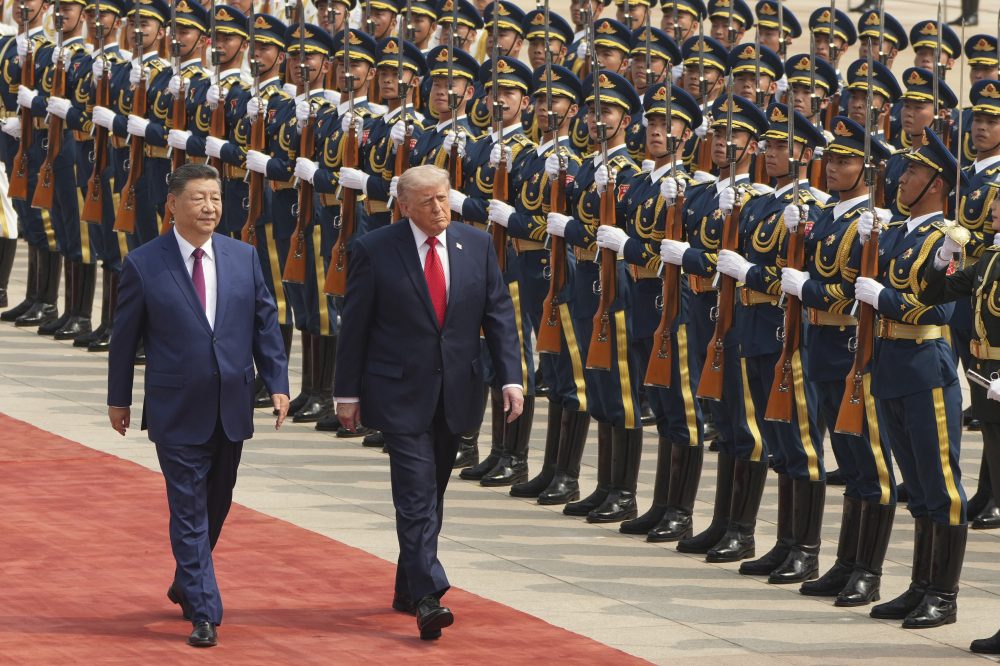

President Donald Trump came back from his diplomatic trip to China facing mounting economic challenges at home, as annual consumer price increases have climbed to 3.8% in April. The ceremonial pageantry and meetings with Chinese officials contrast sharply with growing domestic concerns about the cost of living.
The current inflation rate exceeds what Trump encountered when he assumed office, driven partly by ongoing conflict with Iran and the administration’s trade policies. Price increases are now outstripping income growth, effectively reducing workers’ purchasing power. Economic forecasters at the Cleveland Federal Reserve project inflation could hit 4.2% in May, as the conflict continues to drive up energy costs.
Trump’s diplomatic meetings with Chinese leader Xi Jinping seem unlikely to provide significant economic relief for Americans, regardless of the president’s optimistic statements about potential trade agreements. The visit happened while voters participate in primary elections ahead of November’s general election, all while dealing with higher costs for fuel, food, utilities, clothing, air travel and shipping services. Democratic leaders view this economic situation as a political advantage.
“He’s returning to a dumpster fire,” said Lindsay Owens, executive director of Groundwork Collaborative, a liberal think tank focused on economic issues. “The president will not have the faith and confidence of the American people — the economy is their top issue and the president is saying, ‘You’re on your own.’”
The president’s overseas travel and recent statements that appeared disconnected from voters’ economic worries have indicated his attention may not be centered on domestic concerns, potentially hurting Republican candidates who planned to highlight last year’s tax legislation as beneficial to families.
Trump characterized his China trip as successful, posting on social media that Xi “congratulated me on so many tremendous successes,” while the president has emphasized their positive working relationship.
Trump informed reporters that Boeing would be selling 200 aircraft — and possibly 750 “if they do a good job” — to the Chinese. He predicted American farmers would be “very happy” because China would be “buying billions of dollars of soybeans.”
“We had an amazing time,” Trump said as he flew home on Air Force One, and told Fox News’ Bret Baier in an interview that gasoline prices were just some “short-term pain” and would “drop like a rock” once the war ends.
Before leaving for China, Trump stated that negotiations regarding the Iran conflict centered on preventing Tehran from acquiring nuclear capabilities. “I don’t think about Americans’ financial situation. I don’t think about anybody. I think about one thing: We cannot let Iran have a nuclear weapon,” Trump said.
Those comments sparked criticism for appearing to prioritize foreign policy over domestic economic concerns. Trump stood by his statement, telling Fox News: “That’s a perfect statement. I’d make it again.”
The White House has subsequently emphasized that Trump remains committed to addressing inflation.
When questioned about the president’s remarks, Vice President JD Vance claimed there had been a “misrepresentation” of the comments. White House spokesman Kush Desai said the “administration remains laser-focused on delivering growth and affordability on the homefront” while suggesting measures would be implemented regarding grocery costs.
While Trump met with Xi, new economic data from the United States revealed continued business inflation and rising borrowing costs for government debt.
His announcement about Boeing’s aircraft sales to China led to a decline in the company’s stock value because investors had anticipated larger orders. Few specific details emerged about concrete trade deals from the summit, including Chinese commitments to purchase American exports like liquefied natural gas and beef.
“Foreign policy wins can matter politically, but only if voters feel stability and affordability in their daily lives,” said Brittany Martinez, a former Republican congressional aide who is the executive director of Principles First, a center-right advocacy group focused on democracy issues.
“Midterms are almost always a referendum on cost of living and public frustration, and Republicans are not immune from the same inflation and affordability pressures that hurt Democrats in recent cycles,” she added.
Democratic lawmakers are highlighting Trump’s pre-trip statements as evidence of his lack of concern for reducing costs. His remarks could have lasting political impact as Americans prepare for Memorial Day weekend while facing higher prices for barbecue staples.
“What Americans do not see is any sympathy, any support, or any plan from Trump and congressional Republicans to lower costs – in fact, they see the opposite,” Senate Democratic leader Chuck Schumer of New York said Thursday.
Vance blamed the Biden administration for current inflation issues, despite the rate being higher now than when Trump returned to office in January 2025 with a specific commitment to address the problem.
“The inflation number last month was not great,” Vance said Wednesday, but he then stressed, “We’re not seeing anything like what we saw under the Biden administration.”
Inflation reached its peak at 9.1% in June 2022 during Biden’s presidency. When Trump was sworn in, the rate stood at a much lower 3%.
Current economic indicators show a different pattern, with rising inflation affecting government borrowing costs.
During the past week, interest rates on 10-year government bonds increased from 4.36% to 4.6%, suggesting higher costs for car loans and home mortgages.
“My fear is that the layers of supply shocks that are affecting the U.S. economy will only further feed into inflationary pressures,” said Gregory Daco, chief economist at EY-Parthenon.
Daco observed that previous tariff increases are now contributing to higher clothing costs. Following a Supreme Court decision limiting Trump’s authority to impose tariffs through emergency declarations, his administration is developing new import taxes for summer implementation.
Daco highlighted multiple supply disruptions affecting the economy. Tariffs have reduced import availability, immigration enforcement has decreased foreign worker numbers, and the closure of the Strait of Hormuz has blocked a crucial shipping route for 20% of global oil supplies.
“We’re seeing an erosion of growth,” Daco said.