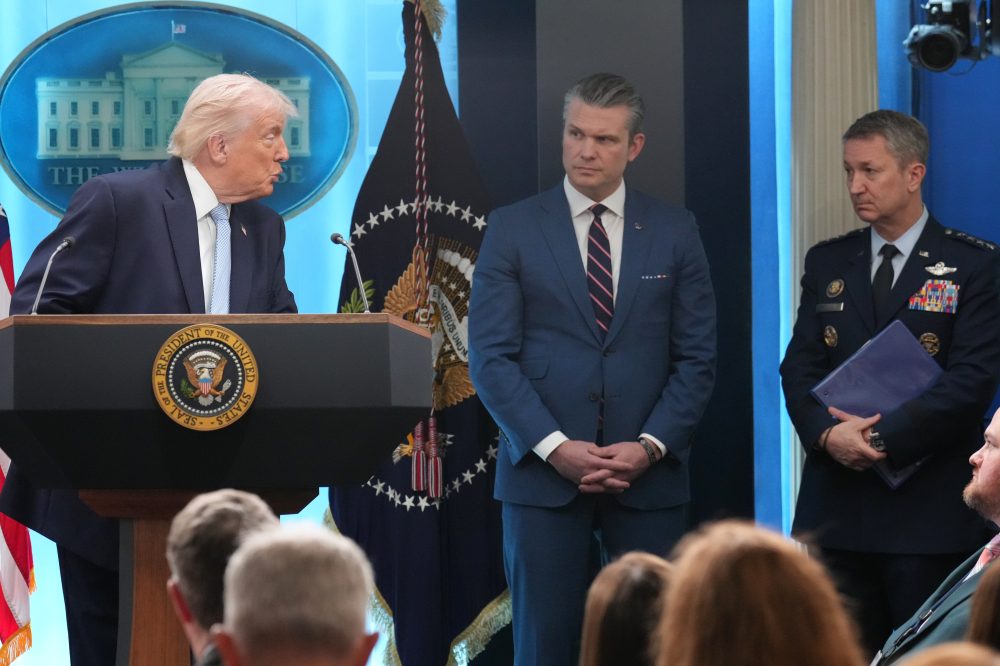

WASHINGTON — President Donald Trump provided extensive details Monday about a dangerous rescue operation that extracted two American airmen from deep within Iranian territory after their fighter jet was shot down last week.
The complex mission involved hundreds of military personnel, numerous aircraft, and advanced CIA surveillance technology to recover the crew of an F-15E Strike Eagle that went down late Thursday, Trump revealed during a White House press conference.
Military forces successfully extracted the pilot within hours of the aircraft being downed, deploying rescue helicopters, aerial refueling planes, and fighter jets into Iranian airspace once his position was confirmed, according to the president’s detailed account of the operation.
The aircraft’s second crew member — the weapons systems officer — was brought home nearly 48 hours after the initial crash.
Trump highlighted the extensive military assets deployed and inter-agency cooperation required for the dangerous mission to retrieve American personnel from hostile territory. He characterized Iran’s downing of the jet as “a lucky hit” while maintaining his previous claims of having “beaten and completely decimated Iran.”
The search and rescue efforts commenced during daylight hours over Iran, with helicopters and supporting aircraft flying at low altitudes for seven hours while “at times facing very, very heavy enemy fire,” Trump explained.
An A-10 Warthog attack aircraft maintaining communication with the downed F-15 pilot sustained enemy fire damage while engaging Iranian forces, according to Gen. Dan Caine, chairman of the Joint Chiefs of Staff.
The A-10 was “not landable,” Caine informed reporters, though the pilot continued combat operations before flying to a friendly nation and ejecting safely. The pilot was quickly recovered and is in good condition.
Following the F-15 pilot’s rescue, HH-60 Jolly Green II helicopters faced intense small-arms fire from Iranian forces, with “every single person in Iran who had a small-arms weapon” engaging the aircraft, Caine said. One trailing helicopter sustained multiple hits, causing minor injuries to crew members who are expected to recover fully.
The pilot, operating under call sign Dude-44 Alpha, was recovered before Iranian forces could organize a thorough search, but locating the weapons systems officer proved significantly more challenging.
Iranian state television affiliates broadcast appeals to residents in the mountainous southwestern region where the fighter crashed, urging them to turn over any “enemy pilot” to authorities and offering rewards for information.
The weapons systems officer, designated Dude-44 Bravo, sustained injuries but followed standard survival protocols by moving away from the crash location.
“Bleeding profusely,” according to Trump’s account, the airman navigated mountainous terrain and contacted rescue forces Saturday using “a very sophisticated beeper-type apparatus.”
“When a plane crashes in hostile territory, they all head right to that site, you want to be as far away as you can,” Trump explained.
CIA Director John Ratcliffe credited the agency’s “exquisite technologies that no other intelligence service” possesses for locating the missing airman. Simultaneously, the CIA conducted deception operations to mislead Iranian search efforts.
Ratcliffe compared the search and rescue mission to “hunting for a single grain of sand in the middle of a desert.”
While the CIA declined to specify the technology used, Trump provided additional context about the discovery process.
Intelligence personnel detected movement during nighttime surveillance in the mountainous search area, Trump said. Officials monitored the moving object for 45 minutes, questioning their assessment when movement ceased.
“It was the head of a human being,” the president revealed. “And then all of a sudden, 45 minutes later, he moved a lot, stood up, and they said, ‘We have him.’”
“And that was really at the beginning of something incredible,” he added.
Protected by an “air armada” including drones and strike aircraft, rescue teams moved in Sunday. Cargo aircraft transported three small helicopters that were assembled near the mountain area where the missing airman was hiding in a cave or crevice.
However, the cargo planes became too heavy with equipment and personnel to depart from the sandy terrain. The rescued airman and his recovery team were evacuated by three “lighter, faster aircraft” while ground equipment was destroyed to prevent Iranian capture, Trump detailed.
Many aircraft involved in the operation served deceptive purposes, the president noted.
“We were bringing them all over, and a lot of it was subterfuge,” Trump said. “We wanted to have them think he was in a different location.”
In Washington, national security officials maintained continuous coordination through an open phone line for nearly two full days.
“From the moment our pilots went down, our mission was unblinking,” Defense Secretary Pete Hegseth stated. “The call never dropped. The meeting never stopped, the planning never ceased.”
During Trump’s operational briefing, his tendency toward dramatic detail conflicted with his advisers’ preference for protecting military and intelligence information. When Trump asked Caine about total personnel numbers, his top military adviser responded cautiously.
“Uhhh, I’d love to keep that a secret, Mr. President,” Caine replied.
“OK, well, we are,” Trump continued. “But I will tell you — the number, I’ll keep it a secret, but it was hundreds.”