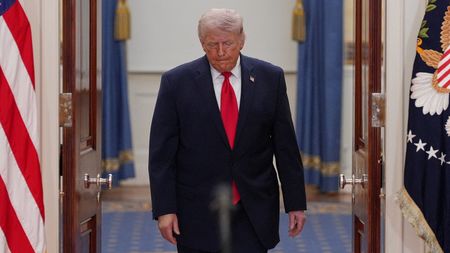

WASHINGTON – Internal discussions at the White House revealed that President Trump’s administration contemplated having him deliver a nationally televised speech about the Iran ceasefire agreement on Tuesday, but senior staff ultimately advised against the prime-time address, according to three federal officials who spoke with Reuters.
The choice reflects the administration’s delicate approach – attempting to demonstrate early optimism about the agreement that paused hostilities and reopened the Strait of Hormuz while simultaneously acknowledging the deal’s uncertain future. These conversations about a potential presidential speech had not been publicly disclosed before.
With negotiations scheduled to commence Saturday in Islamabad, experts question whether the temporary halt in fighting will lead to a permanent resolution of the conflict.
Anonymous sources indicated that Trump was persuaded not to deliver the address. However, the White House disputed these claims in an official response, stating: “This is fake news. This was never even discussed with the president.”
The officials requested anonymity when describing private White House conversations.
Instead of a formal address, Trump revealed the ceasefire through a social media announcement just hours before Tuesday’s deadline, after which he had promised to obliterate Iran’s entire society.
This dramatic policy shift represented one of the most abrupt wartime reversals by any American commander-in-chief.
According to one source, Trump strongly insisted on delivering the televised remarks. Officials explained that while the speech was being considered, the White House abandoned the plan due to lingering uncertainties about the ceasefire terms.
Senior advisers were still analyzing the agreement’s components and felt they lacked sufficient information for a presidential address to the nation, sources revealed.
On April 1, Trump had delivered a 19-minute evening broadcast to Americans, firmly defending his war strategy and announcing plans for intensive strikes against Iran over the following two to three weeks. A subsequent address would have provided an opportunity to explain his strategic reversal.
A senior White House official confirmed internal conversations about Trump speaking to the nation Tuesday evening.
“There was chatter about it, but obviously it didn’t come to fruition, and we didn’t alert the networks or anything; it didn’t get that far,” the official explained to Reuters, though they did not verify that Trump was discouraged from giving the speech.
The ceasefire has suspended American and Israeli bombing campaigns against Iran. However, it has not lifted the Strait of Hormuz blockade, which has created unprecedented global energy supply disruptions, nor has it stopped the separate conflict between Israel and Iranian-supported Hezbollah forces in Lebanon.
The waterway remained closed Friday, and Israel exchanged gunfire with Hezbollah in Lebanon – two ongoing issues that both the United States and Iran characterized as breaches of their ceasefire agreement just before their initial peace discussions.
Trump has expressed his anger publicly, posting that Iran was violating the agreement and declaring Friday: “The only reason they are alive today is to negotiate!”
Nevertheless, both nations are dispatching senior negotiators to Islamabad for discussions beginning Saturday. Vice President JD Vance will head the American delegation and stated Friday that the United States was prepared to negotiate honestly.
“If they’re going to try to play us, then they’re going to find the negotiating team is not that receptive,” Vance warned.
Experts emphasize the minimal trust existing between both parties, noting that Trump’s Tuesday threat that “a whole civilization will die tonight” unless his conditions were satisfied may have caused additional damage.
During his previous presidency, Trump withdrew from a 2018 nuclear agreement his predecessor had negotiated with Iran, then bombed Iranian nuclear facilities during 2025 negotiations. Trump initiated the current war against Iran on February 28, despite mediator Oman expressing optimism for a diplomatic resolution.
“So there’s a baked-in lack of trust that is going to confound any diplomacy going forward,” explained Justin Logan, who directs defense and foreign policy studies at the Washington-based Cato Institute think tank.
Pentagon officials state that American and Israeli operations have severely damaged Iran’s military capabilities for a generation. Yet analysts believe Iran will likely emerge as a persistent, long-term challenge for Washington: a diminished opponent with more extreme leadership and hidden reserves of weapons-grade uranium.
Tehran has also proven its capacity to block the Strait of Hormuz, providing significant influence over international energy markets and regional competitors, experts note.