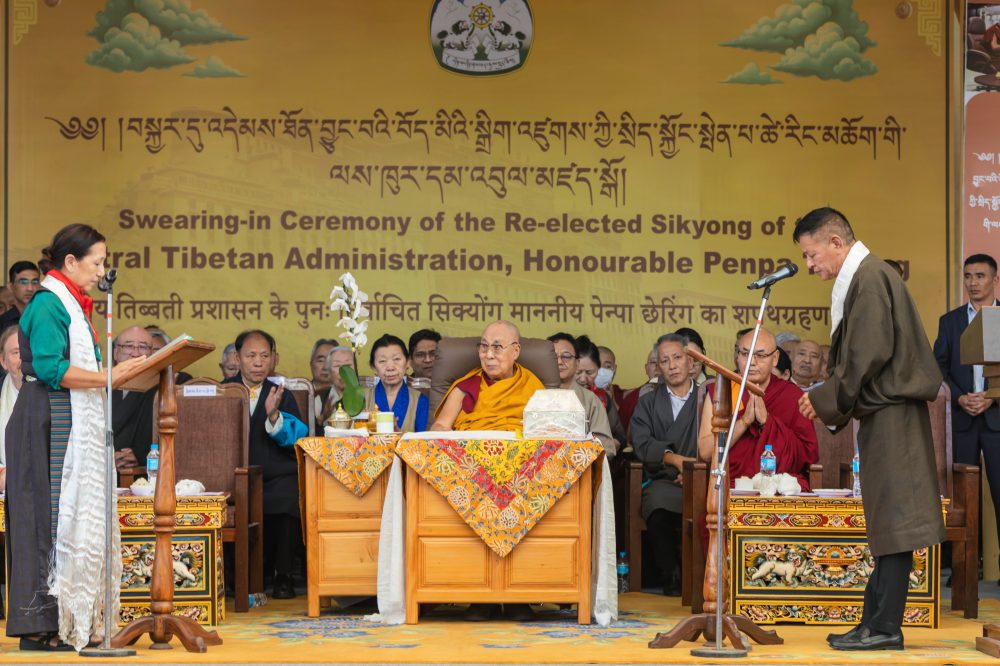

A leader of Tibet’s government-in-exile began his second consecutive term Wednesday after being inaugurated in Dharamshala, India, following his victory in elections earlier this year.
Penpa Tsering, age 58, has headed the exile administration located in Dharamshala since 2021. He won another five-year term during February voting among Tibetans residing in India and other countries. Tsering initially joined the Tibetan Parliament-in-Exile in 1996 and held the speaker position from 2008 before advancing to the chief executive role.
Established in 1959, the Tibetan exile government, currently known as the Central Tibetan Administration, operates with executive, judicial and legislative divisions.
During Wednesday’s ceremony, Tsering declared that the Central Tibetan Administration “remains firmly committed to the ‘Middle Way Policy’ envisioned by His Holiness the Dalai Lama,” explaining that this approach pursues resolution through nonviolence, dialogue and lasting mutual benefit.
“Until a resolution is achieved, we will continue the back-channel communications with caution and steadiness with the Chinese government,” he stated.
The inauguration ceremony occurred with the Dalai Lama present, who arrived at the location accompanied by red-robed monks while drums beat and prayers were chanted. Hundreds of monks and Tibetans watched as Chief Justice Commissioner Yeshi Wangmo of the Tibetan Supreme Justice Commission conducted the oath administration.
February’s election represented the fourth direct vote for Tibetan exile leadership since the Dalai Lama, Tibet’s spiritual leader, officially stepped back from administrative governance in 2011.
China maintains Tibet has belonged to its territory since the mid-13th century and the Communist Party has controlled the Himalayan area since 1951. However, many Tibetans claim they maintained effective independence throughout most of their history and believe the Chinese government seeks to extract resources from the region while destroying its cultural heritage.
China refuses to acknowledge the Central Tibetan Administration and has avoided discussions with the Dalai Lama’s representatives since 2010. India regards Tibet as Chinese territory while providing sanctuary to the Tibetan exile government.
Beijing claims the Dalai Lama wants to split Tibet from China, which he rejects. Certain Tibetan organizations support independence for Tibet, given minimal advancement in negotiations with China.
Yu Jing, a spokesperson for the Chinese Embassy in India, rejected the exile administration’s legitimacy on Sunday, declaring it was “not recognized by any sovereign country” and lacked authority to represent Tibetans or manage the Dalai Lama’s reincarnation process.
During his 90th birthday celebration last year, the Dalai Lama emphasized that Chinese officials would play no part in selecting his successor and the Dalai Lama institution would persist beyond his death.