
DUBAI, United Arab Emirates — Three tiny islands sitting where the Persian Gulf meets the Strait of Hormuz have taken center stage in the growing U.S. military campaign against Iran.
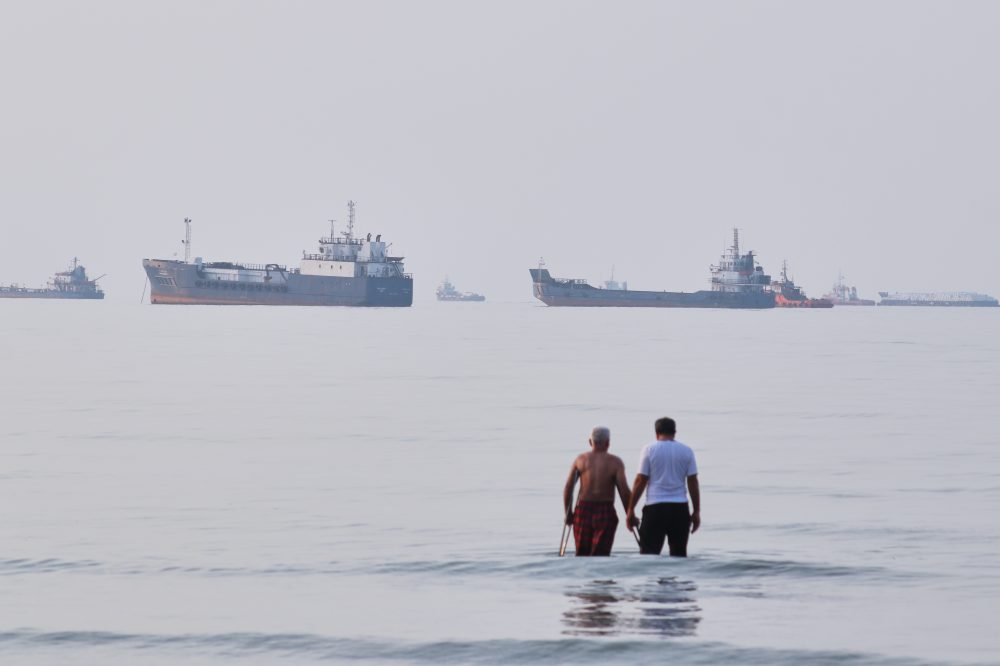
The islands — Abu Musa, Greater Tunb, and Lesser Tunb — were taken by force from what would become the United Arab Emirates back in 1971 by Iran. Since then, they have served as a military stronghold for Tehran, giving the country considerable influence over the strait, which carries one-fifth of the world’s oil and natural gas during peacetime.
Recent American military strikes targeting two of those islands have sparked fresh debate about who ultimately controls these disputed rocky outposts.
Combined, the three islands cover only about 10 square miles — roughly 25 square kilometers — yet their military and strategic value far exceeds their physical size. They sit directly along the deep-water shipping lanes connecting the strait and the Gulf.
Abu Musa, the largest of the three, has a small village but functions mainly as a base for Iran’s paramilitary Revolutionary Guard. The Guard has positioned fast attack boats and missiles there — weapons that have previously been used to threaten ships in the strait — along with air defense systems. Greater Tunb Island serves a similar military function, while the much smaller Lesser Tunb hosts only a military presence.
The strategic value of these islands has made them a prize sought by regional powers for generations.
Iran, at the time governed by Shah Mohammad Reza Pahlavi, seized the islands on November 30, 1971 — just two days before the United Arab Emirates officially came into existence. Because the shah was America’s primary security partner in the region at the time, there was little international objection.
After Iran’s 1979 Islamic Revolution, the islands became a launching point during the so-called “Tanker War” of the 1980s, when the U.S. Navy escorted oil tankers through the region under threat of Iranian attack. Iran used the islands to monitor the strait and send out vessels to lay mines or directly strike ships.
American estimates indicate Iran attacked more than 160 vessels during that conflict. In the current war, the Joint Maritime Information Center — a coalition overseen by the U.S. Navy — has recorded more than 50 attacks on ships and oil rigs, including some instances of U.S. forces firing on vessels accused of attempting to break its blockade of Iran.
As part of the recent escalation, the U.S. military has carried out strikes on both Abu Musa and Greater Tunb. Some military analysts have raised the possibility of an American ground invasion of the islands.
Isabel Oakeshott, a columnist for The Telegraph who now lives in Dubai, described the islands’ combined effect in stark terms: “Together they act as a layered denial system to the most critical energy chokepoint in the world.” She compared Abu Musa to “a fixed aircraft carrier” for Iran.
While analysts say capturing the islands would likely be within U.S. military capability — given that American paratroopers and Marines are already stationed in the region — holding them would present serious dangers.
Brandon Carr, an analyst with the Washington-based Quincy Institute for Responsible Statecraft, which advocates for restraint in U.S. military operations overseas, issued a stark warning: “Without prepared, hardened fortifications to provide cover — even with air support from nearby naval assets — force protection would be an enormous challenge.”
Carr added: “The Marines would come under fire from Iranian ballistic missiles and drones, severely limiting their ability to project power into the strait.”
In recent years, the United Arab Emirates managed to persuade both China and Russia to include language in joint statements calling for the island ownership dispute to be resolved through negotiations or an international court. That diplomatic effort angered Tehran, though the broader international community largely paid little attention to the matter.
Emirati legal scholar Noora Mohamed Al Murry addressed the long-ignored dispute in April, writing: “What the world called a bilateral territorial dispute was, from the beginning, a strategic claim on a global chokepoint.” She added: “Managed ambiguity, in a waterway this consequential, is not a neutral position. It is a choice with a price, and the world is now holding the invoice.”
Columnist Oakeshott predicted that the UAE — which hosts American military forces and has itself come under Iranian fire during the conflict — would likely push to reclaim the islands once the fighting ends.
The current U.S. military campaign may finally force a resolution to a dispute that has simmered for more than five decades — ever since the late shah himself warned in 1971 that the strait could become a problem for the world. “It does not take a big boat to carry a bazooka and a few shells,” the shah told The Guardian newspaper that year. “But the trouble that it could cause is tremendous.”