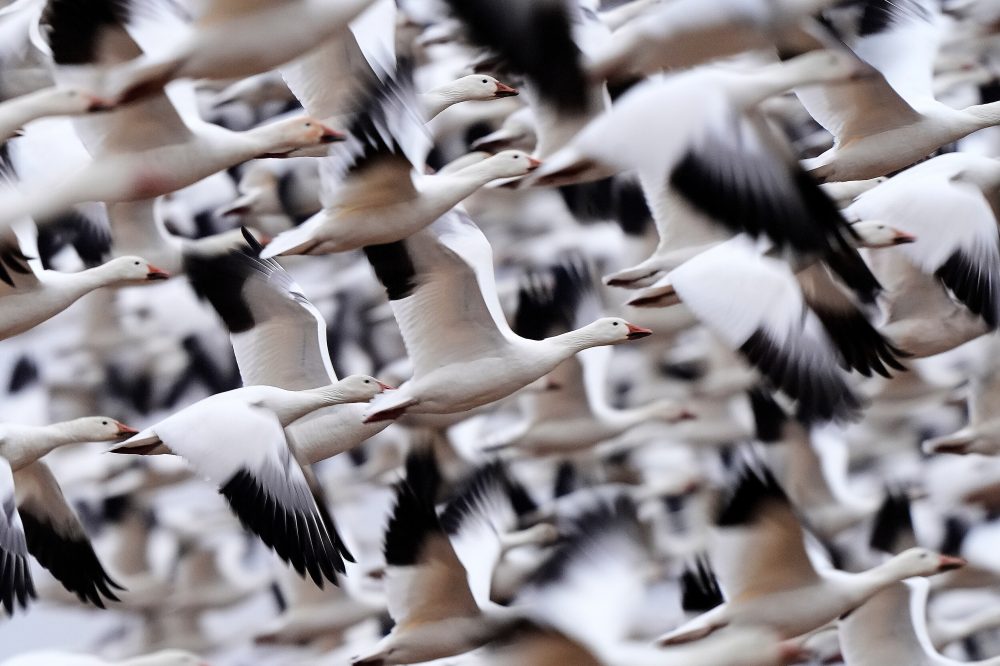

KLEINFELTERSVILLE, Pa. — Bird enthusiasts assembled in the early morning hours to witness an extraordinary spectacle as thousands of snow geese prepared to continue their northward migration from a Pennsylvania wildlife area.
The breathtaking moment unfolded roughly one hour past sunrise when the massive flock suddenly ceased their calling and grooming to launch skyward from the reservoir. The stunning aerial show lasted only minutes as the birds made several passes overhead before departing toward nearby agricultural areas to forage for leftover crops and nourishment during their remarkable spring journey toward New York and Quebec.
The reservoir was constructed five decades ago specifically to draw waterfowl, and the visiting flocks have expanded significantly over time. Payton Miller, an environmental education specialist with the Pennsylvania Game Commission, characterized the sight as a noisy avian whirlwind rising from the water’s surface.
“All it takes is for me to come out here on a really nice morning where there’s a huge morning flight and I’m kind of reminded how awesome it is to see such a large number of such a beautiful bird,” Miller said. “I never get sick of it.”
Adrian Binns, a safari guide from Paoli, Pennsylvania, was among the observers at the Middle Creek Wildlife Management Area seeking “the whole enjoyment of seeing something you don’t see every day.”
Snow geese populations at the 6,300-acre Middle Creek facility have swelled since the late 1990s. During this season, the birds have completed months along the Atlantic coastline, stretching from New Jersey down to the Carolinas, with many having wintered on the Delmarva Peninsula surrounding the Chesapeake Bay.
Their visit to Middle Creek is brief — serving merely as a rest stop during their trek to summer nesting areas in the Canadian Arctic and western Greenland. However, during their short stay spanning several weeks, they become Middle Creek’s primary draw, attracting roughly 150,000 annual visitors, including approximately 1,000 hunters.
The Pennsylvania Game Commission, which manages Middle Creek, reports that around 100,000 snow geese used the area as roosting habitat on the peak day last year, matching recent high activity levels but falling short of the single-day record of approximately 200,000 birds recorded on February 21, 2018.
While snow geese populations remain healthy, their substantial numbers have created challenges. Research published by Springer Nature in 2017 showed greater snow geese populations expanded from roughly 3,000 birds in the early 1900s to approximately 700,000 by the 1990s. Current estimates suggest about one million of these birds exist today, alongside perhaps 10 million lesser snow geese, a smaller variety that also nests in Arctic regions.
Migrating tundra swan numbers at Middle Creek have similarly grown over the decades, climbing from about a dozen in the mid-1970s to 5,000 or more in recent years. Birdwatchers at Middle Creek have documented over 280 species at the location, including bald eagles, northern harriers, ospreys and owls.
The dramatic increase in snow geese populations in recent decades has created complex challenges for wildlife managers in both the United States and Canada, who must balance hunting policies, agricultural damage concerns, shifting migration routes and changing winter habitat preferences. Excessive grazing damage in Arctic environments has led scientists to determine the species has become overabundant.
David M. Bird, a wildlife biology professor at McGill University, called the population “probably one of the biggest conservation problems facing wildlife biologists in North America today.” Snow geese forage by uprooting entire plants, which destroys habitat for their own species as well as other birds and wildlife.
The Pennsylvania Game Commission recently noted that avian influenza strains, detected in the state since 2022, remain active among wild bird populations. Officials have requested public assistance in reporting sick or deceased wild birds and noted that approximately 2,000 wild bird carcasses — primarily snow geese — required removal from a quarry several miles north of Bethlehem during December and January.
Bird explained that snow geese represent different things to different groups: nature enthusiasts find them magnificent while farmers view them as destructive pests. Hunters consider them a food source while animal welfare advocates believe they need protection.
“But if you are a paid professional wildlife manager at a municipal, state or federal level whose challenging job is to try to please all of the aforementioned parties, then you will undoubtedly experience many sleepless nights in the fall when the geese arrive,” Bird said.