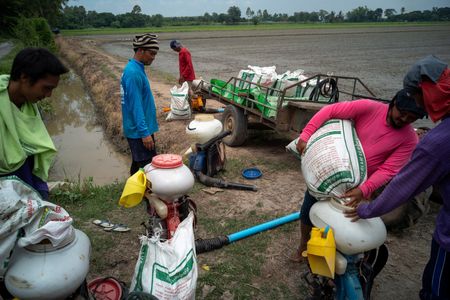

BANGKOK, June 11 – Before Thailand’s February general election, political candidates frequently visited farmers like 69-year-old rice grower Chaon Taiupok in Ayutthaya, located approximately 80 kilometers north of Bangkok.
“Once they won and formed the government, they disappeared,” said Chaon, who faces financial hardship as increasing fuel and fertilizer expenses caused by the Iran war, combined with declining rice prices, devastate agricultural workers.
Thailand’s retail diesel costs jumped over 60% at their highest point due to the conflict, while fertilizer expenses have climbed more than 30%.
“The government is not tackling the problem,” Chaon said.
Chaon’s frustration illustrates the mounting political danger facing Prime Minister Anutin Charnvirakul, who secured an overwhelming electoral win with rural voter support but now confronts pressure as war-related price increases worsen Thailand’s agricultural debt emergency.
Just months into the four-year administration, public backing for Anutin’s government is already declining.
Approximately 57% of participants in a Suan Dusit University poll conducted in May reported having minimal or no confidence in the government’s capabilities, a dramatic shift from March when 68% of respondents expressed hope.
“The government will roll out further measures to support people and boost confidence in its work,” said deputy government spokesperson Ploythalay Laksameesaengjan, noting that elevated oil costs driven by the war were outside the administration’s influence.
Thai farmers’ difficulties highlight the wider challenges affecting Southeast Asia’s second-biggest economy, which has battled sluggish expansion.
Thailand has also fallen behind regional competitors since the pandemic due to its dependence on slowly recovering tourism while internal consumption stays weak, limited by elevated household debt. Almost 78% of May poll participants demanded immediate action regarding increasing living expenses.
‘CRISIS OF CONFIDENCE’
Finance Minister Ekniti Nitithanprapas has already characterized the circumstances as a “cost-of-living crisis,” recognizing the mounting pressure on regular families.
Nevertheless, following years of stimulus spending, the government’s budgetary policy choices are restricted, while inflation is expected to exceed the Bank of Thailand’s 1% to 3% target this year, as the central bank has maintained its primary interest rate at 1%.
Total household debt in Thailand reaches 86.7% of gross domestic product, ranking among Asia’s highest levels, showing weak income growth, previous easy credit access and economic disruptions, reducing government stimulus effectiveness.
To alleviate difficulties, Anutin’s government has implemented support programs and initiated a 176-billion-baht ($5.4 billion) consumer subsidy initiative, part of a broader 400-billion-baht borrowing measure facing legal opposition from rival parties.
Even focused government programs, including subsidies of roughly 1,000 baht ($30) per rai (0.16 hectares) for rice farmers, have barely countered rising fertilizer and fuel costs, as they fail to cover farmers’ expenses, said Pramote Charoensilp, president of the Thai Agriculturists Association.
“The pressure on the government is not just economic,” said Ngamprawan Ehsomnuk, dean at Suan Dusit University’s school of law and politics.
“It’s a crisis of confidence in whether the government can govern effectively.”
‘NOTHING LEFT BUT DEBT’
For many people, including 64-year-old Ayutthaya rice farmer Phayong Saengthong, the present circumstances seem impossible to overcome.
Following decades of agricultural work, Phayong owes over 1 million baht ($30,628) to creditors. The increasing fertilizer and fuel expenses, worsened by poor rice prices, created an additional 200,000 baht ($6,125) in losses following his recent harvest.
Thai rice values dropped last year, with export prices reaching an 18-year low, primarily because of abundant global supply and fierce competition from India.
“The debt is overwhelming,” Phayong said.
He faces this challenge alongside many others. Over half of the 3.73 million farm borrowers at the state-owned Bank for Agriculture and Agricultural Cooperatives are caught in a “debt trap” they will probably not escape before retirement, according to an April report from the central bank’s research institute.
With official loans depleted, Phayong said he depends on suppliers to provide him credit.
“If they stop giving me goods on credit, I may have to stop growing rice,” he said, reflecting the concerns of many among the approximately 4.6 million rice farming households throughout rural Thailand who expected greater government aid.
“There are no clear measures to help farmers,” said Pramote, who intends to advocate for stronger support at a national rice policy board meeting on Thursday.
If paddy prices moved closer to 10,000 baht ($306) per ton, compared to approximately 7,800 currently, farmers might still discover an escape route, said Chaon, who cultivates 72 rai (11.5 hectares) of land in Ayutthaya and owes the state lender roughly half a million baht.
“With costs so high and rice prices so low, there’s nothing left but debt,” he said.
($1 = 32.81 baht)