
WASHINGTON – The concept of astronauts enjoying hummus on the moon may not be as outlandish as it sounds. Researchers have achieved a breakthrough in space agriculture by successfully cultivating chickpeas in artificial lunar soil, bringing us closer to the goal of astronauts producing their own food during extended lunar missions.
The study demonstrated that edible chickpeas could be grown in soil compositions made primarily of simulated moon material, based on lunar samples brought back during NASA’s Apollo missions over 50 years ago.
At Texas A&M University, scientists cultivated a chickpea variety called “Myles” within a controlled growing environment. The seeds received a coating of beneficial fungi before being planted in a combination of artificial lunar soil created by Florida company Space Resource Technologies and vermicompost, a nutrient-dense material produced through earthworm decomposition of organic matter.
The experiment showed successful chickpea harvests in soil compositions containing up to 75% lunar simulant material. While higher concentrations of the simulated moon soil – called regolith – resulted in fewer harvestable chickpeas, the individual chickpea sizes remained consistent. However, seeds planted in pure lunar simulant could not produce flowers or seeds and died prematurely.
Both the United States and China are preparing to return astronauts to the lunar surface in upcoming years, with plans for establishing permanent moon bases.
“Chickpeas are high in protein and other essential nutrients, making them a strong candidate for space crop production,” said Jessica Atkin, a doctoral candidate and NASA fellow at Texas A&M’s Department of Soil and Crop Sciences, lead author of the research published on Thursday in the journal Scientific Reports.
Developing local food production capabilities is essential for sustaining personnel at moon bases, given the impracticality of shipping all necessary food supplies from Earth.
“In our goal toward establishing a lunar presence – or one on Mars – we will need to learn how to grow food on the moon, since it will not be sustainable to ship food in spaceships. This is because it is still quite expensive to ship things to space, so weight is a factor, and also because the survival of astronauts on the moon can’t be dependent on the timely shipment of supplies,” said study co-author Sara Oliveira Santos, a postdoctoral researcher at the University of Texas Institute for Geophysics.
“Plants would also help produce oxygen and enhance life-support systems for future human settlements,” said astrobiologist Jyothi Basapathi Raghavendra of Northumbria University in England, lead author of a second study published on Thursday that examined growing conditions for microbes in simulated Martian soil.
Lunar soil consists essentially of pulverized rock and dust particles, frequently sharp and glass-like in texture, created over billions of years through meteorite collisions. Although it contains necessary nutrients and minerals for plant growth, it lacks organic matter and remains hostile to life, unlike Earth’s nutrient-rich organic soil.
“Previous studies have shown plants can germinate in authentic lunar samples or grow in regolith simulants, often by adding compost or other types of organic matter,” Atkin said. “In this study, we focused on microorganisms. Instead of only adding organic material, we tested whether plant-microbe partnerships could help condition regolith, improve its structure and reduce plant stress.”
WHAT ABOUT THE TASTE?
The flavor of these space-grown chickpeas remains unknown for now.
“The chickpeas are currently being tested for metal accumulation, which is why we haven’t eaten them just yet,” Atkin said.
Both actual lunar regolith and the artificial version used in the research contain elevated concentrations of metals including aluminum and iron. While iron serves as a vital plant nutrient, aluminum does not and can be harmful when ingested.
“Before anyone makes moon hummus, we need to confirm they are safe and nutritious. Those results will be published in a follow-up paper later this year,” Atkin said.
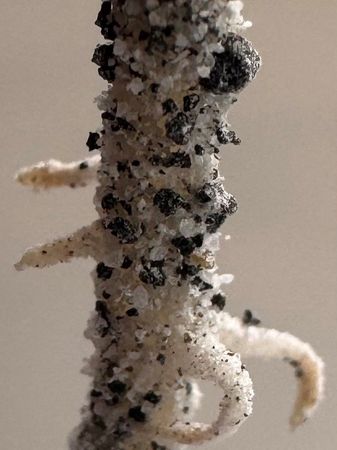
The fungal coating applied to the seeds formed a beneficial relationship with the chickpeas, assisting the plants in absorbing crucial nutrients while limiting their intake of harmful heavy metals. These microorganisms successfully established themselves on plant roots even in pure regolith simulant and helped bind loose particles together, making the regolith behave more similarly to Earth soil.
The research team added some levity to their laboratory work. Atkin played moon-themed music including Creedence Clearwater Revival’s “Bad Moon Rising” to motivate the plants. She also displayed an image of chickpeas growing on the lunar surface.
“Kind of silly, but something to aim for,” Atkin said.
“This is a small first step toward growing crops on the moon,” Oliveira Santos said, “but we have shown this is feasible and we are moving in the right direction.”