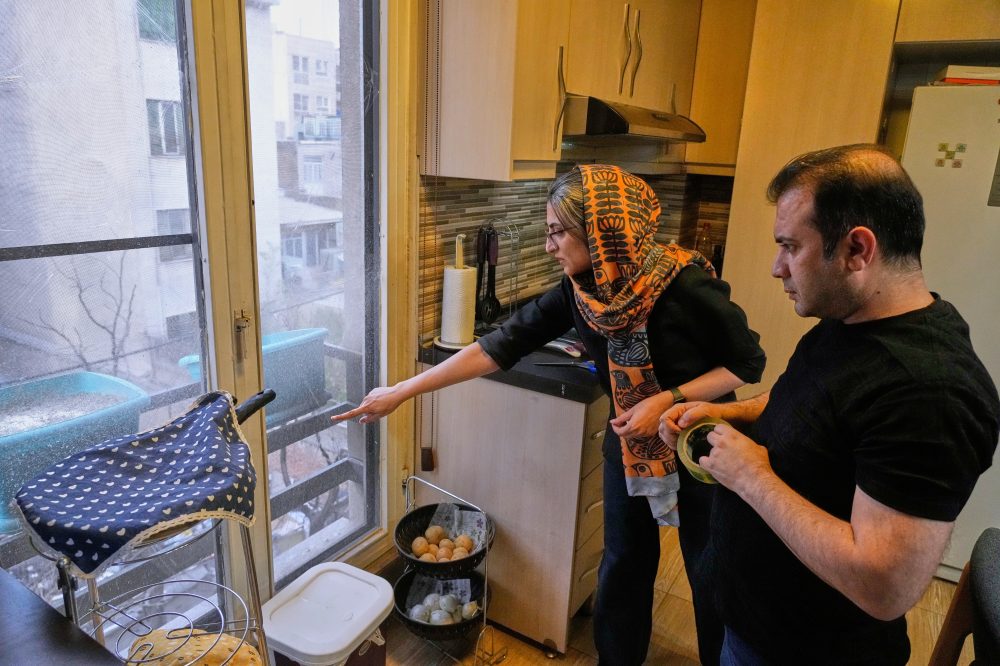

DUBAI, United Arab Emirates (AP) — From their apartment balcony overlooking Iran’s capital, Zahra Arghavan and Mehdi Alishir watched the evening sky while preparing themselves for the possibility of incoming strikes.
With President Donald Trump’s newest deadline approaching, the couple faces troubling questions: What happens if electrical facilities get hit and the lights go out for days? How would they escape Tehran if bombing destroys the city’s bridges?
After five weeks of conflict, the pair has adapted to the thunder of U.S. and Israeli military aircraft overhead, the rumble of explosions, and nights without rest. Similar to many residents, they’ve evacuated and returned to the capital multiple times seeking security. The married couple of more than ten years survived both the coronavirus outbreak and last June’s nearly two-week conflict.
They’ve applied transparent tape along their window frames as protection from potential blast damage. Glass items and breakable decorations have been relocated or fastened down. An emergency bag containing important papers, medicine and necessities sits ready for rapid departure.
During a profanity-filled warning this past weekend, Trump declared that “Tuesday will be Power Plant Day, and Bridge Day,” threatening that Iranian officials will be “living in Hell” unless they reopen the Strait of Hormuz.
“Honestly, the situation is really unclear,” Arghavan said. “We don’t really understand things like how long the power might go out if it does, or what life without electricity would even look like.”
Alishir explained that he and his spouse could manage without electrical power — and possibly without water service — for about seven days maximum. “If it goes on longer, we’ll definitely run into problems,” he said.
Their difficulties started before the initial American and Israeli attacks hit Iran on February 28.
Tehran’s response to January’s nationwide demonstrations included severe internet restrictions. According to NetBlocks, an organization that tracks online connectivity, this represents the most extended countrywide internet blackout on record.
Arghavan operates a small educational business teaching French language skills to Iranian citizens planning to relocate to Quebec, Canada.
“We were basically an online school, and our students had classes with kids abroad,” she said. “Around 50% of our learners were outside the country. But now, with all these internet outages, it’s really disrupting our work.”
Iranian citizens remain split regarding the conflict: Some participate in daily government-supporting demonstrations, while others privately support military action against their leadership despite opposing civilian casualties and infrastructure destruction.
The couple holds Israel and the United States responsible for initiating the conflict and hopes diplomacy will prevail.
“I really hope an agreement is reached soon and that whatever happens, it ends up helping people, because right now people are the ones paying a heavy price,” Arghavan said.