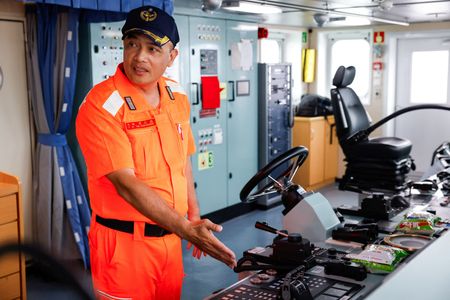

In the rough waters of the Taiwan Strait, a coast guard officer named Yeh Chih-sheng boards his patrol vessel carrying something beyond standard equipment — temple charms blessed by deities long revered by seafarers for protection on the water.
Yeh serves as first mate aboard the CG1005, a 2,400-ton vessel stationed in Taiwan’s Penghu islands. His ship stands as part of Taiwan’s maritime defense line as China continues to press its claim of sovereignty over the democratically governed island.
When he’s not on duty, Yeh takes on a very different role — that of an assistant priest, known in Taiwanese as a “sio-huat,” at a Penghu temple dedicated to the Five Lords, guardian deities traditionally worshipped by coastal communities for calm seas and protection from disease.
Yeh’s connection to these deities goes back to his childhood, when he began assisting spirit mediums during religious rituals in which gods are believed to come down from the heavens and offer guidance.
“The Coast Guard is a tangible backing people can see,” Yeh said. “The Five Lords are a spiritual anchor in people’s hearts. Both help bring fishermen and ordinary people a sense of reassurance.”
That combination of professional duty and personal faith has grown increasingly meaningful for Yeh as China ramps up military pressure on Taiwan. Beijing has not ruled out using force to bring Taiwan under its control, while Taipei firmly rejects those territorial claims — including China’s assertion that it has the right to conduct “law enforcement” patrols in Taiwanese waters.
The situation has drawn concern from the United States and some of its allies, who said last week that recent Chinese operations off Taiwan’s eastern coast posed a threat to regional stability. China’s defense ministry pushed back on Thursday, calling its coast guard patrols “lawful, legitimate and necessary.”
Reuters was given rare access to Yeh’s ship while it was anchored in Penghu, an island chain sitting in the Taiwan Strait — a critical waterway through which billions of dollars in trade flows annually.
Yeh described a changed reality at sea, saying Chinese warships and coast guard vessels now regularly cross what was once an informal dividing line — the median line — and come close to Taiwan’s 24-nautical mile contiguous zone.
“They have already erased the median line,” Yeh said. He added that his mission is to monitor and warn off Chinese vessels using tools like water cannons, loudspeakers, LED display boards, and radio communications, rather than escalating confrontations.
He said he follows the coast guard’s guiding principle of “not provoking and not yielding,” and he takes talismans and ceremonial command tablets from the temple with him whenever he goes out on patrol.
Standing near the temple’s Chienchiu Paochien — a ceremonial divine boat — Yeh drew a parallel between the sacred vessel and his coast guard ship, saying both exist to guard the Taiwan Strait and shield fishermen and everyday people from harm.
“What we protect is people’s sense of safety and peace of mind,” Yeh said. “With the coast guard and navy there, people can live normally.”