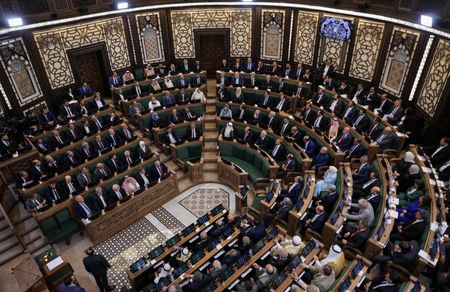

DAMASCUS — Syria’s newly established parliament held its first-ever session on Sunday, a landmark moment in the nation’s ongoing political transition that came roughly 19 months after rebel forces led by President Ahmed al-Sharaa brought down the government of Bashar al-Assad.
Speaking before lawmakers gathered in Damascus, Sharaa urged the body to “make this council a model of responsibility and competence” and called it “a platform for truth and justice.”
“Syria is writing a glorious history that reflects its heroism, and we face the responsibility of building both the nation and the individual,” Sharaa said.
The opening of parliament has been widely viewed as a test of Sharaa’s commitment to establishing an inclusive political system in a country that was governed as a police state under the Assad family for decades. Under Assad, the legislative body was widely regarded as little more than a rubber stamp.
The 210-seat chamber was assembled under interim governing rules. Two-thirds of its members were selected last year through regional electoral colleges, while Sharaa personally appointed the remaining third on July 1. Officials have defended this approach, arguing that years of armed conflict left millions of Syrians displaced and made it impossible to rely on accurate population data or voter registration records.
Critics, however, contend the process gives the executive branch significant influence over who sits in the legislature.
Sharaa has said he supports moving toward general elections once the country’s infrastructure and documentation systems are capable of supporting them.
A temporary constitutional declaration introduced in 2025 granted the parliament limited authority. Notably, the government is not required to secure a parliamentary vote of confidence. The assembly does have the power to propose and pass legislation. It holds a 30-month renewable term and will serve as the country’s legislative authority until a permanent constitution is adopted and elections are organized.
Women account for about 10 percent of the chamber’s membership, with 21 female lawmakers seated — 15 of whom were among those directly appointed by Sharaa. He formally cut ties with al Qaeda in 2016, though he was previously affiliated with the militant group.
Since taking power, Sharaa has worked to build relationships with Western nations and has pledged a new era of freedoms for Syria. His first year in office, however, was marked by several outbreaks of violence between pro-government fighters and members of minority communities.
Authorities have not released a detailed breakdown of lawmakers by ethnic or religious background. Unofficial counts suggest that 10 of the seats filled last year went to members of minority groups, including Kurds, Christians, and Alawites — the religious sect to which Assad belongs.
Four seats currently remain vacant: one lawmaker has died, and three seats set aside for the predominantly Druze province of Sweida have not yet been filled. Officials say the selection of representatives for Sweida has been delayed until “conditions become suitable.” The region has been outside government control since clashes between government-aligned fighters and Druze residents last July, a conflict that the United Nations says claimed approximately 1,700 lives.