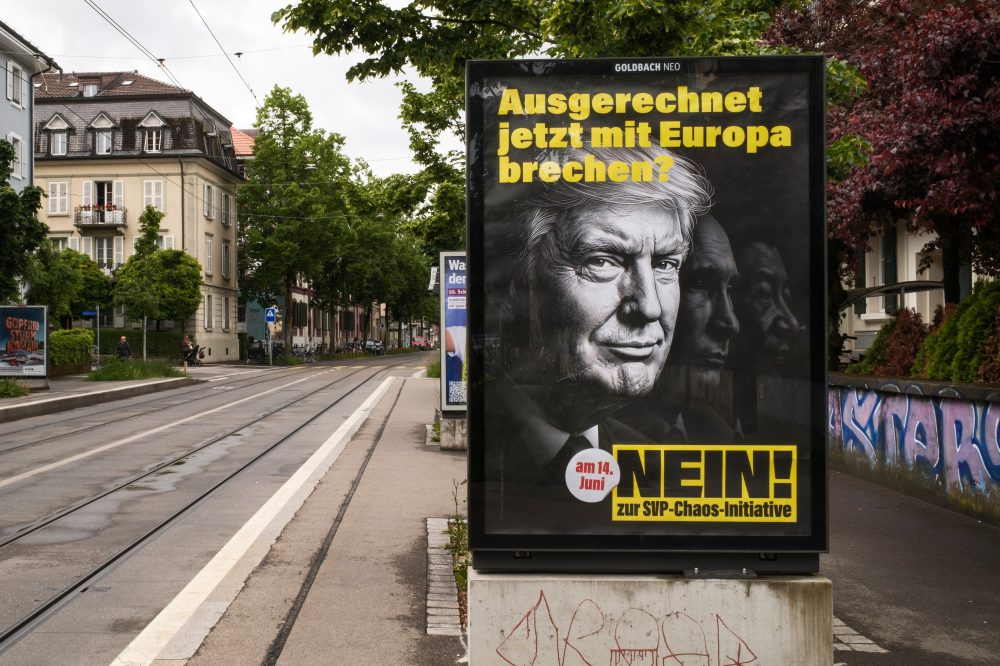

GENEVA — Swiss citizens face an historic decision this Sunday as they vote on an unprecedented measure that would place a ceiling on the country’s population, representing the latest effort by conservative politicians to restrict foreign immigration to the wealthy Alpine nation.
The nationwide referendum asking whether to limit Switzerland’s population to 10 million people in the coming decades will conclude with in-person voting on Sunday. Switzerland’s democratic system allows citizens direct input on policy decisions through ballot measures conducted four times annually.
The populist Swiss People’s Party, which holds the largest number of parliamentary seats and has long promoted isolationist policies in Switzerland, supports the measure.
Polling data from the gfs.bern agency indicates the outcome may be decided by a narrow margin.
Those backing the initiative oppose the arrival of expatriates from nearby European Union nations, claiming that Swiss infrastructure, housing, social services, natural resources and quality of life have suffered due to population increases.
Opponents argue approval would harm the country’s interests, contending that Switzerland gains from stronger EU relationships and receives essential workers, knowledge and expertise from foreign nationals in industries including healthcare, finance, pharmaceuticals and technology.
Both the federal government and Parliament reject the proposal. EconomieSuisse, a prominent Swiss business organization, condemned it as an “absurd proposal” that endangers Switzerland’s security and economic well-being.
Bernard Bapst, a People’s Party legislator from the Fribourg region and former customs official, dismissed security concerns and claimed “various forms of criminality” have increased since Switzerland implemented open-border policies.
Following the 2002 relaxation of border restrictions between Switzerland and the EU for citizens living and working across boundaries, the Swiss population has expanded by 23% to 9.1 million by the end of last year. Economic production has similarly risen by 24% during this timeframe, according to government statistics.
“We are the victim of our own success,” said Reto Föllmi, a professor of international economics at the University of St. Gallen in northern Switzerland.
Approval would mandate government action to establish a 10 million population ceiling by 2050. Should the population reach 9.5 million beforehand, authorities would need to implement limits on asylum, family reunification and residency permits, potentially requiring the elimination of Switzerland’s EU free movement agreement entirely.
Due to the extended timeline, analysts suggest immediate economic and demographic consequences would be minimal.
Rene Schwok, a political science professor at the University of Geneva, warned that approval would damage Switzerland’s relationship with Brussels and create uncertainty for foreign investment, noting the EU serves as the country’s primary trading partner.
The 38-member Organization for Economic Cooperation and Development reported Switzerland’s foreign-born population at 32% in 2024, ranking third behind Luxembourg, where over half of residents were born abroad, and Australia.
Immigration has remained a contentious topic across Europe as nations address aging populations and growing anti-foreigner attitudes. Unlike other European countries where such sentiment focuses on developing world migrants, most foreign residents in Switzerland are Europeans.
Swiss voters have addressed immigration through multiple referendums over five decades. Only the 2014 “Against mass immigration” measure narrowly succeeded, following campaigns that raised concerns about overpopulation and increasing Muslim populations.
Philippe Wanner, a demography expert at the University of Geneva, noted no nation has previously voted to restrict its population, though countries like China have implemented population control policies.
Etienne Piguet, a professor at the Institute of Geography at the University of Neuchatel, observed that many countries do limit immigration.
The debate has persisted for decades in Switzerland.
Around 2000, as anti-immigration sentiment grew in Switzerland, then-President Adolf Ogi declared: “We live from foreigners … we need laborers for tourism … we need intelligent people in Switzerland.”