
Financial markets rallied sharply Wednesday morning after news broke of a temporary ceasefire agreement between the United States and Iran, providing relief to investors who had been watching escalating tensions in the Middle East for more than a month.
The diplomatic breakthrough was announced Tuesday evening, coming just hours ahead of a deadline set by former President Trump, who had threatened devastating strikes against Iranian civilian infrastructure unless Tehran reopened the crucial Strait of Hormuz shipping corridor.
Markets worldwide responded enthusiastically to the news. Major stock indexes across Asia and Europe surged between 4% and 5%, while oil prices plummeted 16% to approximately $90 per barrel as traders anticipated the restoration of Middle Eastern energy shipments. The dollar, which had attracted safe-haven investment during the crisis, dropped 1% against the Japanese yen.
For weeks, investors have been dealing with the uncertainty of the ongoing conflict, complicated by mixed signals from both sides. While Trump had hinted at potential diplomatic solutions on multiple occasions, Iranian officials had consistently rejected reports of any negotiation efforts.
The extended conflict and resulting spike in energy costs had raised concerns about potential damage to economic growth and complications for Federal Reserve policy decisions. The S&P 500 experienced its worst monthly performance in a year during March.
Wednesday morning saw Treasury bond yields decline, reflecting changing expectations about interest rates. Current futures markets indicate investors now anticipate the Federal Reserve will maintain current borrowing costs throughout the year, based on data compiled by LSEG.
Prior to the conflict, market participants had expected at least two quarter-point rate reductions this year. However, inflation worries during the crisis had shifted expectations toward a possible rate increase at one point last month.
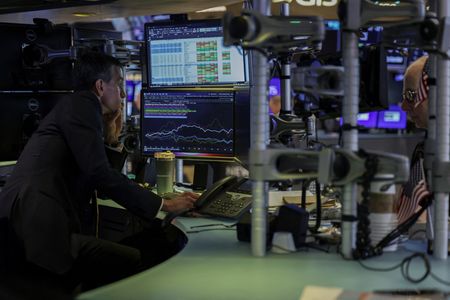
Early Wednesday trading showed significant gains across major indexes. Dow E-mini futures climbed 1,083 points or 2.31%, while S&P 500 E-minis advanced 168.5 points or 2.53%. Nasdaq 100 E-minis posted gains of 790.5 points or 3.24%.
The Russell 2000 Index futures, which are particularly sensitive to interest rate changes, jumped 3.4%. Meanwhile, the CBOE Volatility Index, commonly known as Wall Street’s fear gauge, fell 4.8 points to reach its lowest level in over two weeks.