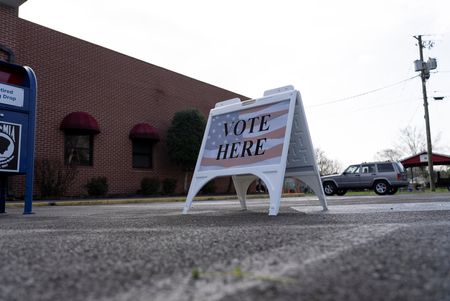

While the SAVE America Act appears headed for failure in Congress, nearly two dozen states have already enacted similar voting changes ahead of November’s midterm elections, according to a new Reuters analysis.
Twenty-three states, primarily under Republican leadership, have modified their election procedures to incorporate elements from President Donald Trump’s comprehensive voting restrictions proposal since 2024.
These state-level changes span from Wyoming to Georgia and include stricter proof-of-citizenship demands for voter registration and tighter controls on acceptable photo identification at polling locations.
A significant portion of these states – at least 17 – have adopted one of the federal bill’s most debated provisions: cross-referencing voter registration databases with a federal system typically used for verifying public benefits eligibility.
The Reuters examination found that while these state modifications generally fall short of the federal proposal’s strictest requirements regarding citizenship documentation and photo identification, they still raise concerns among voting rights organizations.
“Still have really serious impacts on voters,” said Danielle Lang, vice president for voting rights and the rule of law at the Campaign Legal Center, referring to the new state-level citizenship and photo ID mandates despite their less severe nature compared to Trump’s federal push.
Voting rights advocates worry these measures could prevent eligible citizens from participating in elections that will decide Republican control of Congress, particularly those lacking specific identification documents.
Senate Majority Leader John Thune, a Republican, made no reference to the SAVE America Act during his opening remarks when Congress returned to session Monday.
Trump signed an executive order in March targeting mail-in voting procedures, describing voter fraud in the United States as “massive” during the ceremony. However, legal challenges make it unlikely this order will be implemented soon.
Research by the bipartisan reform organization Issue One, examining a Heritage Foundation election fraud database, identified just 65 convictions for non-citizen voting from 2000 to 2025 among approximately 1.4 billion federal election votes cast.
The Heritage Foundation characterizes its database as a “non-comprehensive” collection of election fraud cases and did not respond to requests for comment.
The federal legislation’s headline requirement mandates documentary citizenship proof, such as passports or birth certificates, for federal election voter registration.
Among seven states implementing new citizenship verification requirements for November’s election, only New Hampshire matches the federal bill’s stringency.
Chris Diaz, legislative tracking director at the nonpartisan Voting Rights Lab, observed that most Americans already provide citizenship documentation when obtaining driver’s licenses or state identification, with the 2005 Real ID Act requiring states to maintain digital copies of such records.
“It just doesn’t make any sense for a state to not leverage the massive amount of information they already have about voters,” he said.
Diaz noted that most states recognize the federal proposal’s photo identification restrictions – limiting acceptable documents to unexpired U.S. passports, driver’s licenses, state IDs, military IDs, or tribal IDs – as unnecessarily limiting.
Of nine states tightening photo ID requirements for November, several permit student identification, expired documents, or any photo identification displaying the voter’s name. New Hampshire and Indiana represent exceptions, fully replicating the federal bill’s photo ID standards.
The provision most closely replicated by 17 states involves submitting complete voter registration lists to the Department of Homeland Security for screening through a system normally used for verifying citizenship or immigration status for benefit applications.
Election officials previously used this “Systematic Alien Verification for Entitlements” system only occasionally to investigate individual voters with questionable citizenship status.
The Trump administration expanded this system last year to incorporate additional personal data, including Social Security Administration information, while encouraging states to submit entire voter databases for non-citizen screening.
Six states have enacted legislation requiring periodic voter roll submissions to the DHS system, while election officials in 12 additional states have chosen to participate voluntarily.
Iowa’s screening process identified 277 non-citizens among 2.1 million registered voters, with 40 attempting to vote in 2024, according to the secretary of state’s office. Utah’s review flagged nearly 9,000 of 2 million voters for additional investigation, but manual verification found only one non-citizen, according to the lieutenant governor.
“The initial results of those searches mostly just prove that there’s nothing to see here, that there isn’t a problem to be fixed,” said Sean Morales-Doyle, director of the Voting Rights program at the Brennan Center for Justice.
A February investigation by ProPublica and the Texas Tribune revealed that Missouri and Texas officials incorrectly identified dozens of voters as non-citizens through the system, resulting in suspended voting rights or removal from voter rolls.