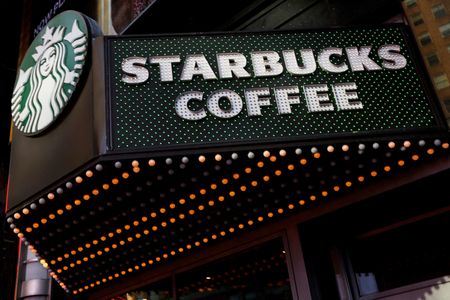

Starbucks stock surged 5% Wednesday following the coffee giant’s decision to increase its yearly projections, suggesting that Chief Executive Brian Niccol’s revival efforts are gaining momentum.
Since assuming leadership in September 2024, Niccol has worked to reinvigorate the coffee company through his ‘Back to Starbucks’ initiative. His approach has centered on streamlining menu options, reducing customer wait periods, boosting employee numbers, and implementing new store technology to better organize order processing.
Niccol reported that foot traffic grew among customers from every income bracket. He noted that economic concerns haven’t impacted shopping patterns, with strong sales performance extending into April.
Data from Placer.ai showed that typical visits to Starbucks stores jumped 5.9% during the first quarter of the year.
Stifel analysts commented that ‘The recovery is notable for its breadth, indicating the turnaround is structurally sound rather than dependent on a specific group.’
Following the second-quarter earnings report, no fewer than five investment firms increased their stock price predictions.
Morningstar analysts observed that ‘Starbucks drove U.S. spending growth across all income and age cohorts, which points to consumers’ appetite for on-trend innovation, even against a hazy macro backdrop.’
TD Cowen analysts highlighted that the company’s March overhaul of its loyalty program contributed to more frequent membership registrations, particularly among Generation Z and Millennial customers.
Despite revenue growth, North American profit margins dropped to 9.9% from the previous year’s 11.6%, reflecting higher workforce investments.
UBS analysts stated they are ‘increasingly focused on North America margins over the coming quarters,’ while noting that operational enhancements should begin yielding benefits, including improved service speed and cost reduction initiatives from the past year.
Starbucks stock has climbed approximately 15.5% year-to-date and currently trades at a forward price-to-earnings multiple of 36.08 times projected 12-month earnings.