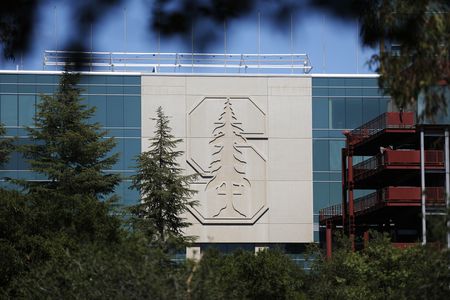

The College Football Players Association, an advocacy group for athletes that was established five years ago, announced Monday that Stanford football players have created the organization’s first chapter run by active players — marking an initial move toward what the group ultimately hopes will become a collective bargaining unit.
When it comes to who the athletes would eventually negotiate with, CFBPA founder and executive director Jason Stahl points to the conferences as the likely counterpart at the bargaining table.
“We are very optimistic that other chapters will be announced soon,” Stahl, who previously served as a faculty member at the University of Minnesota, told The Athletic.
After staying in contact with Stanford players for over a year, Stahl traveled to the school’s campus in Palo Alto, California, late last month and met with more than 50 players. The group voted to elect fifth-year offensive lineman Fisher Anderson and fifth-year linebacker Ernest Cooper as their player representatives.
Anderson pointed to the NFL Players Association as an inspiration for the effort. “We (at Stanford) have always had a pretty tight relationship with the NFL Players Association,” Anderson said on a podcast produced by the CFBPA, which was founded with a goal of organizing players from major colleges. “Last year when this opportunity came about, it made me think if this is something that has had such a benefit on the National Football League, could it be done on the college football level?”
Stanford third-year defensive lineman Benedict Umeh expressed a similar perspective. “Whenever I leave those meetings (with the NFLPA) I think, ‘Why don’t we have one of those?’” Umeh told The Athletic.
On the legislative front, a bipartisan measure called the Protect College Sports Act — introduced in May by Sens. Ted Cruz (R-Texas) and Maria Cantwell (D-Wash.) — is not expected to receive a vote before the congressional session wraps up in early August, according to The Athletic. The bill is designed to create antitrust protections and set national compensation standards for the NCAA and college conferences.
Without such legislation, leaders in college sports believe that direct collective bargaining with athletes could provide stability and help ensure compliance with antitrust laws without requiring government intervention.
Umeh acknowledged the bill’s potential but raised concerns about player input. “Standardization is necessary,” he said. “The congressional bill could serve toward that purpose, give us the legal scaffolding to get everything in place. The issue with a congressional bill, in my eyes, is the players don’t get much of a say at all.”
This is not the first attempt by college athletes to organize. Previous efforts have not succeeded, including a push by Northwestern football players in 2014 and a bid by the Dartmouth men’s basketball team in 2024.
Stahl was involved in a player-driven movement launched by Pac-12 athletes in 2020, and went on to found the CFBPA the following year. In 2022, he attempted to organize Big Ten athletes to push for improved long-term medical benefits and potentially a portion of conference revenue. That effort also stalled, despite making some headway, particularly at Penn State.
While schools have been permitted to pay athletes directly since 2025 as part of a revenue-sharing arrangement, the payments are technically classified as compensation for name, image and likeness — not pay for playing — and the athletes are considered independent contractors.
Umeh pushed back on that distinction. “The schools are paying us to play,” he said.
Because varying state labor laws could complicate a nationwide effort, Stahl said the CFBPA’s strategy is to have Division I players build local chapters and then bargain collectively with their individual conferences.
“College football players deserve a meaningful voice in the decisions that shape their athletic, academic and economic futures,” Stahl said. “Stanford football is the first of what the CFBPA envisions as 17 ACC football chapters, creating the framework for conference-wide player representation and, ultimately, collective bargaining.”