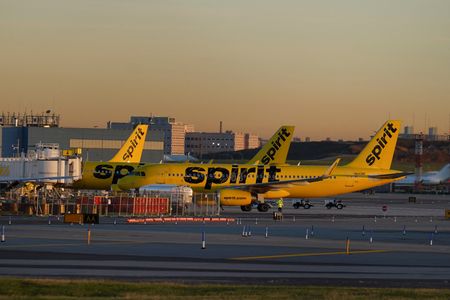

Spirit Aviation Holdings announced Friday its plans for a dramatic downsizing, revealing the budget airline will operate roughly one-third the number of aircraft it had before entering bankruptcy proceedings, according to new court documents.
The discount carrier has been actively marketing planes and seeking potential purchasers as it continues an extensive financial overhaul designed to reduce expenses and restore stability following two bankruptcy filings within 12 months.
When Spirit first sought Chapter 11 bankruptcy protection last August, the airline operated 214 planes. By October, the company had already eliminated approximately 100 aircraft through lease cancellations and aircraft retirements.
This week, a federal bankruptcy judge granted Spirit permission to begin auction proceedings for roughly 20 more planes from its current operating fleet of 114 aircraft. Friday’s announcement represents the next phase in the airline’s fleet reduction strategy.
“We are pleased to achieve another milestone that reflects the confidence our lenders and noteholders have in our future, with our plan better positioning Spirit to continue delivering value to American consumers,” Spirit’s President and CEO Dave Davis stated.
According to Friday’s court filing, Spirit intends to further decrease its fleet to between 76 and 80 aircraft by the third quarter of 2026, with the remaining planes primarily being Airbus A320 and A321ceo aircraft.
The restructuring plan calls for Spirit’s debt and lease commitments to drop to approximately $2 billion, down from $7.4 billion prior to the bankruptcy filing.
During a Wednesday court hearing, the airline cautioned that unpredictable fuel costs related to the Iran conflict have made negotiations for exiting Chapter 11 more challenging.
Spirit submitted both a restructuring support agreement and a proposed reorganization plan to the U.S. Bankruptcy Court for the Southern District of New York.
On Wednesday, U.S. Bankruptcy Judge Sean Lane authorized Spirit to proceed with bidding procedures featuring CSDS Asset Management as the initial “stalking-horse” bidder, establishing a baseline price of approximately $530 million while permitting other interested parties to submit higher bids through April 20.
During the hearing, Spirit’s attorney Marshall Huebner from Davis Polk & Wardwell explained that negotiations have extended beyond initial expectations partly due to fuel expenses becoming more difficult to predict amid geopolitical tensions surrounding the Iran war. This uncertainty has prompted creditors to question Spirit’s projected cash flow and liquidity estimates.
Judge Lane acknowledged these concerns as reasonable, observing that airlines face particular vulnerability to fuel price fluctuations caused by international events.
“Global uncertainty regarding fuel is just a fact of life for any airline,” Lane commented.
Huebner indicated Spirit is working toward confirming its Chapter 11 bankruptcy plan by late May or potentially June.
Moving forward, the airline plans to concentrate on its most successful routes and markets, which include Fort Lauderdale, Orlando, Detroit, and the New York City region.
Spirit also indicated it anticipates adding aircraft between 2027 and 2030 when profitable expansion opportunities arise, while planning to enhance its Spirit First and Premium Economy offerings by continuing the deployment of premium economy seating throughout its fleet.