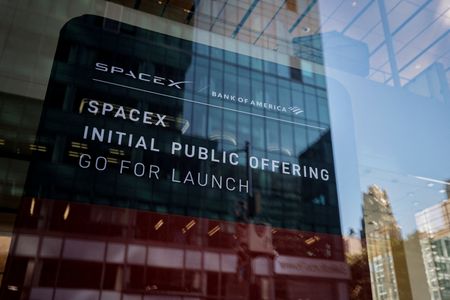

Elon Musk’s rocket and spacecraft company SpaceX achieved a historic milestone Thursday, completing the largest initial public offering in United States history by setting its share price at $135 each.
The aerospace manufacturer generated a record-breaking $75 billion through the sale of 555.56 million shares, establishing a company valuation of $1.77 trillion – the highest ever recorded for a debut offering. This places the space, satellite and artificial intelligence provider among the world’s most valuable corporations.
When trading begins Friday on the Nasdaq, SpaceX will become the seventh-largest company by market value among U.S.-listed businesses, despite posting losses in the previous year and generating significantly less revenue than other mega-cap corporations.
The pricing announcement represents the culmination of a lengthy process that brought Musk’s most ambitious venture to fruition, even as he challenged conventional financial practices. Some market analysts have raised concerns about whether the company’s elevated valuation can be sustained.
At its current pricing, SpaceX will debut with a higher market value than established companies including JPMorgan Chase, Berkshire Hathaway, Eli Lilly, Meta Platforms, and even Musk’s electric vehicle company Tesla.
The previous record-holder for largest IPO was Saudi Aramco’s December 2019 public debut, which generated $25.6 billion at a $1.71 trillion company value. When adjusted for inflation, Aramco’s offering raised $33.2 billion with a $2.21 trillion valuation.
SpaceX’s $1.77 trillion market value, calculated using 13.08 billion outstanding shares, could increase further if underwriters choose to sell additional shares – a decision typically made within 30 days following the offering. Previous reports indicated SpaceX was targeting a $1.75 trillion valuation.
The company announced its IPO pricing at 3 p.m. EDT (1900 GMT), following the conclusion of its pricing meeting with investment bankers while U.S. markets remained active, through a “free-writing prospectus” submitted to the Securities and Exchange Commission.
A press release followed 30 minutes later. Standard practice involves conducting pricing meetings and announcing IPO prices after regular trading ends at 4 p.m., as securities issuers typically avoid potential market-moving events during active trading hours.
This announcement exemplifies Musk’s approach to executing Wall Street’s most anticipated debut according to his own preferences. SpaceX allocated 30% of shares for individual retail investors – an uncommonly high percentage – and determined Thursday’s share price prior to the traditional roadshow process that bankers and investors typically use for IPO negotiations.
Musk also advocated for expedited index inclusion to expand the investor base for SpaceX stock and established corporate governance structures that maintain substantial founder authority. Following the IPO, Musk will retain 82% ownership of SpaceX.
The U.S. IPO market appears positioned for significant recovery this year after experiencing earlier volatility. Goldman Sachs projects proceeds could increase fourfold to reach a record $160 billion in 2026, supported by a pipeline featuring not only SpaceX but also artificial intelligence companies OpenAI and Anthropic.
Last week, SpaceX announced it has secured a multi-year cloud services partnership with Alphabet’s Google, ensuring computing capacity amid growing industry competition.
Established in 2002, SpaceX describes its mission as “to build the systems and technologies necessary to make life multiplanetary, to understand the true nature of the universe, and to extend the light of consciousness to the stars.” The company estimates its market opportunity at $28.5 trillion, which it characterizes as the largest in human history.
SpaceX’s launch operations have handled more than four-fifths of all mass sent into orbit during the past three years, while its Starlink internet division serves “millions of consumer, enterprise, and government customers across 164 countries, territories and other markets.” Starlink generates the majority of SpaceX’s current revenue.
A substantial portion of its projected addressable market stems from xAI, which many consider secondary to OpenAI and Anthropic, though SpaceX contends the integration of its AI computing infrastructure, its model, and access to real-time data on X “creates a significant strategic advantage.”
Challenges facing the company at its massive valuation include competition from rivals like Jeff Bezos’ Blue Origin, which seeks to accelerate space commercialization and pursue government contracts to develop new markets beyond Earth.
Goldman Sachs, Morgan Stanley, BofA Securities, Citigroup and J.P. Morgan serve as joint book-running managers for the offering.