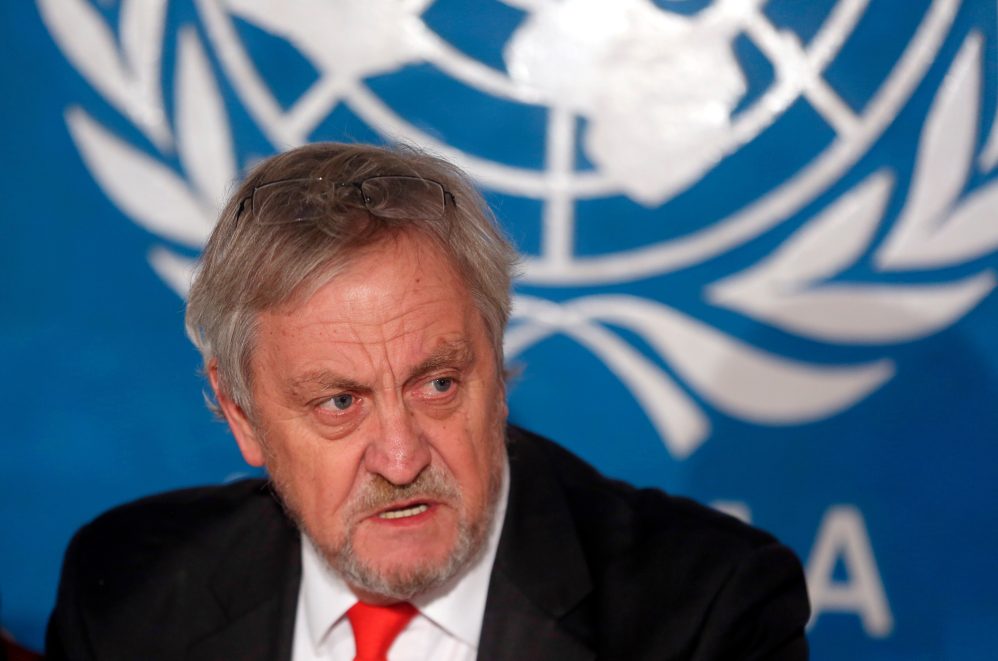

Nicholas Haysom, a prominent South African lawyer who played a crucial role in helping Nelson Mandela create his country’s groundbreaking post-apartheid constitution, passed away Tuesday at age 73.
The white South African, who dedicated his life to fighting racial segregation, later built an impressive international career working for the United Nations in troubled regions including Afghanistan, Iraq, Somalia and South Sudan.
Rebecca Haysom confirmed to The Associated Press that her father died in New York “after a long, valiant battle with heart and lung complications.”
UN Secretary-General Antonio Guterres praised Haysom’s commitment, saying he “devoted his life to justice, dialogue, and reconciliation — from his central role in South Africa’s democratic transition serving as chief legal and constitutional adviser to president Nelson Mandela to years of leadership in U.N. posts in some of the world’s most complex and fragile settings.”
Guterres added that Haysom’s influence “will endure in the peace processes he advanced, the institutions he strengthened, and the principles he helped bring to life around the world.”
South African President Cyril Ramaphosa, himself a former freedom fighter, described the loss of “a distinguished diplomat and a pioneer of our democratic administration whose commitment to justice and peace made our country, our continent and the world a better place.”
“I remember him for applying his legal acumen, mentorship, wisdom and integrity to the development of our constitution,” Ramaphosa stated, encouraging South Africans “to honor his contribution to our nation and the international community by upholding the fundamental rights and maintaining the peace he advocated so passionately and eloquently.”
Born Nicholas Roland Leybourne “Fink” Haysom, he was raised in Durban by a progressive family that championed racial equality, particularly his activist mother who opposed apartheid. During his university years, he developed strong opposition to the segregation system and pursued legal studies at the Universities of Natal and Cape Town to address social injustices.
Haysom rose to lead the anti-apartheid National Union of South African Students and faced multiple arrests and detentions, including six months in solitary confinement around 1980, according to a UN interview he gave last year. Ramaphosa noted his artistic talents as well, recognizing him as South African Playwright of the Year in 1987.
At the time, Haysom recalled, few believed apartheid would collapse, making Mandela’s 1990 release “a tremendous moment.” Working with an activist human rights law firm, he was recruited by Mandela’s African National Congress to join its Constitutional Commission.
Haysom described spending years with “a very exciting group of intellectuals” designing the new South Africa and negotiating with the National Party, which had created and maintained apartheid, on transitional arrangements.
Following South Africa’s international isolation, Haysom explained the group sought “the perfect formula for a constitutional state that appreciated the need for equality among all its citizens and recreated a social contract which we wanted to be a lesson for the world.” Despite challenges, he noted “the South African constitution is still regarded as perhaps one of the most progressive constitutions in the world.”
“And I think that’s what led to me being asked to be Mandela’s legal adviser… while he was president,” Haysom explained, serving in that capacity from 1994 to 1999.
According to Haysom, Mandela aimed to establish precedent for the first post-apartheid administration to honor the rule of law, “and he was really at the forefront of creating a society built on respect for legal equality and human rights.”
Meeting with Mandela daily, Haysom described him as “tremendously gracious.”
“But he was steely, strong in the conviction he had that he was embarking on the right path, and he persevered,” Haysom observed. “As I say to my children, the lesson of Mandela is not just being a nice person, it’s perseverance in your ideals that’ll change the world.”
During Mandela’s presidency, Haysom joined efforts to resolve ethnic conflicts between Hutus and Tutsis in Burundi during the 1990s. He subsequently worked on peace formulas for Sudan’s north-south divide, ultimately contributing to South Sudan’s 2011 independence.
From 2005 to 2007, Haysom worked in Iraq seeking solutions for Shia, Sunni and Kurdish communities to coexist peacefully, recognizing this as a common challenge across conflicts. Between 2007 and 2012, he served in then-UN Secretary-General Ban Ki-moon’s office overseeing political, peacekeeping and humanitarian affairs, followed by four years in Afghanistan in various UN positions from 2012 to 2016.
His later UN work concentrated on Sudan and South Sudan, where he led the peacekeeping mission starting in 2021, with a brief assignment in Somalia. The Somali government expelled him in 2019 after he questioned the detention of a former al-Shabab extremist leader.
Haysom leaves behind his wife Delphine and sons Charles and Hector, plus three children from his first marriage to Mary Ann Cullinan: Rebecca, Simone, and Julian.
Reflecting on his career, Haysom admitted being “quite probably inappropriately proud” of his work in Burundi, Sudan and South Africa, though he acknowledged that after several years, those peace agreements faced difficulties.
This taught him that peace doesn’t endure indefinitely and democracy demands “constant engagement by people of good intention.”