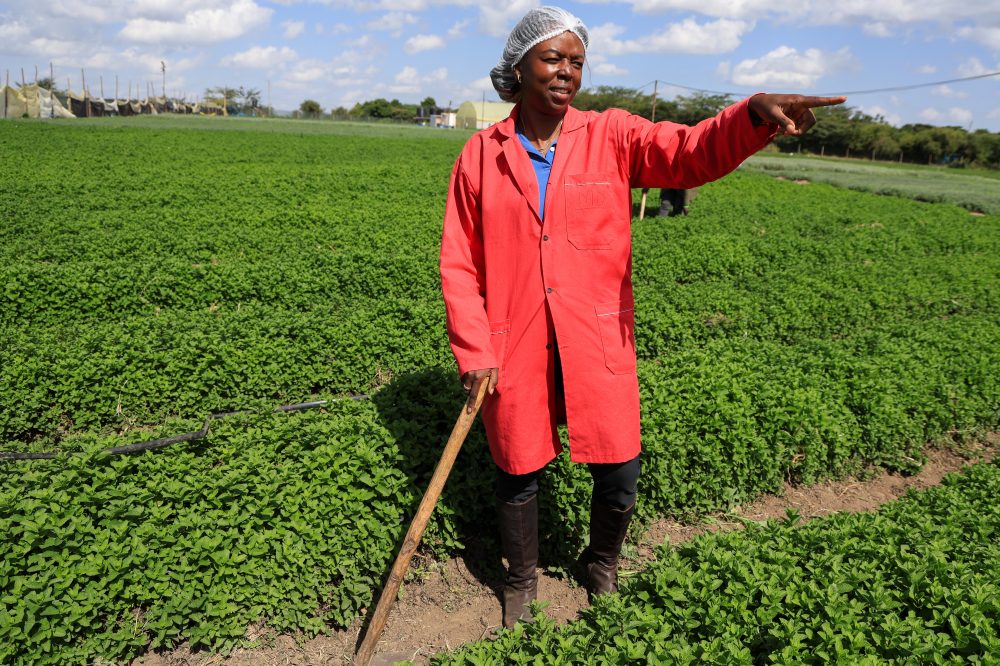

NAIROBI, Kenya — Kenyan farmer Yvonne Anyonyi Mumiah starts her mornings walking through rows of rosemary, basil, and other herbs and vegetables bound for grocery shelves in Europe. Not long ago, she lived with the constant fear that heat or delayed transportation would ruin her harvest before it ever reached a buyer. Today, she counts on a solar-powered cold storage service to keep her produce in prime condition.
The service she uses is provided by a cold-chain company called SoKo Fresh, which charges farmers based on how many kilograms of produce they store — a pay-as-you-go approach that’s part of a broader movement across the African continent. The goal is to tackle one of farming’s most stubborn problems: food spoilage before it ever reaches consumers.
According to the Food and Agriculture Organisation, as much as 40% of the food grown in Africa is lost somewhere between the farm and the marketplace, with poor storage, transportation, and processing infrastructure bearing much of the blame.
Solar-powered cold rooms, off-grid warehouses, and cooling centers are giving farmers and traders a way to keep perishable goods fresh without depending on costly or unreliable electrical grids. This approach is picking up steam in Kenya, Nigeria, Ethiopia, Rwanda, and South Africa.
“The biggest challenge was preserving the quality after harvest,” Mumiah said. Like many smallholder farmers, she could not afford the approximately $30,000 price tag for her own solar cold storage unit.
“You can do everything right on the farm, but if the produce is not stored properly, you lose both the product and income,” she explained. She also pointed to the freedom cold storage gives her: “We are no longer forced to sell immediately because we fear the produce will spoil. We can wait for collection and still maintain quality.”
Climate change, rising temperatures, and disruptions to supply chains are putting increasing pressure on food handling systems worldwide, making cooling technology more essential than ever.
In countries like India, China, Japan, the Netherlands, and the United States, well-developed cold-chain networks can keep fresh produce marketable for weeks at a time. Across much of Africa, however, many farmers have no access to cooling facilities and are forced to sell their crops right after harvest — often at a loss.
The problem grows worse as temperatures climb, since intense heat speeds up the spoilage of vegetables, fruits, dairy, and fish. Unreliable electricity makes traditional refrigeration too expensive or simply impractical in many rural communities.
“Cold storage remains one of the missing links in Africa’s agricultural value chains,” said Emmanuel Aziebor, regional director for Africa at CLASP, a nonprofit that promotes energy-efficient appliances and technologies for productive use.
“When farmers can store produce for longer, they gain access to better markets, reduce waste and increase incomes,” he added.
SoKo Fresh reports that it has reduced spoilage rates for its clients from as high as 50% down to less than 2%, while also helping farmers earn up to 50% more per kilogram of produce.
In Nigeria, companies such as ColdHubs have set up solar-powered walk-in cold rooms at major farming markets, letting farmers and traders pay for daily rental space rather than purchasing costly equipment outright. In Rwanda, solar refrigeration is being used to support dairy cooperatives and improve how milk is collected and stored. In Ethiopia, cold-chain investments are growing to support horticultural exports, one of that nation’s fastest-developing agricultural sectors.
Analysts say these kinds of innovations are becoming critical as African nations work to strengthen food security while also working to reduce greenhouse gas emissions.
Conventional cold storage systems frequently rely on diesel generators, especially in areas where the power grid is inconsistent. Solar-powered options can reduce both fuel use and operating expenses while producing fewer emissions.
Still, experts suggest the most significant benefit may be economic rather than environmental. For years, development work across Africa has centered heavily on expanding access to electricity. While many households have gained power, far less attention has gone toward making sure people can actually use that electricity to earn a living.
“We have neglected the conversation around how people can turn electricity into opportunity,” Aziebor said. “We keep extending electricity infrastructure, but unless people can use that power productively, the economic benefits never fully materialize.”
Throughout Africa, solar-powered irrigation systems are making year-round farming possible. Solar-powered milling machines and other processing equipment are helping rural communities add value to what they grow right where it’s produced.
Funding, however, continues to be a significant hurdle.
“The challenge today is not demonstrating that these systems work,” said Carol Koech, vice president for Africa at the Global Energy Alliance for People and Planet. “It is building enough bankable projects that can attract larger pools of investment and scale across countries.”
Grants, low-interest loans, and donor contributions can help offset startup costs, but industry insiders say drawing in substantial commercial investment remains difficult because many agricultural markets are fragmented and made up largely of small-scale producers.
“These investors see emerging technologies as high risk because we lack enough proven business models with reliable returns,” said SoKo Fresh CEO Denis Karema. “That makes funding for our type of projects expensive.”