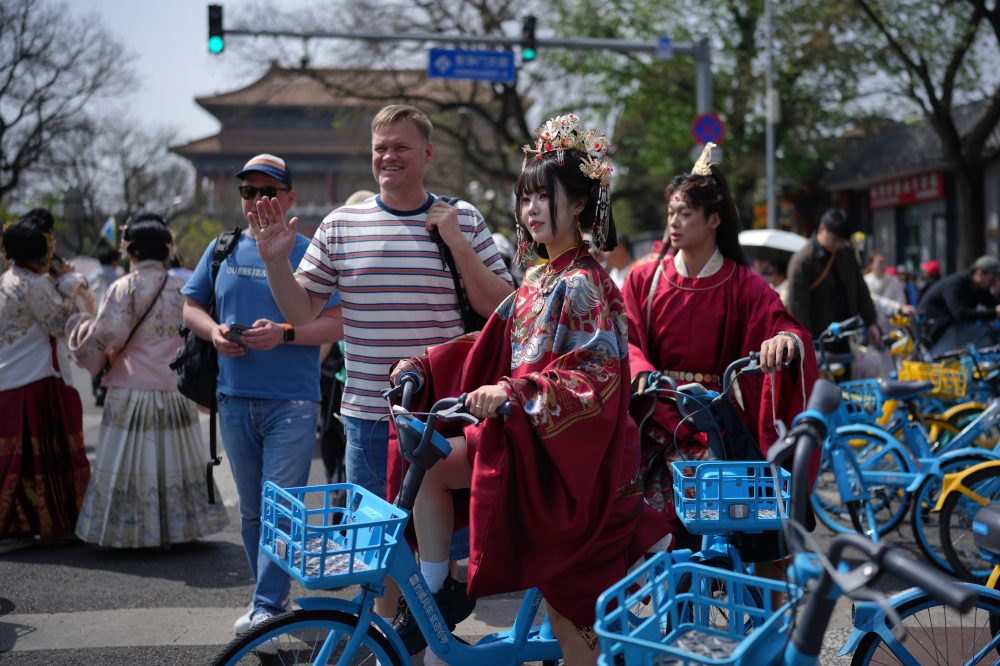

A viral social media phenomenon has young adults worldwide showcasing their adoption of Chinese lifestyle practices, signaling a notable shift in global cultural influence.
The trend, known as “Chinamaxxing” or being in a “very Chinese time,” features millions of TikTok videos where users celebrate activities like consuming hot water with goji berries, enjoying dumplings, wearing indoor slippers, and praising China’s modern infrastructure after visiting the country.
This grassroots cultural movement has achieved what years of official Chinese government efforts to expand soft power could not accomplish through traditional diplomatic channels.
Chinese Ambassador to the United States Xie Feng has acknowledged the phenomenon, using it to promote new visa policies while encouraging Americans to “experience for yourselves a real, dynamic and panoramic China.”
The viral content represents part of a broader surge in global appreciation for Chinese entertainment, products, and everyday customs that were previously unknown or overlooked internationally.
“China is gaining real soft power, and you can see it most clearly in how Chinese culture and ‘Chineseness’ are becoming familiar, repeatable, and globally consumable in everyday life,” explained Shaoyu Yuan, a professor at New York University’s Center for Global Affairs.
Yuan added that “That legitimacy is earned through taste, utility, and entertainment.”
This cultural momentum stems from China’s advancement across multiple sectors, including manufacturing where it maintains a record $1.2 trillion trade surplus, technology development behind platforms like TikTok, and domestic brands that now rival international competitors.
New Jersey resident Sherry Zhu, 23, sparked the movement with videos joking that enjoying noodles, hotpot, and house slippers made someone Chinese. Her December post received nearly one million shares, inspiring countless similar videos.
However, the trend has generated controversy among some Chinese Americans who view it as cultural appropriation rather than genuine appreciation.
“Appreciation does not erase the racism that many Chinese people grew up with,” stated Elise Zeng, 28, from Brooklyn, whose critical response video received over 36,000 likes.
Zeng described her family’s fear during the COVID-19 pandemic when anti-Asian attacks increased, saying “Those experiences don’t just disappear because Chinese culture is suddenly cool and trendy.”
Despite acknowledging similar experiences with discrimination, Zhu maintains pride in her heritage, believing “that visibility and cultural sharing can reduce misunderstanding over time.”
The social media craze coincides with broader international success for Chinese cultural products.
Labubu dolls, carried by celebrities including Rihanna, created such demand that parent company PopMart saw 300% annual profit growth during peak popularity last spring and summer.
Chinese rapper Skaii isyourgod gained worldwide followers despite performing in Cantonese with a regional accent that many mainland Chinese cannot understand. His track “Blueprint Supreme” accumulated billions of TikTok views globally last summer.
The animated film “Ne Zha 2,” based on traditional Chinese mythology, became the highest-grossing animated movie ever before its North American release, while video game “Black Myth: Wukong” set Steam records with 2.4 million simultaneous players.
Even Chinese mapping applications like Amap have gained social media attention for superior features compared to Apple or Google Maps, including shade versus sun positioning details.
Chinese President Xi Jinping has promoted cultural outreach since 2013, urging officials to “tell China’s story well” through initiatives like the Belt and Road infrastructure program and Confucius Institutes.
Many Confucius Institutes have closed in Western countries amid espionage and propaganda concerns, while the Belt and Road Initiative faces criticism as potential debt entrapment.
While China’s economic and military strength is well-established as the world’s second-largest military power and dominant green energy manufacturer, soft power influence proves more difficult to measure or artificially create.
State media outlet Global Times has attempted to link the “becoming Chinese” trend to successful “social development,” but Professor Yuan warns that government claims may backfire.
“Cultural influence travels farther when it is chosen rather than announced,” Yuan observed.