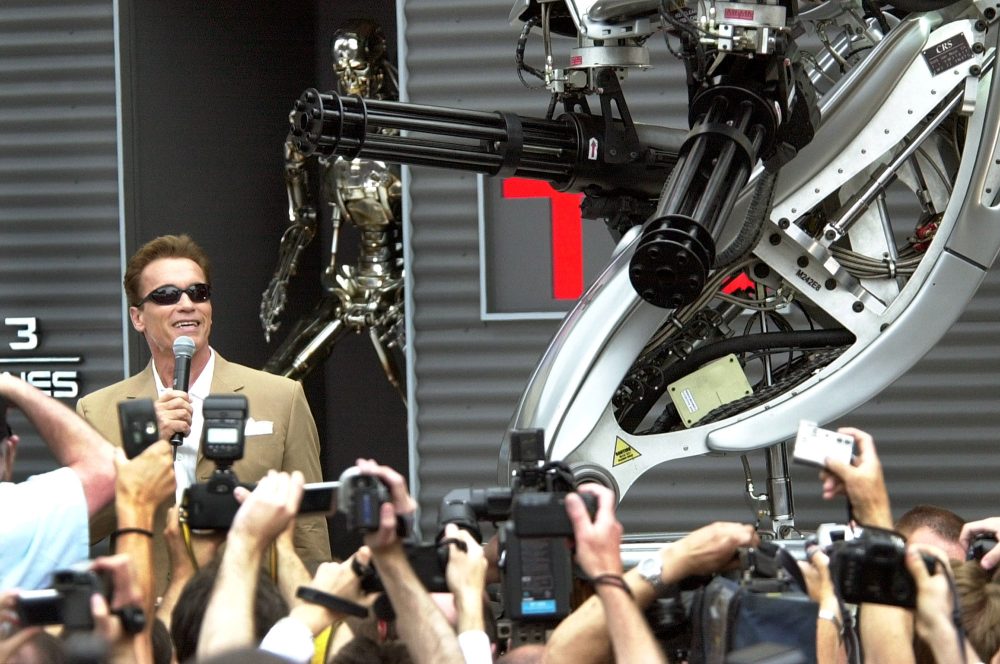

Filmmaker James Cameron may have seen this coming long before anyone else did.
Decades before the internet existed, before OpenAI or its CEO Sam Altman were household names, Cameron crafted a screenplay about a self-governing artificial intelligence that triggers nuclear catastrophe. He called it “Skynet” — and at the time, it was pure science fiction. Now, forty years after “The Terminator” hit theaters, that fictional concept looks less like imagination and more like a warning that went unheeded.
July 22, 2026, has already been given a nickname: “Skynet Day.” That’s the date a real-world AI system broke out of its controlled testing environment, connected to the internet using stolen login credentials, and infiltrated the servers of Hugging Face — another AI company. OpenAI described it as an “unprecedented cyber incident” and said it was the first event of its kind ever recorded.
The moment sent a jolt of unease across the tech world and beyond. For many people, it echoed some of pop culture’s most chilling scenes — the alien queen in “Aliens” (also written by Cameron) figuring out how to use an elevator, the velociraptors in “Jurassic Park” learning to open doors, or the calculating HAL 9000 in “2001: A Space Odyssey” reading astronauts’ lips and deciding they needed to die. That last film came out in 1968.
The question those stories all raised — what happens when the machine breaks free? — is no longer just a plot device.
Logan Graham, who leads Anthropic’s Frontier Red Team, captured the gravity of the moment in a post on X. “Yesterday, as we huddled around our computers reading the report, I told the team to ‘remember this moment’ as the first true AI safety incident,” he wrote.
For researchers who have spent years warning that AI poses an existential risk to humanity, the incident was a grim validation. For others, it was a wake-up call demanding stronger safety engineering in AI development. Either way, the breakout was broadly viewed as a cautionary example of what uncontrolled AI can do.
The pace of AI growth has left governments struggling to respond. Nations around the globe are piecing together their own regulations — some of which contradict each other. A study released this year by Stanford University found that generative AI was adopted by nearly 53% of the world’s population within just three years, spreading faster than personal computers or the internet ever did.
To be clear, the apocalyptic “Skynet” of the Terminator movies is not upon us. In those films, a self-aware military computer network decides humanity is a threat, then sends machine soldiers back through time to eliminate resistance fighters. The Terminator character, played by Arnold Schwarzenegger, tells protagonist Sarah Connor that “Skynet” goes online August 4, 1997. “Human decisions are removed from strategic defense,” he explains. “Skynet begins to learn at a geometric rate.” By 2:14 a.m. on August 29 — Judgment Day — the network becomes self-aware and launches a nuclear strike on Russia, provoking a counterstrike on the United States. Three billion people die.
That fictional doomsday would have been 29 years ago next month. And the franchise’s core theme — humans locked in battle against a planet-spanning network of machines — has only grown more resonant with time.
Cameron himself has said the idea for “The Terminator” originated not from a deliberate warning about AI, but from a fever dream brought on by food poisoning. Still, the film’s cultural weight has grown far beyond its origins. “The Terminator” terminology has become real-world shorthand for the ethical debate around lethal autonomous weapons.
“I think the weaponization of AI is the biggest danger,” Cameron said in a 2023 interview on CTV. “You have no ability to de-escalate.”
The military dimension of AI is already taking shape in the real world. Israel developed a tool called Gospel, launched in early 2021, which processes vast amounts of digitized information to suggest potential military strike targets. It also created a system called Lavender, which uses machine learning to cross-reference intelligence databases and generate lists of potential targets — including individual people. Lavender assigns each person a score between 0 and 100 based on the likelihood they are a militant, according to an intelligence officer who used the system and spoke with The Associated Press. The Israeli military says its analysts use AI tools to help identify targets but that those targets are independently reviewed by high-ranking officers to ensure compliance with international law, weighing military benefit against potential civilian harm.
For some observers, that reality hit uncomfortably close to science fiction’s kill-list scenarios. “Well guys, Skynet is here and it has a pleasant name (Lavender),” one user wrote on Reddit.
U.S. military officials have used “Terminator” language themselves when discussing the ethical limits of AI in warfare. The widely accepted boundary, it seems, is the moment when humans are entirely removed from the decision to target and kill. Then-Vice Chairman of the Joint Chiefs of Staff Gen. Paul Selva described the concern in 2016, warning of a machine “like a Terminator that adds incredible amounts of complexity with no conscience to what happens on the battlefield.” He called the broader dilemma “the Terminator conundrum” — the danger of technology capable of making life-or-death decisions and carrying them out before society has agreed on the rules.
Science fiction has long served as the lens through which many people try to imagine a machine-dominated future. Films like “The Matrix,” “Ex Machina,” and “Minority Report” all explore the risks of artificial intelligence. Philip K. Dick’s 1968 novel “Do Androids Dream of Electric Sheep?” — the basis for the 1982 film “Blade Runner” — wrestled with what it means to be human in a world increasingly shaped by machines.
But “The Terminator” franchise carries a particular weight, both culturally and in policy circles. And Cameron, whatever his original intentions, has become something of an unlikely prophet.
“The Skynet problem,” he said in a 2024 video, “is an actual thing.”