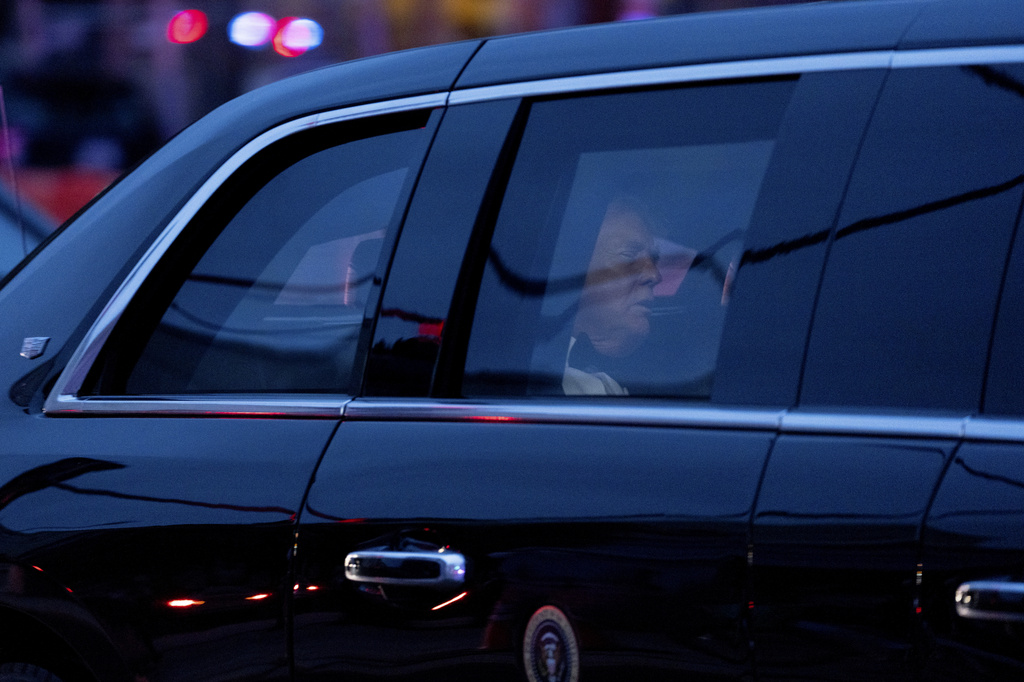

WASHINGTON — President Trump remained unharmed Saturday evening following a shooting incident that forced the evacuation of the White House Correspondents’ Dinner at the Washington Hilton, according to authorities. No casualties have been confirmed in the incident.
Federal agents and Secret Service personnel flooded the venue as attendees scrambled for cover beneath dining tables. Witnesses reported hearing someone shout “Out of the way, sir!” while others called out for people to take cover.
Multiple guests estimated they heard between five and eight gunshots during the chaos. The ballroom, packed with hundreds of high-profile media figures, entertainment personalities, and government leaders who were awaiting the president’s remarks, was quickly cleared by security forces.
National Guard troops positioned themselves throughout the hotel while authorities permitted departures but blocked anyone from returning to the building. Enhanced security measures were implemented around the entire perimeter.
Law enforcement sources verified that gunfire occurred, though additional details about the circumstances remain unavailable at this time.
The guest list included Trump, Vice President JD Vance, Defense Secretary Pete Hegseth, and Secretary of State Marco Rubio among other prominent figures.
The incident occurred during Trump’s first appearance at the annual media gathering since becoming president. The event traditionally highlights the complex dynamics between the White House and the press corps that covers it.
Trump had made his entrance to the hotel’s lower-level ballroom accompanied by “Hail to the Chief,” exchanging pleasantries with notable journalists at the head table and acknowledging White House Press Secretary Karoline Leavitt with an enthusiastic gesture.
This year’s program featured mentalist Oz Pearlman as the main entertainment, departing from the usual format of comedian performances that typically include presidential roasts.
The president’s participation had already generated discussion about journalistic ethics, particularly regarding whether reporters should socialize with their subjects. Media ethics specialist Kelly McBride from the Poynter Institute had criticized such events, stating: “What was once (a fairly long time ago) a well-intended night of fundraising and camaraderie among professional adversaries is now simply a bad look.”
Trump’s relationship with news organizations has been notably strained throughout his second term, involving legal battles with major outlets including The Times, The Wall Street Journal, and The Associated Press, along with implementing restrictions on Pentagon media access.
Prior to the dinner, nearly 500 former journalists had petitioned the White House Correspondents’ Association “to forcefully demonstrate opposition to President Trump’s efforts to trample freedom of the press.”
WHCA President Weijia Jiang of CBS News had defended the organization’s approach, telling C-SPAN: “I don’t think people realize how closely we are working with the White House. The relationship is important. It can be complicated. It can be intense. But it is robust.”
During her opening remarks, Jiang had referenced the tense atmosphere by thanking Leavitt “for everything your team does to work with us every day, whether you like it or not.”
CNN’s Manu Raju, arriving at the event, had emphasized his role as a journalist rather than an activist, saying: “I’m not an activist. My job is not to protest.”
Small groups of demonstrators had gathered outside the hotel before the incident, including one person wearing a prison costume with a Pete Hegseth mask and another displaying a “Journalism is dead” sign.
Various news organizations had invited administration officials as their guests, including Treasury Secretary Scott Bessent (New York Post), Interior Secretary Doug Burgum and Secretary of State Marco Rubio (NBC).
The Associated Press had extended an invitation to Taylor Budowich, a former deputy chief of staff whom the organization sued last year over reduced presidential access related to the Gulf of Mexico naming controversy.
“We maintain professional relationships with people across the political spectrum because we are nonpartisan by design — focused on reporting the facts in the public’s interest,” explained AP spokesman Patrick Maks.
The evening was also scheduled to recognize outstanding journalism, including coverage that had drawn Trump’s criticism, such as a Wall Street Journal report about a birthday message he allegedly sent to Jeffrey Epstein, which resulted in a presidential lawsuit.