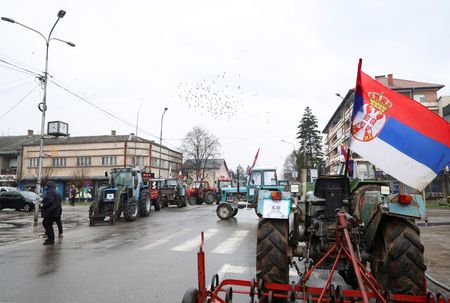

Agricultural workers throughout Serbia brought traffic to a standstill Tuesday as they positioned tractors across major roadways, calling for increased government financial support and barriers against low-cost foreign agricultural products including dairy and pork.
The demonstrations began in Serbia’s southwestern region nearly two weeks ago and have now expanded nationwide, with protesters targeting 42 locations on Tuesday alone.
In the agricultural community of Bogatic, located west of Belgrade, tractors adorned with Serbian flags occupied the primary road junction. Agricultural workers stated they would maintain their blockade until officials address their concerns.
“We are ready for anything … and we will not back down … as this is the rock bottom,” stated Milan Zorbic, representing a local farmers’ organization, while recognizing that agricultural workers like himself have lost valuable field work time during the demonstrations.
Those in the dairy industry report that massive quantities of imported milk and related products, primarily originating from European Union nations and other Western Balkan countries, are being marketed at costs well beneath what local Serbian producers can maintain, pushing domestic operations toward financial ruin.
Agricultural workers also report that livestock prices have fallen to unsustainable levels, with viable pricing needing substantial increases to cover operational expenses.
Demonstrators are pursuing enhanced government financial assistance and temporary trade limitations or duties on certain agricultural imports to create more competitive market conditions.
Agriculture Minister Dragan Glamocic announced Tuesday that farming representatives had not appeared for scheduled discussions regarding measures designed to strengthen the dairy market. He noted that certain retail chains had committed to purchasing more dairy products from domestic producers.
These agricultural demonstrations are occurring alongside broader anti-government protests that began in 2024 following a train station canopy collapse that killed 16 people. Some protest signs also demanded the resignation of Serbian President Aleksandar Vucic.
Agriculture represented 6.1% of Serbia’s gross domestic product in 2024, while employing 20% of the nation’s workers.
As a European Union membership candidate, Serbia has agreed to align its agricultural policies with the bloc’s standards, including opening domestic markets to EU products.