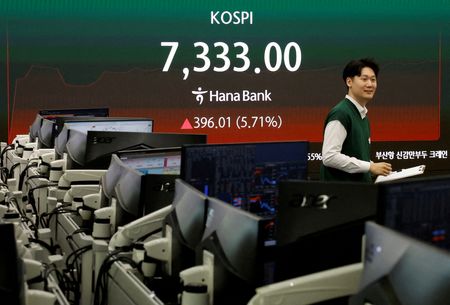

South Korea’s primary stock market achieved a historic milestone Wednesday, with the KOSPI index climbing above 7,000 points for the first time as artificial intelligence enthusiasm propelled semiconductor companies to record heights.
Samsung Electronics reached the coveted trillion-dollar market capitalization threshold, becoming just the second Asian corporation to achieve this status after Taiwan Semiconductor Manufacturing Co (TSMC).
The remarkable surge demonstrates how worldwide appetite for AI technology has emerged as the primary driver transforming global stock markets, elevating South Korea’s semiconductor-focused index among the planet’s top-performing major exchanges.
Wednesday’s trading session saw the KOSPI finish 6.45% higher at 7,384.56 points, after momentarily triggering an uncommon “sidecar” trading halt and reaching a peak gain of 7.06% at an all-time record of 7,426.60. The rally followed overnight gains in American chip stocks that pushed the Philadelphia Semiconductor Index up 4.2%.
Samsung Electronics and SK Hynix both soared to unprecedented levels, climbing 14.4% and 10.6% respectively. These two technology giants now represent 44% of the KOSPI’s entire market value.
Samsung’s achievement places it among only four Asian companies worth more than $500 billion, alongside TSMC, SK Hynix, and China’s Tencent.
The day’s impressive performance followed a 5.1% surge on Monday, when domestic economic data revealed strong manufacturing activity and trade driven by semiconductor demand amid global AI investment. Markets were closed Tuesday for a national holiday.
Year-to-date, the KOSPI has skyrocketed 75%, building on a remarkable 76% increase in 2025 that marked the best annual performance since 1999, supported by government market reform initiatives.
“Despite high oil prices and bond yields sparked by Iran war noises, foreign flow conditions are improving on a jump in the Philadelphia Semiconductor Index and AMD shares,” said Han Ji-young, an analyst at Kiwoom Securities.
Advanced Micro Devices shares jumped 12% in after-hours trading Tuesday following the company’s forecast of second-quarter revenue exceeding market projections, fueled by strong demand for data-center processors as cloud computing firms increase AI infrastructure spending.
Currency markets also responded positively, with the won gaining as much as 1.7% to 1,451.5 per dollar on domestic trading platforms, reaching its strongest position since February 27.
Market confidence received an additional boost when U.S. President Donald Trump announced a temporary pause in operations escorting ships through the Strait of Hormuz, citing “great progress” toward a comprehensive Iran agreement, which sent oil prices tumbling during Asian trading hours.
Beyond technology stocks, securities companies jumped 13.5% and financial groups rallied 4.2% Wednesday on expectations that the stock market boom would boost profits. However, gainers were outnumbered, with 200 advancing stocks among 893 traded shares, while 679 declined.
“South Korea’s stock market is still undervalued compared with historical valuations in terms of earnings per share, trading at about nine times this year’s earnings forecasts,” said Seo Sang-young, an analyst at Mirae Asset Securities.
“If the demand for AI chips continues at this level, the KOSPI could reach 10,000 points by the end of this year – but if the demand collapses with worries over inflation and weak growth due to the Iran war, it could plummet to as low as 4,500 points,” Seo said.
The index, which traded around 2,000 when President Lee Jae Myung assumed office in early June 2025, crossed 3,000 within a month and powered through 6,000 in late February just before the Iran conflict began.
“I believe the KOSPI’s jump is due to the recovery of capital market confidence in South Korea, which had been undervalued,” Jung Cheong-rae, the leader of the ruling Democratic Party, said, crediting various government policies for the achievement.
International investors drove Wednesday’s rally with their largest-ever single-day purchase of Korean shares, totaling 3.1 trillion won ($2.13 billion).