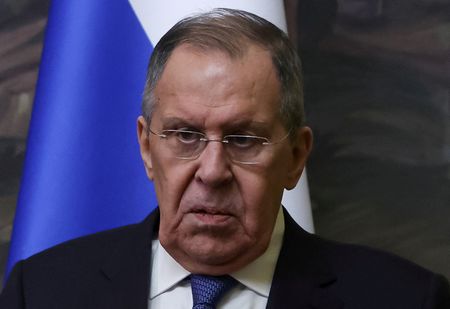

MOSCOW — Russian Foreign Minister Sergei Lavrov is pushing back against U.S. Secretary of State Marco Rubio, demanding that Washington clarify exactly what role it is playing in attempts to bring the war in Ukraine to an end.
In written responses to media questions released Friday, Lavrov intensified a public dispute with Rubio over whether Presidents Vladimir Putin and Donald Trump had reached some form of understanding during their meeting in Alaska last year — an encounter Russia has repeatedly referred to as “the spirit of Anchorage.”
Rubio told reporters Thursday that no deal was struck at that summit. “There was a proposal in Alaska, but there was no agreement in Alaska. If there had been an agreement, we would have had an end of the war,” he said.
Lavrov offered what he described as the most thorough account yet of what took place at the Alaska meeting last August. According to Lavrov, Putin went through a list of U.S. proposals that Trump’s envoy Steve Witkoff had brought to Moscow just days before the summit, going point by point and checking with Witkoff — who was present alongside Trump and Rubio — that he was accurately recalling each proposal. Lavrov, who was also at the meeting, said Witkoff confirmed each point.
“Therefore, when my colleague M. Rubio says that there were only proposals in Alaska but no agreement, it raises a question regarding what we actually mean by ‘agreement,’” Lavrov said.
He continued: “If one side — in this case, the U.S. — put on the table its proposals for a settlement and a way to approach this crisis, and the other side expressed its consent to those proposals, then claiming there was no agreement seems rather inelegant.”
Lavrov added that the “entire situation” surrounding the U.S. role in the peace process needed to be clarified.
The pointed remarks from Lavrov and other Russian officials this week suggest a shift in how Moscow views Washington’s peace efforts, which have stalled since the U.S. and Israel launched military action against Iran in February.
Ukrainian President Volodymyr Zelenskiy told Trump and other Western leaders last week that Ukraine was gaining the upper hand in the conflict, pointing to deep strikes inside Russian territory targeting oil refineries and industrial facilities.
Russia disputes that assessment, maintaining it will achieve battlefield victory if diplomatic efforts fail. Russian forces currently hold roughly one-fifth of Ukrainian territory after more than four years of fighting.
The Kremlin said Friday that it continues to value Trump’s mediation efforts and hopes they will resume. However, Kremlin spokesman Dmitry Peskov, when asked whether Russia views the U.S. as a neutral mediator, said true neutrality is impossible given that the U.S. is still supplying weapons and technical support to Ukraine.