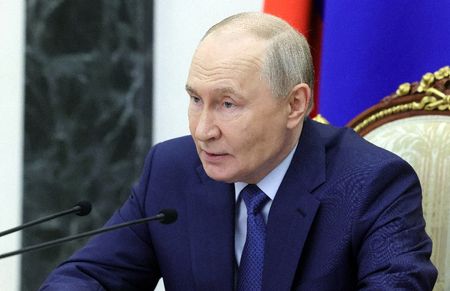

Russian President Vladimir Putin confronts increasingly limited options in Ukraine as his military forces struggle to make meaningful progress while Western economic sanctions continue draining his country’s resources, according to Estonia’s intelligence leadership.
Kaupo Rosin, Estonia’s foreign intelligence chief and a senior intelligence official on NATO’s eastern border, informed Reuters that Russia is experiencing higher casualty rates than recruitment numbers in the fifth year of its comprehensive military campaign. He noted that implementing widespread military conscription would likely face strong public opposition and could threaten domestic stability.
“All these factors together are creating a situation where some people in Russia including in the higher levels understand that they have a big problem. Hard to say what Putin thinks about it, but I think all these factors are starting to float into his decision-making,” Rosin stated during an interview conducted in Tallinn.
Recent months have seen Russian military units achieving some of their most limited territorial gains in Ukraine since 2023, occurring one year following their comprehensive invasion of Ukraine. Russia’s $3 trillion economy experienced a 0.3% decline during the initial quarter.
Putin maintains that government initiatives aimed at strengthening the economy are starting to produce favorable outcomes, and he has consistently stated that Russian military forces will continue operations until achieving all their objectives.
Rosin indicated that the primary factor behind Russia’s deteriorating financial circumstances was sanctions targeting the financial sector that were “really, really hurting,” while punitive actions against Russia’s oil export industry were also restricting revenue streams.
“I think it’s very difficult choices for them now. It’s hard to predict what they will decide in this current situation,” he said.
Estonia, which maintains a direct land boundary with Russia, serves as a prominent Ukraine supporter within the NATO military alliance and European Union, consistently urging fellow members to intensify pressure against Moscow.
“So my message is let’s push forward with (sanctions). This is not the time to hesitate, just let’s keep going,” he emphasized.
A separate European intelligence leader, speaking under anonymity conditions, told Reuters in independent comments that while growing pressure indicators on Russia were evident, no signs suggested this was altering Moscow’s strategic approach to the conflict.
“It’s very difficult for me to see that they (Russia) would get rid of their objective to get the whole Donbas area… and Russia is in no hurry, basically,” the official explained.
Russia has maintained during U.S.-facilitated peace negotiations that Ukraine must retreat from the eastern Donbas territory as part of any agreement, a demand that Kyiv has dismissed.
The Donbas territory includes the Russian-controlled province of Luhansk and the Donetsk area, portions of which Ukraine has successfully defended against prolonged Russian military operations.
The intelligence official added that Russia appeared unlikely to moderate its war objectives or that any significant “big breakthrough” was approaching. The official characterized Russian society as demonstrating resilience.
“It is wishful thinking that now Russia’s leadership is in some way eroding, or Putin is somehow challenged (domestically)…” the official stated.
The Estonian intelligence leader forecasted that Russia would maintain its goal of controlling Ukraine while Putin continues in leadership, and would also position substantial military forces along Ukraine’s borders following the conflict’s conclusion.
Additionally, he predicted that after hostilities end, Moscow will attempt to build up its military presence along NATO borders and pursue “military dominance … from the Arctic until the Black Sea.”
“The military ambition is very, very big on the Russian side,” he stated, predicting Moscow would persist in conducting sabotage operations in Western nations despite risks to civilian populations.
Russia has repeatedly denied participation in sabotage planning or attacks, dismissing such claims as Western fear tactics.
“Russia sees this (such attacks) as something which doesn’t ignite a big war,” Rosin concluded.