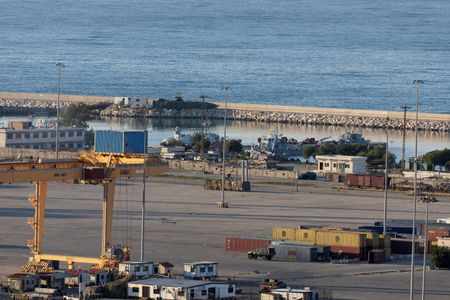

Russian officials are hoping to have a commercial logistics hub operational by mid-July at one of two berths within the naval base Russia leases at the Syrian port of Tartous, according to Syrian officials who spoke with Reuters. The remaining berth would continue to serve Russian military purposes.
The facility is expected to handle a broad array of Russian products, including wheat, grains, animal feed, vegetable oils, timber, steel, coal, rice, sugar, and mineral oils. Organizers are targeting initial cargo volumes of roughly 250,000 tons each month.
The effort reflects Russia’s push to hold onto and grow its footprint in Syria through economic means, after the 2024 overthrow of former President Bashar al-Assad left Moscow without its closest partner in the Middle East.
The stakes go well beyond commerce. Washington is actively working to ensure Syria steers contracts toward American companies and pulls back on Russia’s military presence in the country.
Russia has supported Syria for decades and sent its military forces in 2015 to back Assad during a 14-year civil war. Assad’s removal cast doubt on the future of Russia’s lease agreement for its naval base at Tartous along the Mediterranean coast, as well as its military base at Hmeimim, located southeast of the city of Latakia.
Since Assad was removed from power, Syria’s new government has been building closer relationships with Western and Gulf nations, while still working with Moscow on energy, food imports, and military matters.
Negotiations between Moscow and Damascus over the future of the Tartous and Hmeimim bases are currently ongoing.
Earlier in 2025, Syria’s new leadership cancelled a 49-year contract that had given Russian firm Stroytransgaz rights to develop commercial facilities at Tartous. The United Arab Emirates’ DP World then secured an $800 million, 30-year agreement to redevelop and operate the port.
Despite that, on June 6, the Russian-Syrian Business Council — a body operating under Russia’s Ministry of Industry and Trade — announced intentions to set up an “assembly and distribution centre for Russian goods” at Tartous.
The project is being developed by Syrian logistics firm Rus Line in partnership with Russian companies working through the Russian-Syrian Business Council. Organizers say they have reached an agreement with Syria’s Sovereign Fund for joint management of the logistics center, creating a direct connection to the state’s primary investment body.
Ossama Ajaj, general manager of Rus Line and an adviser to the Russian-Syrian Business Council, confirmed the range of goods the hub would handle. Jinan Mubadda, Rus Line’s chief executive, said the hub would operate from Pier No. 4 at Tartous port, in what Ajaj described as a “restricted zone” within the naval base.
Syria’s ports and customs authority did not respond when contacted for comment.
Russia’s government also declined to comment. However, Foreign Ministry spokeswoman Maria Zakharova said in June that Moscow and Damascus were discussing a potential “reformatting” of Russia’s military facilities in Syria and that cooperation between the two nations was actively moving forward.
Ajaj told Reuters that operations were expected to kick off in mid-July with a 30,000-ton grain shipment, and that Russia would maintain a “reduced military presence.”
Ajaj and two Syrian foreign ministry officials said the project was laid out during a January 28 meeting in Moscow between Syrian President Ahmed al-Sharaa and Russian President Vladimir Putin. Those officials described the meeting as a turning point in efforts to revive economic ties between the two countries.
The project aims to establish a regular shipping route between Russia’s Black Sea port of Novorossiysk and Tartous, from which goods would be distributed throughout Syria and into neighboring countries. Ajaj identified Iraq and Jordan as the primary target markets, with Saudi Arabia, Kuwait, Qatar, and Bahrain also in focus.
A concept document from May, prepared by the Russian-Syrian Business Council, said the project would use Syrian private security companies to protect cargo when needed, explicitly ruling out the use of Russian security firms.
The planned hub would add to Russia’s already considerable economic role in Syria. Syrian customs documents show that roughly 85% of Syria’s imported wheat — approximately 2.9 million tons for the 2025-26 season — comes from Russia and Russian-occupied Crimea. Reuters has also reported that Syria’s dependence on Russian crude oil has grown since Assad’s fall, with the country receiving about 16.8 million barrels of Russian oil in 2025 and an estimated 60,000 barrels per day in the early months of 2026.
An intelligence source briefed on a confidential report from Russia’s military intelligence agency, the GRU, submitted to the Russian presidential administration in December 2025, said the report recommended boosting support for economic actors who could strengthen Russia’s leverage in Syria. The report identified Louay Youssef, head of the Russian-Syrian Business Council, as someone Moscow could count on to advance that strategy.
Youssef has held multiple senior roles in Russian-Syrian organizations and served as an adviser on Syrian affairs to a deputy defence minister, according to two of his associates. Youssef, who has announced he is now an adviser to the defence and security committee of Russia’s Federation Council — the country’s upper house of parliament — did not respond to requests for comment.
Nanar Hawach, a senior Syria adviser at International Crisis Group, said the project could help Russia preserve influence regardless of what ultimately happens with its military presence.
“Russia’s hold on Syria rests on what it supplies and maintains, and on its (United Nations) Security Council vote, which gives it influence that outlasts any drawdown of troops,” Hawach said. “A logistics role reinforces that by keeping Russia physically present at the port, strengthening its hand while the future of the base is being decided.”
The United States is keeping a close watch on the situation. Congressman Joe Wilson recently secured an amendment to the Pentagon budget directing it to evaluate options for reducing Russia’s influence in Syria and pushing for the withdrawal of Russian forces from Tartous and Hmeimim.
“We closely monitor Russian-backed commercial and logistics projects in Syria and are concerned that such initiatives may not contribute to stability in the country,” a U.S. State Department official said in response to questions from Reuters.
The official added that the U.S. is urging Syria to work with “trusted corporate partners — especially U.S. firms” as the country rebuilds after years of civil war, and is pressing Damascus to honor U.S. sanctions against Russia.