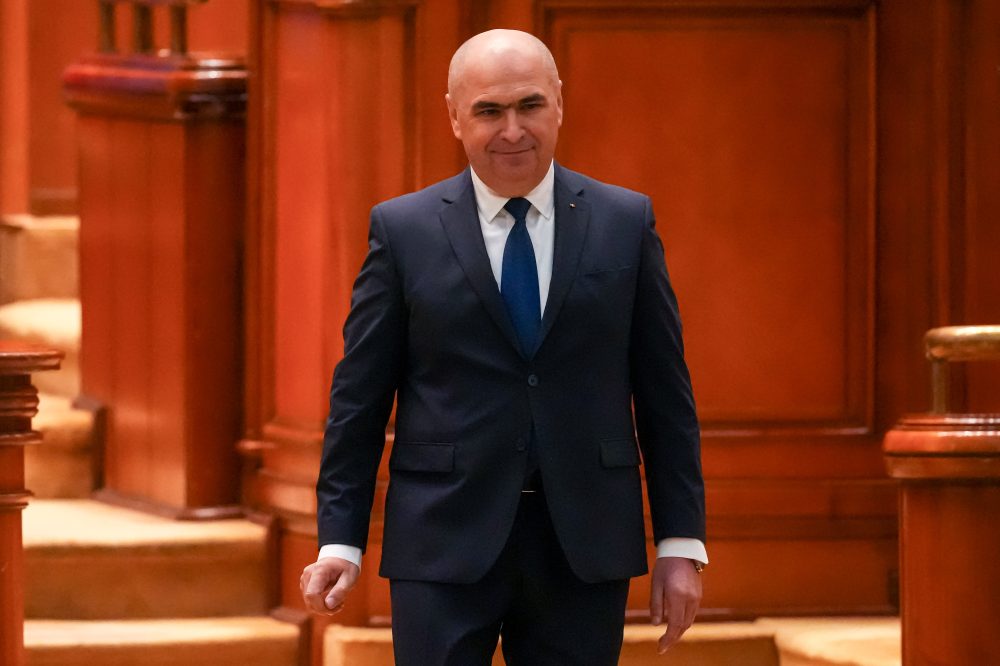

BUCHAREST, Romania (AP) — Romanian Prime Minister Ilie Bolojan is defending his government Tuesday as lawmakers debate a no-confidence motion that could topple his administration, bringing together unlikely allies in an attempt to oust the pro-European leader.
The challenge emerged last week when the Social Democratic Party (PSD), which abandoned the governing coalition in April, teamed up with the far-right Alliance for the Unity of Romanians (AUR) to file the parliamentary motion. This alliance has pushed the EU member nation back into political turmoil.
Parliamentary members are discussing the measure Tuesday ahead of a crucial vote that needs a minimum of 233 lawmakers to succeed. Both the PSD and AUR claimed last week they have secured sufficient backing for the motion.
Bolojan, who leads the center-right National Liberal Party (PNL), dismissed the challenge as “cynical and artificial,” telling Parliament Tuesday that it “seems to be written by people who were not in government every day and did not participate in all the decisions.”
“It is cynical, because it does not take into account the context in which we find ourselves,” he stated. “I assumed the position of prime minister, being aware that it comes with enormous pressure and that I would not receive applause from the citizens. But I chose to do what was urgent and necessary for our country.”
The Eastern European nation has endured extended political turmoil following the cancellation of presidential elections in December 2024, while also confronting among the EU’s largest budget shortfalls, soaring prices, and economic contraction.
Following its installation last June, the ruling coalition promised to prioritize deficit reduction. The PSD frequently clashed with Bolojan regarding strict economic policies, including higher taxes, frozen government salaries and pensions, and reductions in public expenditures and civil service positions.
The PSD accused Bolojan of failing to “implement any genuine reform” during his 10-month tenure, arguing Romania requires leadership “capable of collaboration.”
Bolojan defended his record, stating he implemented difficult but essential economic policies that successfully “regained the trust of the markets in the Romanian government.”
Should Bolojan fall, the PSD would become essential for establishing a pro-European parliamentary coalition. However, the party has previously rejected forming any administration alongside AUR.
AUR leader George Simion declared Tuesday that citizens had “supported and wanted water, food, energy,” but instead “received taxes, war and poverty.”
“We assume the future of this country, a future government and restore the hope of the Romanians,” he stated. “Romania must go back to the vote of the Romanians.”
Bucharest political analyst Cristian Andrei predicts the crisis will result in deadlock, explaining that “no one has a majority, or a coalition, and it will take the president … weeks to find such a majority and name a new prime minister, prolonging the indecision.”
“At this moment, there are two tentative options for a new Cabinet, both difficult to achieve; either a reshuffled coalition, without Bolojan, in the same formation … or a minority Cabinet, rather led by PSD and satellites from populist parties, like AUR, or other small groups,” he explained. “A PSD-AUR official Cabinet is not a possibility today because the president will not endorse it.”
Under the original power-sharing arrangement, the prime minister role was scheduled to transfer from Bolojan to a PSD leader in 2027. National elections are planned for 2028.