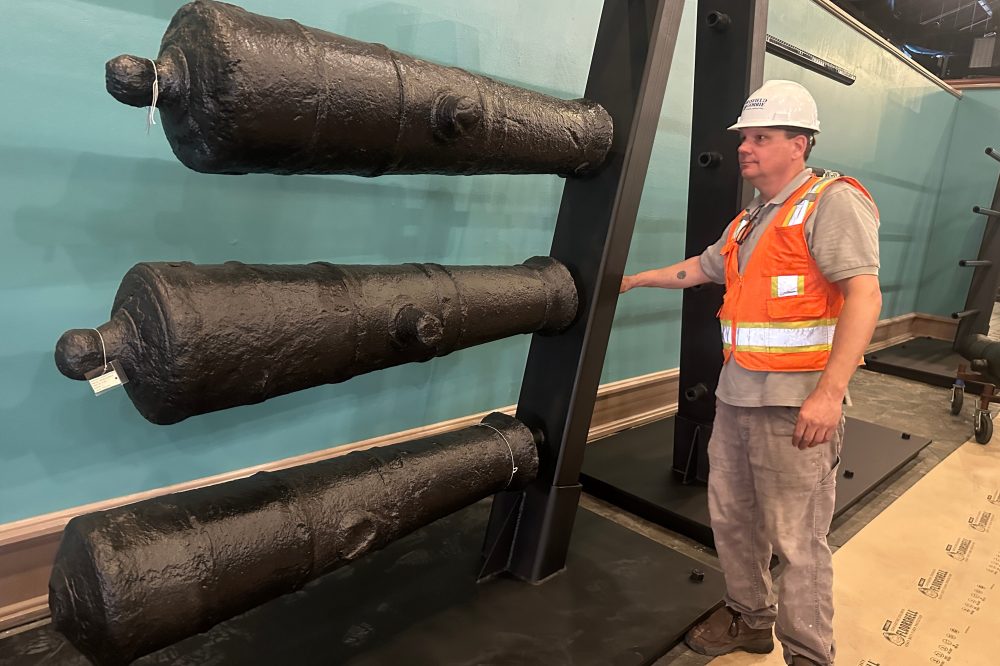

SAVANNAH, Ga. — Staff at a museum in Georgia’s historic port city received an extraordinary delivery Wednesday — seventeen artillery pieces that researchers believe plunged into the Savannah River during America’s fight for independence and lay hidden beneath the water for almost two and a half centuries.
Museum employees methodically lifted each massive weapon from a delivery truck and transported them into the Savannah History Museum, where visitors will be able to view them during America’s 250th independence anniversary celebration this Fourth of July.
“They look brand new,” said Andrea Farmer, a U.S. Army Corps of Engineers archaeologist who was part of the team that researched and preserved the cannons. “They could pretty much be fired if someone wanted to.”
The historic weapons came to light in 2021 during an Army Corps initiative to make Savannah’s shipping channel deeper, when dredging equipment brought up a cannon from the river bottom. Workers quickly found two additional pieces.
Over the following year, crews recovered a total of 19 artillery pieces from the site located downstream from Savannah, the spot where Georgia began in 1733 as Britain’s final American colonial settlement.
Following their recovery from the waterway, most of the weapons traveled to a specialized facility in Texas for extensive cleaning and conservation treatment.
Researchers first thought the cannons dated back to the Civil War era. However, additional investigation suggested they were actually nearly 100 years older and went down during events leading up to the Revolutionary War’s devastating battle for Savannah.
British forces controlled Savannah during autumn 1779, when American colonists organized an assault to reclaim the city alongside their French partners.
Upon seeing French naval vessels approaching the Georgia coastline with soldiers aboard, British commanders deliberately sank at least six ships in the Savannah River below the city to prevent French access.
The ground combat that ensued became among the war’s most devastating encounters. British troops killed close to 300 colonial soldiers and their supporters, while injuring hundreds of additional fighters.
The museum displaying the cannons sits directly adjacent to that historic battleground. Staff members Wednesday positioned the weapons, each weighing as much as 1500 pounds, onto specially designed display structures that workers compared to oversized wine storage systems.
The artillery will anchor a new exhibition focusing on Savannah’s involvement in the Revolutionary War, planned to debut during Fourth of July weekend, according to museum curator Samantha Moss.
“Our great team has been prepping for months — building mounts and planning how we can safely display these very large, very special artifacts,” she said.
Every iron cannon emerged from the river encased in thick layers of sediment and mineral deposits.
Two pieces were kept in their original condition for museum display. The remaining 17 traveled to Texas A&M University, home to a laboratory specializing in underwater artifact preservation. Technicians spent years methodically cleaning each weapon and applying protective paint and wax coatings to prevent rust and deterioration.
“A lot of them have scour marks on the side from anchors or dredging, so there’s some scarring on the cannons,” said Chris Dostal, a professor of nautical archaeology who leads Texas A&M’s Conservation Research Lab. “But most of them look pretty exceptional.”
Many of the cannons still contained their original wooden seals in the firing chambers, which held cannonballs and explosive charges.
Dostal explained that radiocarbon analysis of the wooden stoppers dated them to approximately the late 1700s. His research team provided the cannons’ dimensions and other characteristics to specialists in London, who determined three were very likely manufactured by British military forces.
The remaining pieces appeared to follow French specifications but lacked identifying marks. Dostal believes those weapons may have been produced in America during the war period.
Additional items recovered alongside the cannons included anchor fragments and part of a ship’s bronze bell. Similar to the cannons, none carried engravings identifying their vessel of origin.
This means significant aspects of the cannons’ history remain unknown.
“You don’t have all of the information,” Farmer said. “You’re trying to piece it together as best as you can.”