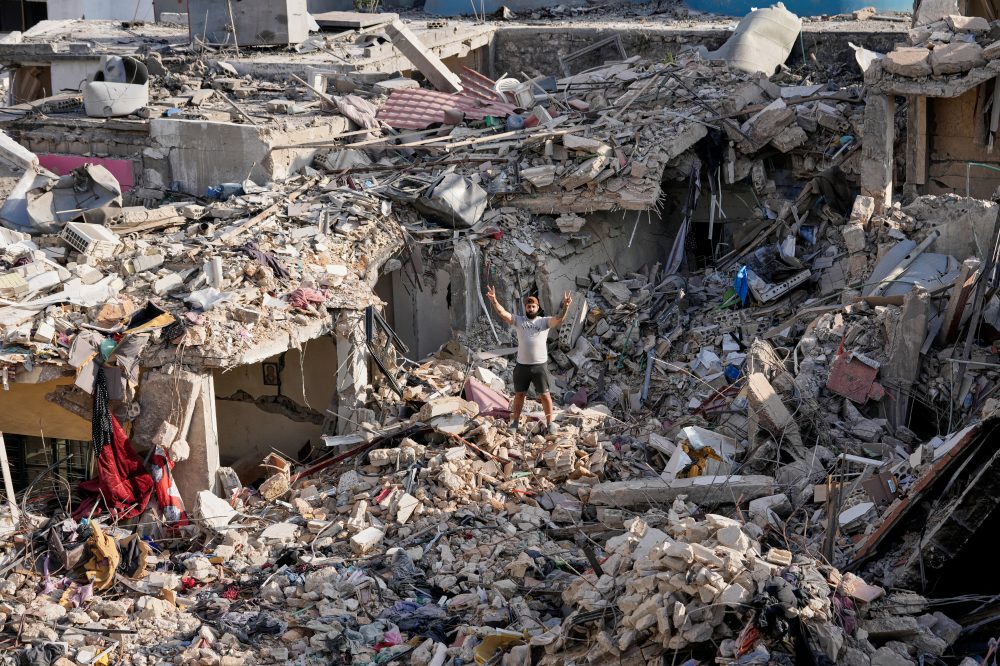

NABATIYEH, Lebanon — In the early morning hours of Tuesday, a woman named Aida Jleilati and her daughter began sifting through the wreckage of what used to be their home in the southern Lebanese city of Nabatiyeh, salvaging whatever survived an Israeli airstrike that hit in late May.
The two women were part of a small wave of residents who made their way back to the city after news broke of an agreement between the United States and Iran to bring their conflict to a close. Iranian officials have stated that the deal will also require an end to the ongoing war between Israel and Hezbollah in Lebanon.
While the violence in southern Lebanon has not fully ceased, strikes have become less frequent since the U.S.-Iran agreement was announced, giving many displaced residents a window to go back and assess the damage to their homes.
Jleilati and her 22-year-old daughter, Sukaina al-Muhtadi, had been living on the ground floor of a three-story, six-unit apartment building that was completely destroyed in the strike. Jleilati was able to recover most of her husband’s scuba diving gear along with some clothing. Her daughter’s main priority was locating a photo album filled with pictures from her childhood.
“What can I say? All that we have gathered in our life has been wasted,” Jleilati said. She noted that the family first learned their home was gone on May 26, when al-Muhtadi spotted images of the destroyed building on a social media platform.
Since the beginning of the latest round of fighting between Israel and Hezbollah, Nabatiyeh — a city with ancient roots — has endured relentless airstrikes and shelling that have left scores of people dead or wounded.
The city’s once-thriving marketplace has been heavily damaged. On Tuesday, several bulldozers were clearing away rubble and debris as some residents returned in the wake of the late Sunday agreement between the U.S. and Iran.
Jleilati and other returning residents expressed doubt about whether the truce will hold, pointing to previous ceasefires that first took effect on April 17 but quickly broke down as both Israel and Hezbollah continued their attacks.
In recent weeks, Israeli ground forces have advanced deep into southern Lebanon, pushing to within about 4 kilometers — roughly 2.5 miles — southeast of Nabatiyeh, a city that has served as a regional trade center for centuries. The city is well known for its Monday market, where people from surrounding villages traditionally gathered to sell their goods.
Nabatiyeh has long held historical and cultural significance. Since Lebanon was established in 1920 following the collapse of the Ottoman Empire, the city and its surrounding area have been a hub for Shiite religious and cultural life, with strong ties to the holy cities of Najaf and Karbala in present-day Iraq. Historically, the city served as the capital of the predominantly Shiite Jabal Amel region, and some of its religious scholars traveled to Iran in the 16th century, playing a role in helping the country’s Safavid rulers convert much of the population to Shiite Islam.
Nabatiyeh is also one of Lebanon’s most prominent centers for the observance of Ashoura, a solemn Shiite commemoration marking the 7th-century martyrdom of Imam Hussein, the Prophet Muhammad’s grandson. The ten-day mourning period, which concludes on the 10th day of the Muslim month of Muharram, was set to begin on Wednesday.
At the heart of the city, 75-year-old Kamel al-Kamel stood in stunned silence before the charred remains of his business — a supermarket and coffee roastery — housed in a century-old building that had crumbled to the ground. Walking with a cane, al-Kamal estimated his losses at $2.5 million. He said that compared to every previous conflict he has lived through — including Lebanon’s 15-year civil war that began in 1975, Israel’s 1982 invasion, and multiple rounds of Israel-Hezbollah fighting — this latest war has been the most devastating.
“Thank God we are still alive,” he said, recounting how he wept as he walked back into Nabatiyeh on Thursday.
Another returning resident, Samar Zuraik, was relieved to find her home still standing, though it sustained damage that will require repairs. But she said no amount of material recovery could make up for the loss of her 27-year-old son Ali, who was killed in an Israeli airstrike on the outskirts of the city.
Zuraik said that despite the Iran-U.S. agreement, Nabatiyeh remains uninhabitable right now — still under fire and without electricity, phone service, or internet access.
“I wish I lost my house and my son stayed alive,” she said.
The Nabatiyeh area is home to three major hospitals. The oldest, Najdeh El Chaabiyeh Hospital on the edge of the city, treated hundreds of people wounded during the latest conflict. The hospital’s medical director, Dr. Shafi Fouani, said the current war was comparable in intensity to the previous conflict in 2024.
“It was a very harsh war,” he said of the latest round of fighting, which he said broke out on March 2 after Hezbollah fired rockets into northern Israel — two days after the U.S. and Israel launched attacks against Iran. He said the hospital recorded roughly 500 deaths and treated close to 1,200 patients during the conflict, with some of the most critically injured being transferred to medical facilities in Beirut or the southern city of Sidon.
Lebanon’s Health Ministry reports that more than 3,800 people have been killed in Lebanon during the latest fighting. According to Israeli Prime Minister Benjamin Netanyahu’s office, 30 Israeli soldiers and one defense contractor have been killed in or near southern Lebanon, and two civilians have died in northern Israel.
On Tuesday, Israeli forces fired artillery toward the outskirts of Nabatiyeh while Hezbollah launched rockets at Israeli positions near the city. The sounds of explosions were clearly audible throughout Nabatiyeh as Israeli troops continued efforts to seize the Ali Taher hill, a strategic high point overlooking much of the city. Lebanese military forces closed certain roads leading to areas where Israeli troops are operating inside Lebanon.
As Jleilati and her daughter picked through the ruins of their former home, al-Muhtadi came across a watch her mother had given her as a young girl. The two women planned to return later Tuesday to a suburb of Beirut where they have been sheltering, saying they are waiting to see whether the truce holds before coming back to Nabatiyeh to rent an apartment while their building is eventually rebuilt.
“We cannot live outside Nabatiyeh,” al-Muhtadi said.