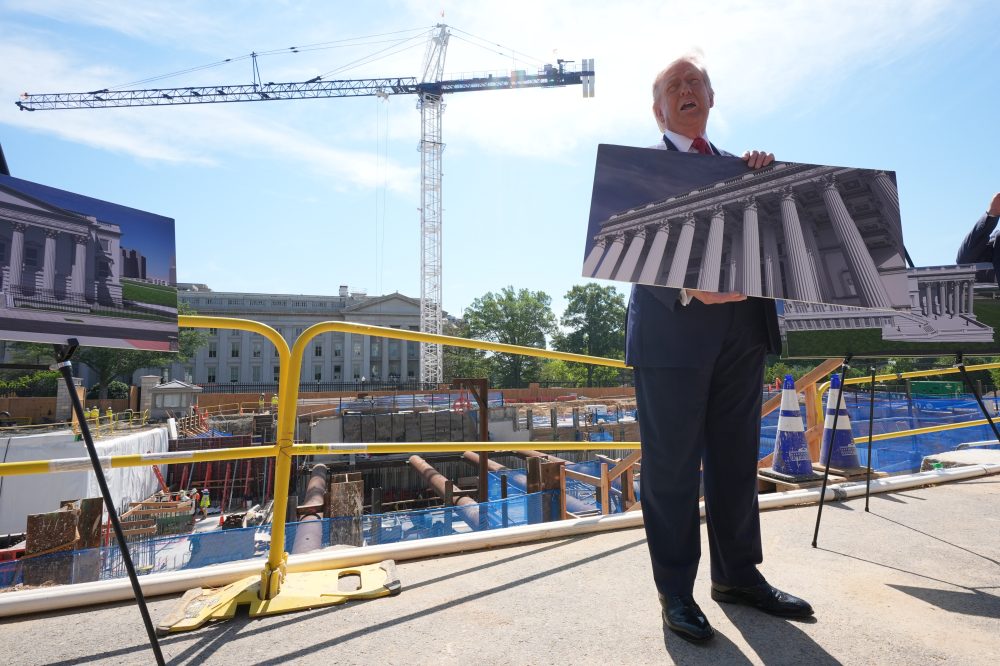

WASHINGTON — Congressional Republicans are expressing growing resistance to a $1 billion security enhancement package for the White House complex and the president’s ballroom, despite backing from President Donald Trump and the U.S. Secret Service as lawmakers prepare for an anticipated vote this week.
GOP leaders are revising their approach after the Senate parliamentarian determined Saturday that the proposal failed to qualify for inclusion in legislation targeting immigration enforcement funding. Even with potential modifications to satisfy parliamentary rules, the plan’s future remains unclear as multiple Republican senators voice concerns about the security expenditures while White House-Senate relations have grown more strained recently.
“In the end it’s going to come down to what we have the votes to pass,” said Senate Majority Leader John Thune, R-S.D., said Tuesday, suggesting that the support was still an open question.
Thune indicated that discussions continue across both chambers and with the White House regarding the legislation’s structure and compliance with parliamentary requirements.
Multiple GOP senators have indicated they’re unlikely to back legislation carrying the full $1 billion White House security cost.
People “can’t afford groceries and gasoline and healthcare, and we’re going to do a billion dollars for a ballroom?” asked Louisiana Sen. Bill Cassidy, who lost reelection in the GOP primary on Saturday after Trump endorsed one of his opponents.
Cassidy described the initiative, covering Secret Service training and a White House visitor center alongside security for Trump’s ballroom, as rushed given unresolved project details. He noted the Trump administration has failed to deliver engineering studies, environmental reviews, or architectural plans to Congress.
“And by the way, the president has pledged to us that he would use private donations to pay for it,” Cassidy said.
Republican Sens. Rand Paul of Kentucky and Lisa Murkowski of Alaska have similarly indicated potential opposition to the security funding, joining others expressing reservations. Sen. Thom Tillis, R-N.C., has declared his opposition unless the proposal undergoes changes.
The security funding debate and Trump’s ballroom project emerge as Senate Republicans work to maintain their majority in upcoming midterm elections while Democrats emphasize affordability as a key campaign theme.
“Americans can barely afford to keep a roof over their own heads,” Senate Democratic Leader Chuck Schumer, D-N.Y. “They should not be forced to pay for a golden roof over Trump’s head.”
While Republicans typically align with Trump, this week has seen heightened friction between the Senate and White House, including disputes over the announcement of a $1.8 billion court settlement compensating Trump’s allies who claim they faced political targeting.
“I don’t see a purpose for that,” Thune told reporters Tuesday morning.
Later that day, Trump unexpectedly endorsed a Texas Republican primary candidate opposing incumbent Sen. John Cornyn, frustrating GOP senators who had spent months urging Trump to support Cornyn.
“Not very enthusiastic” is how Murkowski described her own mood after Trump’s endorsement and the Republicans’ weekly conference lunch.
Sen. Jim Justice, R-W.Va., said he’s supportive of the security money and thinks it is necessary to protect the president. But he conceded that the optics aren’t very good for Republicans, and that they haven’t communicated about it very well.
“We’ve got people out there who are worried about how in the world they’re going to have enough gas to get home,” Justice said.
Republicans are exploring options to reduce White House security funding or substantially narrow the proposal while seeking votes and parliamentarian approval. They’re employing a complex budget procedure called reconciliation to circumvent Democrats, who have obstructed funding for U.S. Immigration and Customs Enforcement and Border Patrol for months.
Thune emphasized that immigration enforcement funding represents the legislation’s “principal objective.”
Floor consideration will trigger an extended series of votes allowing Democrats to propose removing various bill components.
The Homeland Security and Governmental Affairs Committee approved the immigration elements of the $72 billion package Tuesday morning during a session where Democrats seeking ICE and Border Patrol reforms presented approximately five dozen amendments.
The Republican-controlled committee rejected all Democratic amendments, including requirements for federal agents to display surnames and identification numbers on uniforms and obtain judicial warrants before entering homes.