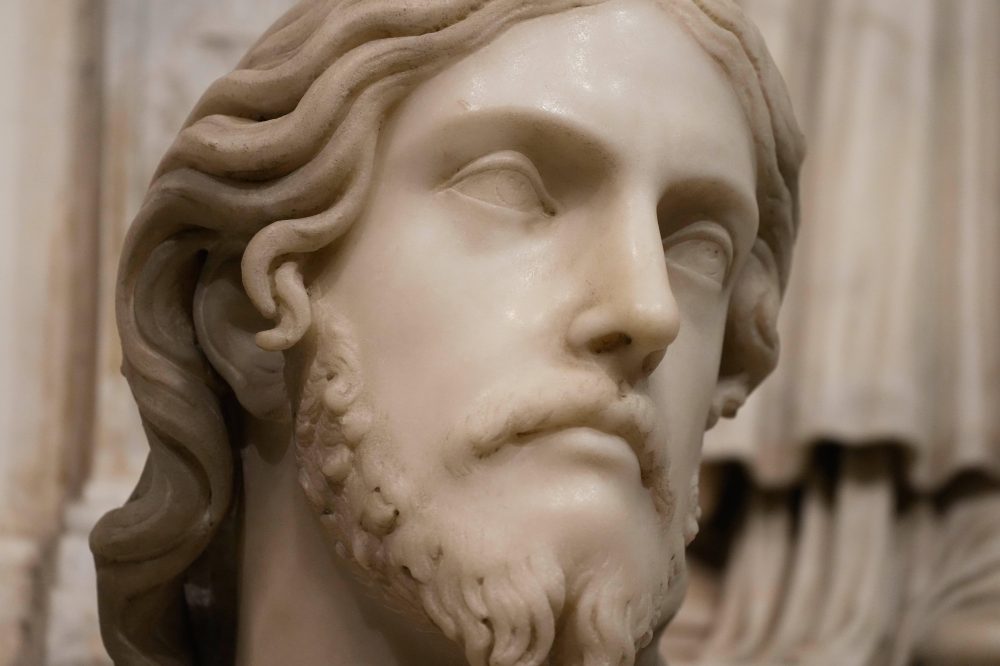

ROME — A researcher without formal art history credentials has sparked controversy in academic circles by declaring that a marble sculpture of Christ housed in a Roman church was created by Renaissance master Michelangelo.
Independent investigator Valentina Salerno made her announcement Wednesday, causing unease among Renaissance scholars who note the high financial stakes involved. A recent drawing of a foot attributed to Michelangelo sold for $27.2 million at Christie’s auction house, though some experts questioned its authenticity.
The timing has drawn extra scrutiny as Friday commemorates 550 years since Michelangelo’s birth, with numerous exhibitions and scholarly events celebrating his artistic contributions.
Salerno published her findings on academia.edu, a commercial academic networking platform that doesn’t require peer review, before presenting her conclusions at a Wednesday news conference.
The disputed artwork sits in the Basilica of Sant’Agnese fuori le mura, where Italy’s culture ministry currently lists it as an anonymous piece from the Roman school of the 16th century. However, this isn’t the first time someone has suggested Michelangelo created the work.
Art expert William Wallace noted in a 1996 ArtNews piece that 19th-century French author Stendhal once wrote about the same church: “we noticed a head of the savior which I should swear is by Michelangelo.”
“Stendhal’s vow notwithstanding, the head has never been taken seriously, and nowadays would not even appear in a catalog raisonné under ‘rejected attributions,’” Wallace observed at the time.
According to Salerno’s theory, historical documents from the centuries following Michelangelo’s death in 1564 properly credited him with the sculpture, until a 1984 scholarly analysis incorrectly dismissed the attribution.
“I have provided and will continue to provide — I hope, because the research continues — a whole series of documentary evidence on this,” Salerno stated. “There will be experts in the field who will conduct their own investigations. To date, we can say that, according to the documents, the object is attributed to Michelangelo.”
Her research suggests the bust was modeled after Tomaso De’ Cavalieriis, who was close to Michelangelo, and became part of the artistic legacy the master left to his circle when he died. Salerno says she reached this conclusion by examining wills, estate inventories, and notarized records stored in church archives, state repositories, and Roman confraternity collections that included Michelangelo and his pupils.
The culture ministry declined to participate in Salerno’s announcement, according to Rev. Franco Bergamin, who leads the religious order managing the church. Italy’s Carabinieri art crime unit refused to authenticate the statue but has increased security around it, installing a warning sign that reads “Alarm armed.”
“We hope that this asset, which belongs to our cultural heritage regardless of whether it can be attributed to Michelangelo Buonarroti or not, is part of the national heritage that we are responsible for defending,” stated Lt. Col. Paolo Salvatori.
Salerno, who works as an actress and fiction writer, lacks a college education or formal training in art history. She says she stumbled into this research “by chance” while gathering material for a Michelangelo novel a decade ago.
Her published work describes discovering evidence of a secret “pact of indissolubility” between some of Michelangelo’s students and their descendants to preserve the master’s works after his death. This agreement allegedly included a previously unknown chamber that required three separate keys, held by three different pupils, to unlock.
Cardinal Mauro Gambetti, who oversees St. Peter’s Basilica, took notice of Salerno’s work and appointed her and her mentor to a 2025 scientific committee exploring a potential Vatican exhibition for Michelangelo’s birth anniversary.
The committee’s work has yet to produce results, and its members have either minimized Salerno’s contributions or refused to discuss them publicly. Some expressed bewilderment at her inclusion alongside world-renowned Renaissance scholars like Vatican Museums director Barbara Jatta, British Museum curator Hugo Chapman, and Washington University art history professor William Wallace.
When contacted by The Associated Press, Jatta distanced herself from the Vatican committee. The British Museum declined to make Chapman available for interviews, and Gambetti’s office didn’t respond to requests for comment.
Wallace told the AP that while Salerno’s research methods have merit and noted Europe’s tradition of accomplished non-academic researchers, he disagrees with her broader conclusions. He supports her argument that Michelangelo didn’t destroy his works in a fire — a myth scholars have already debunked — and agrees the artist likely entrusted remaining pieces to students in his final years.
However, Wallace disputes the idea that vast quantities of Michelangelo’s work were hidden away and await discovery. He points out that the aging master was managing six architectural projects in Rome and likely produced mainly technical sketches that wouldn’t have survived as “working drawings.”
While acknowledging the secret three-key chamber concept is novel, Wallace said proper academic practice would require Salerno to transcribe her source documents and submit them for peer review.
Italy regularly sees claims of newly discovered works by famous artists, with fake, fraudulent, and disputed attributions to Modigliani and others appearing frequently in art history discussions.
“I think I counted up 45 attributions to Michelangelo since 2000, and not one of which you can remember or mention, but every single one arrived with the headline, ‘The greatest discovery of the time,’ (or) ‘It will change everything we think about Michelangelo,’” Wallace explained. “And then five years later, we can’t even remember what it was.”
Michelangelo Buonarroti, who lived from 1475-1564, produced some of the Renaissance’s most celebrated masterpieces, including Florence’s David statue, St. Peter’s Basilica Pieta, the Sistine Chapel ceiling, and “The Last Judgment” fresco.