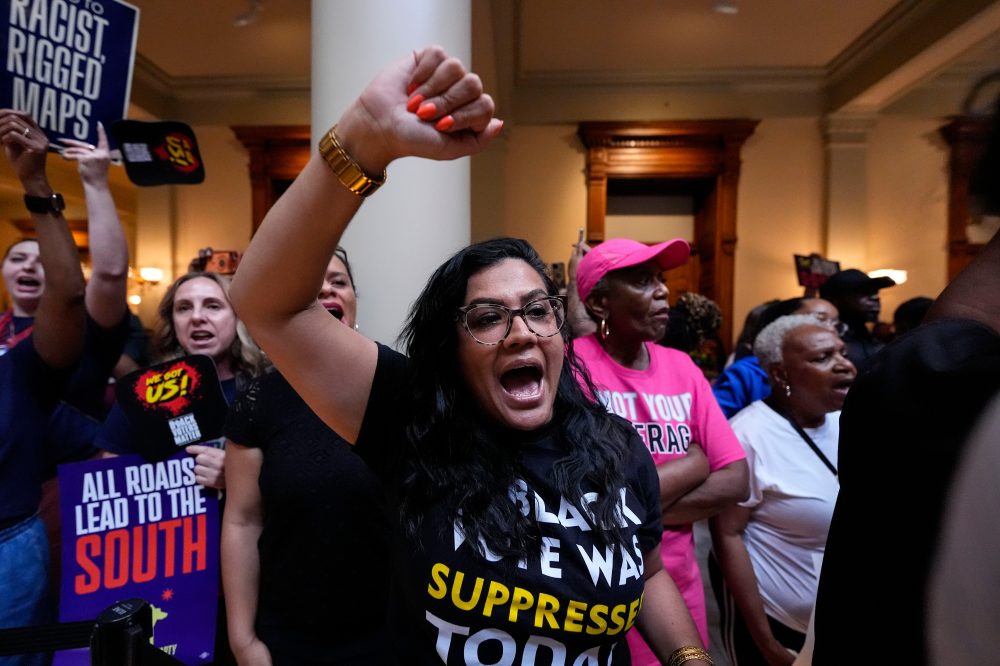

The November midterm elections haven’t happened yet, but politicians in several states are already plotting their next move — redrawing congressional maps to gain an advantage heading into the 2028 elections.
This new wave of redistricting efforts represents the second phase of a mid-decade boundary battle that already touches 10 states, which together are home to two out of every five people living in the United States.
The first phase got underway last summer, when President Donald Trump called on Republican-controlled states to redraw U.S. House district lines in an effort to limit losses in the midterms. Democratic-led states responded by pursuing their own partisan remapping. Then, in late April, a U.S. Supreme Court ruling weakened the federal Voting Rights Act, giving Southern Republicans new legal footing to restructure districts with large minority populations that have historically elected Democrats.
The midterm results will serve as a report card on those changes. Republicans believe they could pick up as many as 10 additional House seats under the redrawn maps. Democrats, however, point to historical trends — the president’s party typically loses seats in midterm elections — and argue that Trump’s low approval ratings could work in their favor.
If November produces another razor-thin majority for either party, the incentive to redraw maps before 2028 could intensify significantly.
Here’s a breakdown of where things stand in key states:
New York has already taken an early step toward 2028 redistricting. The state legislature recently passed a proposed constitutional amendment that would permit mid-decade redistricting, remove existing bans on partisan gerrymandering, and make it easier for lawmakers to sidestep an independent redistricting commission down the road. The measure must clear another legislative vote next year before it can be placed before voters statewide.
In Maryland, the state House speaker has asked members to block off time in July for a possible special session focused on redistricting. One proposal would put a constitutional amendment before voters that would change the requirement for compact districts — a standard that was cited in a 2022 court ruling that threw out a previous map as “a product of extreme partisan gerrymandering.”
In Colorado, supporters of an initiative petition are working to get a constitutional amendment on the November ballot that would set aside congressional maps drawn by an independent commission and allow new ones to be created.
New Jersey lawmakers face a higher bar — any constitutional amendment to bypass a bipartisan redistricting commission would require either a three-fifths vote in each chamber or simple majority approval in two consecutive years before it could go to voters.
Virginia could make another attempt at a redistricting amendment that bypasses its bipartisan commission. Under state rules, amendments must pass the legislature in two separate sessions with an election in between. The state Supreme Court ruled in May that lawmakers had missed their opportunity to act before the 2025 elections, but they could restart the process with an eye toward the state’s 2027 elections.
Georgia’s legislative leaders on Wednesday chose not to pursue redistricting for 2028 during a special session called by Gov. Brian Kemp. While they expressed reluctance to act hastily, they left the door open for revisiting the issue at a later date.
Kansas Republicans fell short last year of the two-thirds support needed to call themselves into a special session on redistricting and override a potential veto from the Democratic governor. However, if Republicans capture the governor’s office in November, the path to redistricting next year could become much smoother.
The Indiana Senate rejected a Trump-backed congressional redistricting plan last year. But in this year’s Republican primaries, several senators who had opposed redistricting were defeated by Trump-endorsed challengers, potentially clearing the way for another attempt next year.
South Carolina’s Senate also turned down congressional redistricting ahead of the midterms in May, though the issue could come back before the next election cycle.
Minnesota has the most evenly split legislature in the country, with a tied House and a one-seat Democratic Senate majority. If Democrats win control of both chambers in November and hold the governorship currently held by Democratic Gov. Tim Walz, they would have the power to redraw congressional lines. Republicans, if they win the governorship and legislative races, would have the same opportunity.
Pennsylvania is in a comparable position. Democrats hold a slim House majority while Republicans have a narrow Senate edge. If Democrats win both chambers and Democratic Gov. Josh Shapiro wins reelection, they could redraw the state’s congressional map. Republicans also have a path to full control. For either party, a 2018 state Supreme Court decision that struck down a Republican-drawn map as unconstitutionally gerrymandered serves as a warning against overreach.
Wisconsin faces a competitive race to fill the seat of outgoing Democratic Gov. Tony Evers. Legislative candidates will run this November under new district lines that give Democrats better odds. If Democrats gain full control, they could reconfigure the state’s Republican-leaning congressional districts — though Republicans are also in contention for the governor’s office and could hold at least one legislative chamber. Two active lawsuits challenging the current congressional map could also force redistricting regardless of election outcomes.
Republican Mississippi Gov. Tate Reeves has said he anticipates state lawmakers will redraw congressional districts before the state’s 2027 elections, though no specific plan has been introduced yet.
In Illinois, Democratic state lawmakers dismissed a national party suggestion last year to redistrict congressional seats before the midterms, citing concerns that doing so could reduce representation for Black voters. Still, Democrats left open the possibility of revisiting redistricting at a later point.